
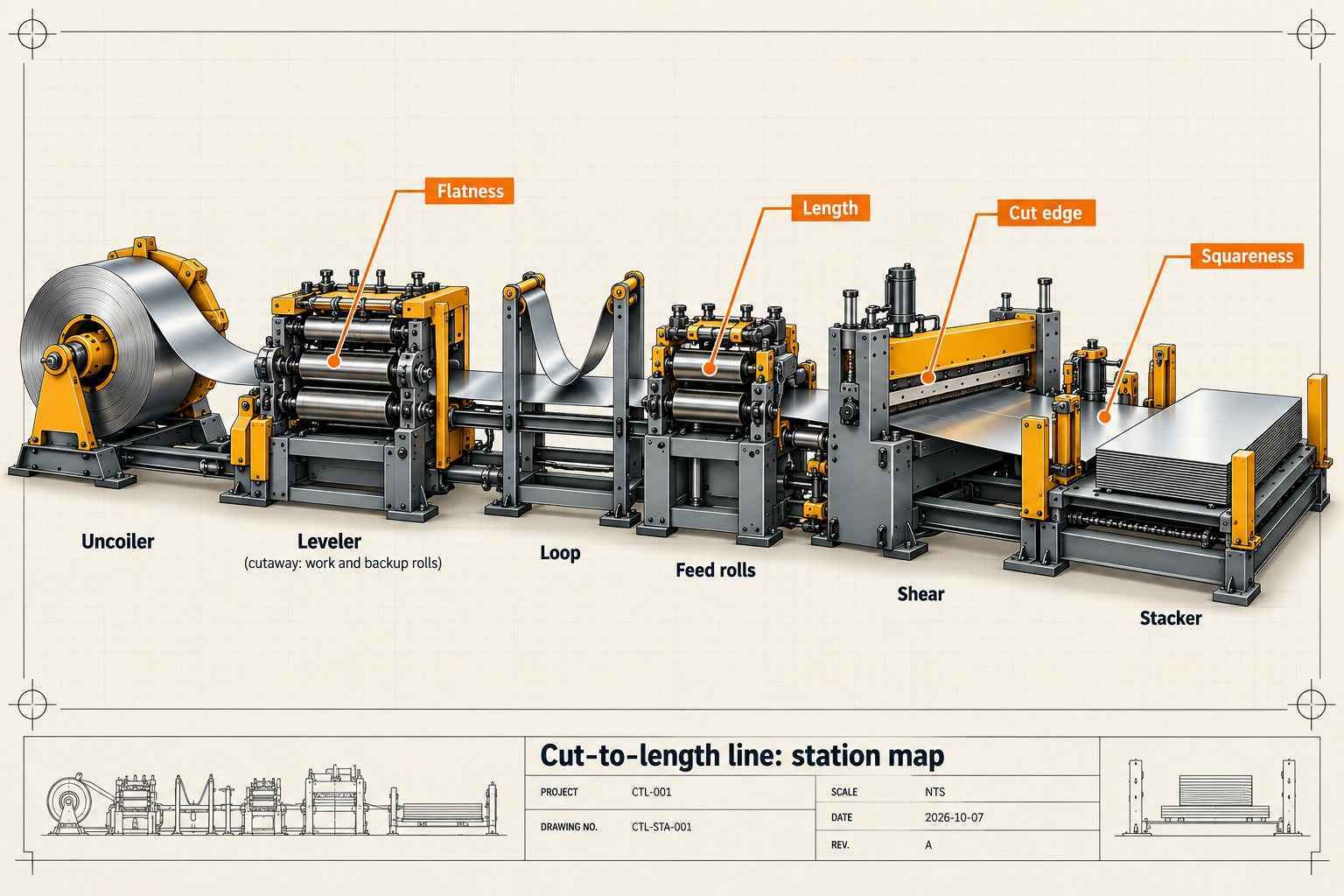
A cut-to-length (CTL) line turns a coil of flat-rolled steel or aluminum into flat sheets or blanks of a set length. The strip is unwound, flattened in a straightener or leveler, measured, sheared and stacked, often by one or two operators working from a console.
When sheets come off wrong, the fault usually lives at one station, and the quickest fix starts there. Adjusting the wrong station tends to swap one complaint for another. This map is what the rest of the guide is built on.
| Station | What it controls | Complaint when it drifts |
|---|---|---|
| Straightener or leveler | Flatness and locked-in stress | Coil set, crossbow, edge wave, sheets that move when laser cut |
| Feed and measuring system | Sheet length | Sheets short, long or scattered |
| Strip guidance and shear alignment | Squareness | Parallelogram sheets with unequal diagonals |
| Shear blades | The cut edge | Burr, rolled-over edges, burr heavier on one side |
| Conveyors and stacker | Surface | Scratches and scuffs on the stack |
One caveat before blaming the line. Some defects arrive with the coil: camber and the uneven elongation behind edge wave are rolled in at the mill, and a CTL line can only reduce them so far.
How a cut-to-length line works, station by station
- Coil car and uncoiler. A coil car lifts the coil onto the uncoiler mandrel, which expands to grip the inside diameter. A peeler or hold-down arm lifts the outer wrap and threads the strip forward.
- Edge trimmer or slitter (optional). Rotary knives trim the mill edge to width or split the strip into several strands. A CTL line with a slitter is called a multi-blanking line.
- Straightener or leveler. Banks of rolls bend the strip up and down past its yield point. That takes out coil set and, on a leveler, the length differences that show up as waves.
- Loop (free-loop lines only). A pit or catenary between the leveler and the feeder lets the leveler run at a steady speed while the feeder starts and stops.
- Feeder and measuring system. Servo-driven feed rolls, a hitch feed or a measuring wheel advance the strip by the programmed length.
- Shear. A stationary shear cuts while the strip stands still. Flying, double eccentric and rotary shears cut it on the move.
- Conveyor and stacker. Sheets are carried off and piled for strapping. Some lines add film application, marking or punching before the stacker.
Five common line layouts, and what each does to the sheet
Layout settles two things you cannot tune away later: whether the strip stops for each cut, and whether the leveler stops with it.
| Layout | Strip at the cut | Typical use | Effect on quality and tooling |
|---|---|---|---|
| Tight line, stationary shear | The whole line stops for every cut | Heavy and hot-rolled gauge. Lowest cost and lowest output | Thin material can take roll marks where it stops inside the leveler |
| Tight line, flying shear | Keeps moving while the shear travels with it | Lines that cannot stop, such as those with a skin pass mill | More output, but a heavy shear has to match strip speed exactly, so length tolerance is usually looser |
| Free loop, stationary shear | Leveler runs steadily; the feeder stops the strip at the shear | Light and medium gauge, the most common layout for thin material | Length comes from encoder counts (servo roll feed) or a mechanical stop (hitch feed). Slip and clamp marks are the main risks |
| Continuous, double eccentric shear | Never stops, and no loop pit | Thin gauge at high output | No acceleration per cut, so less slip. The blades stay vertical through the cut, which helps keep burr down |
| Multi-blanking | Slitter ahead of the loop; the shear cuts every strand at once | Several narrow blanks per cut | A slitter ahead of the loop runs at constant speed, which is far kinder to the knives |
These trade-offs come from two line builders writing in The Fabricator. Braner’s Ken Shoop, in Survival of the fastest, puts the practical ceiling for free-loop running at about 6.35 mm (0.250 in) with proper catenary guides. He also reports that moving the multi-blanking slitter ahead of the loop greatly improves knife life and stops scuffing.
Georg’s Alexander Tschoeltsch, in The cutting edge of cut-to-length lines, points out that start-stop running wears components faster and can mark the strip. The acceleration and deceleration of pulling strip from a loop can also upset flatness on some materials. His company’s double eccentric shears run continuously at up to 100 m/min (330 ft/min), depending on line design.
Flatness: what a leveler can and cannot correct
A coil keeps the shape of the mandrel it was wound on. Coil set is a bow along the length and crossbow is a bow across the width. Edge wave and center buckle are a different animal: the edges or the middle of the strip are physically longer than the rest.
A straightener uses a few large rolls and is built to take out coil set. A precision leveler has more, smaller rolls supported by backup rolls, and it works the strip under tension. That lets it stretch the short fibers until they match the long ones, which is why only a leveler can bring edge wave and center buckle down.
The WorldAutoSteel guide Coil Processing: Straightening and Leveling puts numbers on the gap. Coil set comes out when the outer 20% of the thickness yields on each face. Waves and buckles need about 80% yielded, leaving only a 20% elastic core.
Roll diameter sets a hard limit
A strip cannot be bent tighter than the roll it wraps around. Its outer fibers only start to yield once it is bent to a diameter of E × t ÷ σy, where E is Young’s modulus, t the thickness and σy the yield strength. To yield a fraction p of the thickness, the strip centerline has to reach (1 – p) × E × t ÷ σy.
Set that against the roll diameter and you get the thinnest material a leveler can work properly. The table uses 80% plastic and E = 200 GPa for steel.
Thinnest steel a work roll can bring to 80% plastic
| Work roll diameter | 250 MPa yield (mild steel) | 350 MPa | 550 MPa | 700 MPa | 1,000 MPa |
|---|---|---|---|---|---|
| 25 mm | 0.16 mm | 0.22 mm | 0.35 mm | 0.45 mm | 0.64 mm |
| 38 mm (1.5 in) | 0.24 mm | 0.34 mm | 0.53 mm | 0.68 mm | 0.98 mm |
| 50 mm | 0.31 mm | 0.44 mm | 0.70 mm | 0.89 mm | 1.28 mm |
| 80 mm | 0.50 mm | 0.71 mm | 1.12 mm | 1.42 mm | 2.05 mm |
| 120 mm | 0.75 mm | 1.06 mm | 1.67 mm | 2.14 mm | 3.08 mm |
Treat these figures as a ceiling. They assume simple bending with no strip tension and no work hardening, so for thicker material the leveler maker’s gap tables still decide the setting. For anything thinner than the figure in the table, no amount of roll intermesh will get there.
The method agrees with a worked example by SMS Demag engineers in Reducing setup time in strip leveling. On a 19-roll leveler with 1.5 in rolls, they found 75 ksi (517 MPa) strip thinner than 0.025 in (0.64 mm) could not reach 85% plastic. The formula above puts that limit at 0.67 mm.
Higher-strength coil pushes every leveler parameter the same way. AHSS Insights lists smaller rolls, closer roll spacing and 50 to 60% more penetration than mild steel needs. Small rolls under that load deflect, and a deflecting work roll puts edge waves into the strip it is meant to flatten.
Backup rolls exist to stop that. When a leveler that ran a grade cleanly starts adding waves, check the backup rolls and their bearings before blaming the coil.
Two setting rules worth knowing
With the usual tilted setting, roll set three, counting from the entry, does the deepest plastic work. The last roll set must not yield the strip at all, or it puts coil set back in on the way out, according to the same SMS Demag article. Torque also climbs steeply past about 85% plastic penetration: in their analysis, going from 85% to 87% raised roll torque by 20%.
Leveling harder than flatness needs has a price. It work-hardens the strip and cuts formability, which matters when the sheets go on to a press.
A sheet that passes a flatness check can still move when a laser cuts it, because leveling that only corrects shape can leave coiling stress locked inside. If the blanks are going to a laser, put that on the order.
Length: why sheets come off short or long
On a servo roll feed, the controller sets length by counting pulses from an encoder on the feed motor. That rests on two assumptions. The feed roll is the diameter the controller thinks it is, and the strip moves exactly as far as the roll surface does.
Shoop’s article puts real-world piece-length tolerance for a well-run servo roll feed at ±0.13 mm (±0.005 in). He also notes that most slip happens while acceleration is changing rather than once it is steady, so smoothing the start and end of each move is the usual cure.
The direction of the error points to the cause:
- Short, and drifting shorter over weeks. The feed roll or measuring wheel has worn smaller than the controller assumes. The error scales directly: sheet length × diameter lost ÷ wheel diameter. Losing 0.1 mm of diameter on a 250 mm wheel makes a 3,000 mm sheet 1.2 mm short.
- Short, and scattered sheet to sheet. The strip is slipping in the feed rolls. Check roll pressure, oil or coating on the strip, and the move profile.
- Long. A measuring wheel riding on the strip is slipping, so it under-counts and the feeder overshoots.
Recalibrate against a cut sheet measured with a calibrated tape, never against the display. Hitch feeds set length with a mechanical stop instead. Shoop notes that hitch feeds clamping alternately on each side gain speed but give up some length and squareness accuracy.
Squareness: why sheets come off as parallelograms
A stationary shear cuts along its own blade line. If the strip reaches it at an angle, both ends of every sheet are cut at that angle and the sheet becomes a parallelogram.
The quick check is the diagonals. On a parallelogram sheet the diagonal difference is about 2 × e × L ÷ D, where e is the out-of-square at each end, L the sheet length and D the diagonal. On long sheets D is close to L, so the diagonals differ by nearly twice the out-of-square.
A 1,250 × 2,500 mm sheet that is 2 mm out at each end shows diagonals 3.6 mm apart. Measure both diagonals on a sheet from the start of the coil and one from the end. A difference that changes along the coil points at the strip or how it is guided, while a steady one points at fixed alignment in the shear or the guides.
Common causes:
- Side guides set wide or worn, letting the strip wander between cuts.
- A shear that is no longer square to the pass line after a rebuild or a crash.
- Camber in the incoming strip. A cambered strip cannot run square, so trim the edges on line or slit it first. For camber limits by standard, see slit coil tolerances.
- Hitch feeds that clamp alternately, as above.
The cut edge: burr and the shear blades
Burr on a sheared edge comes from clearance that is wrong for the thickness, or from a cutting edge that has rounded over. Either way the cut face shows a deeper rollover and a taller burr.
When burr is heavier on one side of the sheet, the blades are out of parallel and clearance varies across the width. Check it with feeler gauges at both ends of the blade before anything goes out for regrinding. Clearance values by thickness and material are in our shear blade clearance guide.
Blade grade matters as much as the setting. Cold-work steels such as D2 hold an edge longest on thin cold strip, while hot-work grades like H11 and H13 survive the shock of heavy hot-rolled gauge. The trade-offs are set out in our shear blade materials guide.
CTL sheet defects by symptom, and the station to check first
| Symptom | Station | First check |
|---|---|---|
| Sheets short, drifting shorter over weeks | Feed roll or measuring wheel | Measure the diameter, then recalibrate on a cut sheet |
| Length scatters sheet to sheet | Feed rolls | Slip: roll pressure, strip surface, move profile ramps |
| Sheets long | Measuring wheel | Wheel slipping on the strip: pressure and cleanliness |
| Unequal diagonals | Strip guidance or shear alignment | Side guides, shear square to the pass line, incoming camber |
| Bow along the length after leveling | Leveler | Entry intermesh too light, or the exit roll set still yielding the strip |
| Edge wave or center buckle | Leveler | A straightener cannot fix it; on a leveler, check the backup roll setting |
| Waves on a grade that used to run flat | Leveler backup rolls | Backup roll and bearing condition, work roll deflection |
| Thin high-strength coil will not flatten | Leveler capacity | Work roll diameter against the table above |
| Marks repeating at a fixed spacing | A leveler or feed roll | Spacing ÷ 3.14 gives the roll diameter (a 157 mm spacing points to a 50 mm roll); clean or regrind that roll |
| Burr or rolled edge across the whole cut | Shear blades | Clearance for the gauge, edge wear |
| Burr heavier on one side | Shear blades | Blade parallelism, clearance at both ends |
| Sheets move during laser cutting | Leveler depth | Locked-in stress: level deeper or order stress relief |
Tooling that wears on a CTL line
Most of the defects above trace back to a handful of parts that wear on a schedule nobody writes down. These are the ones worth logging.
- Shear blades. Rotate to an unused edge first if the blade has one, then regrind before burr reaches the customer’s limit. Maxwell makes CTL shear blades for entry and exit shears, and regrind limits are covered in when to sharpen or replace shear blades.
- Leveler work rolls. A dent, flat or patch of pickup prints on every sheet, once per roll circumference. Inspect the rolls at each planned stop and regrind or replace any that mark. Maxwell supplies precision-ground leveler work rolls.
- Backup rolls and bearings. Lost support shows up as new edge waves on material that used to run flat.
- Feed rolls and the measuring wheel. Diameter loss shows up as short sheets. Measure and log the diameter on a fixed schedule, so recalibration follows the wear instead of a customer complaint.
- Edge trim and multi-blanking knives. These are rotary slitter knives running on spacers, so the slitting rules apply unchanged. Set clearance from the slitter knife clearance chart and keep spacer tolerance tight, because blank width error is the sum of the errors in the stack. Maxwell makes the slitter knives and spacers for these heads.
Cut-to-length or slitting: which line does the job
| Cut-to-length line | Slitting line | |
|---|---|---|
| Cuts | Across the strip | Along the strip |
| Output | Flat sheets or blanks | Narrower coils |
| What it controls | Length, squareness, flatness | Width, edge condition, camber |
| Main wear tooling | Shear blades, leveler rolls | Rotary slitter knives, spacers, stripper rings |
Many service centers run both, slitting first and cutting to length afterward, or doing both in one pass on a multi-blanking line. The choice usually comes down to whether the customer’s next machine is fed with sheets or with coil.
Frequently Asked Questions
CTL stands for cut-to-length. It is the line that unwinds coil, flattens it and shears it into sheets or plates of a set length, stacked for shipping.
Slitting cuts along the strip to make narrower coils. Cut-to-length cuts across it to make sheets. A multi-blanking line does both in one pass.
A stationary shear fed by a servo roll feed, because the strip is standing still when it is cut. A flying shear has to match strip speed exactly, and Ken Shoop of Braner describes its length tolerances as usually looser. Double eccentric shears avoid much of that problem by never accelerating the strip.
A cut-to-length line with a slitter ahead of the shear, so each cut yields several narrow blanks. Placing the slitter ahead of the loop lets its knives run at constant speed.
A precision leveler can reduce edge wave and center buckle by working the short fibers harder than the long ones. A straightener bends the full width equally, so it cannot.
The strip is reaching the shear at an angle. Check the side guides, the shear’s alignment to the pass line and camber in the incoming coil. On long sheets the diagonal difference is about twice the out-of-square at each end.
When burr or rollover approaches the customer’s limit. A fixed calendar either wastes edge life or ships burr. Rotate to an unused edge first if the blade has one; our guide on when to sharpen or replace shear blades covers how far a blade can go.
For shear blades, send the shear make and model, a blade drawing or the dimensions of a worn blade, and the thickness and grade range you cut. For leveler rolls, add the roll diameter, face length and leveler model. Use the Request a Proposal form at the foot of this page and an engineer will reply within two hours on working days.
Shear blades and knives are hardened in our own vacuum furnace in Rajpura and checked on a CMM before dispatch.