
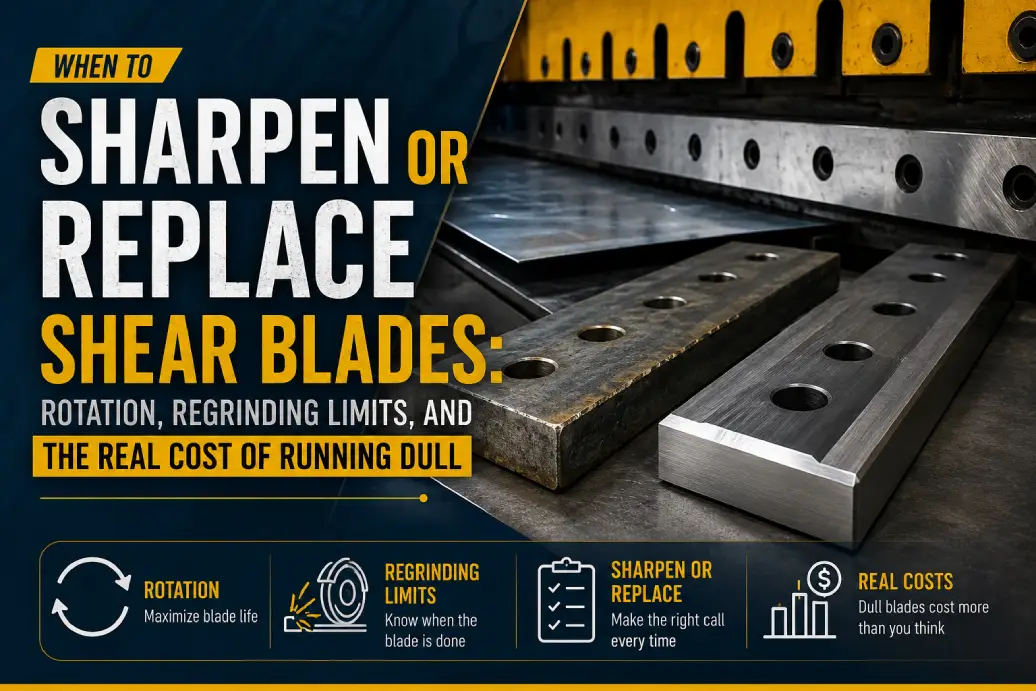
When to Sharpen or Replace Shear Blades: Rotation, Regrinding Limits, and the Real Cost of Running Dull
Quick answer: Sharpen (or rotate) the blade the moment cut quality drops: burrs, rolled edges, or a heavier cut are the signals. Send it for regrinding once every usable edge is dull, which restores original tolerance at 40 to 60 percent below the price of new. Replace it only when it hits the minimum height in your machine manual, or when a crack, deep chip, or heat damage puts it past grinding. Most blades take several regrinds, so plants that scrap a blade at the first sign of wear are throwing away more than half the life they paid for. Knowing when to sharpen shear blades, and when to stop sharpening and replace them, is worth real money per tonne cut.
This guide covers the full decision: how to read a dull edge early, when rotation alone fixes it, how many regrinds a blade can genuinely take, and how to run the sharpen-versus-replace call on numbers instead of habit. If you already know you need new blades and just want grades, dimensions, or a quote, the shear blades product page has that; this article is about deciding when you have reached that point.
Why the Sharpen-or-Replace Call Costs More Than the Blade
A blade is a consumable, not a disposable. From installation to retirement it passes through three stages: fresh edge, rotated edges, and reground body. Operations that work all three stages get several lives out of one blade body. Those that jump straight from dull to buy-new pay for steel they never touch.
The larger cost sits downstream. A dull edge tears the material instead of shearing it: burred edges, rolled corners, work-hardened faces, rejected sheets. It also demands more tonnage per stroke, loading the ram, the gibs, and the drive. The cutting edge is the cheapest link in that chain. Running it blunt to save money simply moves the wear onto the most expensive parts of the machine.
Signs of a Dull Shear Blade
The material warns you before the machine does. Six signals mean the edge is going:
- Burrs on the cut edge. A sharp edge with correct clearance leaves a clean sheared band and a controlled fracture. When the edge rounds over, the fracture turns ragged and a burr forms on the underside. If operators are suddenly deburring parts that used to come off clean, inspect before touching anything else.
- Rolled or turned-down edges. A dull edge pushes the material before it cuts, rolling the corner over instead of shearing it square. It shows first on softer stock like aluminium and thin mild steel.
- Higher cutting force. On hydraulic machines the pump labours or cycle time stretches. On mechanical shears the cut sounds harder and the frame shudders. A rounded edge can lift the required force sharply, and the machine absorbs that every stroke.
- Incomplete cuts or tearing. If sheets hang on by a sliver at the end of the stroke, or the last portion tears rather than shears, the edge is gone.
- Polished wear lands. Shiny, mirror-like bands along the cutting edge mean the edge radius has grown. Run a fingernail along it during a locked-out stop: sharp grabs, dull feels rounded.
- Nicks and chips. These come from welds, hard spots, or double sheets. A single deep chip prints a defect at that spot on every cut. Chips are not dullness and cannot be fixed by rotation, only by grinding past the damage.
Before blaming the edge, rule out clearance. Incorrect shear blade clearance produces almost identical symptoms: too much gap rolls edges and raises burrs even on a sharp edge, too little accelerates wear. Verify the gap first. If it is correct and the defects remain, the edge is the cause. The same diagnostic order applies on slitting lines, where burrs and edge defects follow the same sequence.
When to Sharpen Shear Blades: Rotate First, Then Regrind
The first answer to when to sharpen shear blades is often “don’t yet, rotate instead.” Most straight blades are ground with two or four usable edges. A four-edge blade is a rectangular bar with a cutting edge at each corner. When one edge dulls, you unbolt it, flip or rotate it to a fresh edge, and reinstall. No grinding, no shipping, no lead time. Four edges means four working lives before the first regrind is even due.
Rotation is the most underused cost lever on the shop floor. It takes a crew an hour or two and multiplies edge life for the price of the labour. If you still buy single-edge bars for a standard guillotine, specifying two-edge or four-edge geometry on the next order is usually the single biggest cost-per-cut improvement available, because the extra edges cost a fraction of extra blades.
Practical rules for rotation:
- Log which edges are used. Paint or stamp the corners so the crew never reinstalls a dead edge.
- Rotate at the first drop in cut quality, not after the edge is destroyed. A lightly worn edge grinds back with minimal stock removal later; a hammered one needs deep grinding that eats blade height.
- Clean the seat and check the bolts at every rotation. A blade sitting on scale or swarf will not seat flat, and the clearance you set is not the clearance you get.
When every edge is finally dull, rotation is out and it is time to sharpen properly. For a hardened blade that means professional regrinding, not a quick touch-up. The blade is surface ground on all working faces to restore edge geometry, flatness, and parallelism to original tolerance. Done right, a reground blade performs identically to a new one, because functionally it is one: the same hardened tool steel with a freshly generated edge.
How many times can a blade be sharpened? It depends on three things:
- Stock removed per regrind. A blade rotated promptly and kept clear of chips needs only a few tenths of a millimetre per face. One run to destruction, or carrying deep chips, can lose a millimetre or two in a single pass. Disciplined shops get five or more regrinds; abusive ones get one or two.
- Minimum height for your machine. Every shear maker specifies a minimum blade height (and sometimes width) below which the bar can no longer be clamped and adjusted safely. That figure is in your machine manual and it is the hard limit. Regrindable stock is new height minus minimum height, and every regrind spends part of it.
- Hardness depth. This is where quality decides regrind life. A properly vacuum-hardened blade holds 58 to 62 HRC uniformly through the section, so every regrind exposes fresh steel at full hardness. Cheaper heat treatment can leave the core softer, so each regrind exposes a weaker edge than the last. If your blades get worse with every sharpening, the hardening method is the likely reason. Grade choice matters too; see our guide to the right shear blade material grade for the full comparison.
Why in-house grinding often backfires. Any shop with a large surface grinder can grind an edge, but two failures are common. First, overheating: let the edge get hot and the steel tempers back and loses hardness, so it dulls in a fraction of the normal life. Professional regrinding uses flood coolant and controlled feed precisely to prevent this. Second, geometry: the faces must stay flat and parallel to within hundredths of a millimetre over lengths up to several metres, or clearance varies along the length and so does cut quality. A blade that cuts clean at one end and burrs at the other has lost parallelism.
Maxwell regrinds worn blades (ours or any brand) back to original tolerance on CNC surface grinders, hardness-checked, in 5 to 7 working days at 40 to 60 percent below the cost of new.
When to Replace Shear Blades Instead of Sharpening Them
Regrinding has limits. The point to replace shear blades rather than sharpen them arrives when any of these is true:
- Minimum height reached. Ground down to the maker’s minimum, the bar is finished. Running it under-height compromises clamping and adjustment range and is a safety issue, not just a quality one.
- Cracks. Any visible crack, or crack indication found on inspection, retires the bar at once. Hardened tool steel under impact loading can fail suddenly. No crack is ever ground out “enough”.
- Deep chips near the stock limit. If clearing a chip would drop the bar below minimum height, or burn most of the remaining regrind budget for one more edge life, new is the better spend.
- Heat damage. Temper colours (straw, blue) along the edge, from a grinding accident or a severe cutting event, mean lost hardness locally. Sometimes it grinds past; if the softened zone runs deep, the edge will never hold again.
- It never performed from new. A bar that dulled abnormally fast out of the box has a metallurgy problem, not a wear problem. Regrinding a bad bar just gives you a freshly sharpened bad bar. Replace it with a correctly specified one and the “sharpening problem” disappears.
The Economics: Cost per Tonne Cut, Not Price per Blade
Compare options on cost per tonne of material cut, not on the invoice price of the bar:
- New four-edge blade: the price buys four edge lives up front, plus a regrind budget worth several more sets of edge lives at 40 to 60 percent less each.
- Regrind cycle: each regrind buys another full set of edge lives for roughly half the money and about a week of turnaround. One spare set removes even that downtime, because the spare runs while the worn set travels.
- Running dull: free on the tooling budget, expensive everywhere else: scrap, deburring labour, machine wear, slower throughput. Always the dearest option, just billed to other cost centres.
Two habits make the maths work. Keep a log per bar: install date, tonnage or hours, rotation dates, regrind history, remaining height. Decisions become scheduled maintenance instead of emergencies. And own a spare set. The plants that suffer most are the ones with a single set and no plan, because every event becomes unplanned downtime, and that pressure is exactly what keeps a dull edge running
A Simple Sharpen-or-Replace Decision Framework
Run this sequence whenever cut quality drops:
- Check clearance first. Wrong gap mimics a dull edge. Verify before spending anything.
- Fresh edge available? Rotate. Log the change.
- All edges dull, above minimum height, no cracks? Send for professional regrinding. Run the spare set meanwhile.
- At minimum height, cracked, deeply chipped, or heat damaged? Replace, and specify two-edge or four-edge geometry in the correct grade for what you cut.
- Dulling faster after every regrind? Question the steel, not the grinder. Through-hardness is the usual culprit.
Get the Blade Life You Are Already Paying For
Maxwell Slitter Industries has ground precision shear blades since 1976, CNC-finished to ±0.01 mm and vacuum-hardened in-house to 58 to 62 HRC through the full section, which is exactly what lets a blade take regrind after regrind. We also regrind worn blades, any brand, back to original tolerance in 5 to 7 working days at 40 to 60 percent under new.
Send your blade size, machine model, or a photo of the worn edge, and our engineers reply within 2 business hours with a sharpen-or-replace recommendation and a quote. Call +91 82646-21011 or use the enquiry form.
Frequently Asked Questions
There is no fixed interval. Life depends on the grade you cut, its thickness and hardness, stock cleanliness, clearance accuracy, and volume. Sharpen or rotate on condition, not on the calendar: at the first steady appearance of burrs, rolled edges, or heavier cutting force. High-volume service centres may rotate or regrind in weeks; lighter operations run months on one edge.
Replace rather than sharpen when the bar is at the machine’s minimum height, shows any crack, carries a chip too deep to grind out within the remaining stock, or has heat damage below the surface. Short of those, regrinding is the correct and cheaper call because grinding stock still remains.
Until it reaches the minimum blade height in your machine manual, typically two to more than five regrinds. Bars rotated promptly and kept free of deep chips need light grinding each time and reach the higher end. Bars run to destruction burn their stock in one or two heavy passes.
Only with a large surface grinder, flood coolant, and the ability to hold flatness and parallelism within hundredths of a millimetre over the full length. Overheating (which softens the edge) and lost parallelism (which makes cut quality vary along the length) are the two common in-house failures, so most plants use a professional regrinding service.
Regrinding typically costs 40 to 60 percent less than new and restores original tolerance, so it wins whenever grinding stock remains and there is no crack or deep damage. New becomes the better spend at minimum height, or when the repair would consume most of the remaining stock.
It tears rather than shears, producing burrs, rolled edges, and work-hardened faces that need deburring or get rejected, and it raises the force per stroke, accelerating wear on the ram, gibs, and drive. The cost of scrap, rework, and machine wear always beats the cost of a timely regrind.