Precision Manufactured Since 1976 · ISO 9001:2015

Metal Slitting Saws, Ground to Your Slot.

HSS, cobalt and solid-carbide slitting saws for slotting, parting and narrow grooving, burr-free.

Plain, staggered-tooth and side-and-face forms in M2, M35, powder-metal and carbide, hardened to 63 to 66 HRC and ground to a ±0.01 mm slot-width tolerance. Custom-made to drawing or sample to DIN 1837 / 1838 / IS:5031. Shipped to 30+ countries in 4 weeks.

  • OD 40 to 450mm, any thickness
  • Custom bore + keyway, ground to H7
  • Plain, staggered & side-and-face teeth
  • 4-week lead, 2-week rush available

Send a drawing or sample → reply in 1 working day  ·  +91 82646-21011

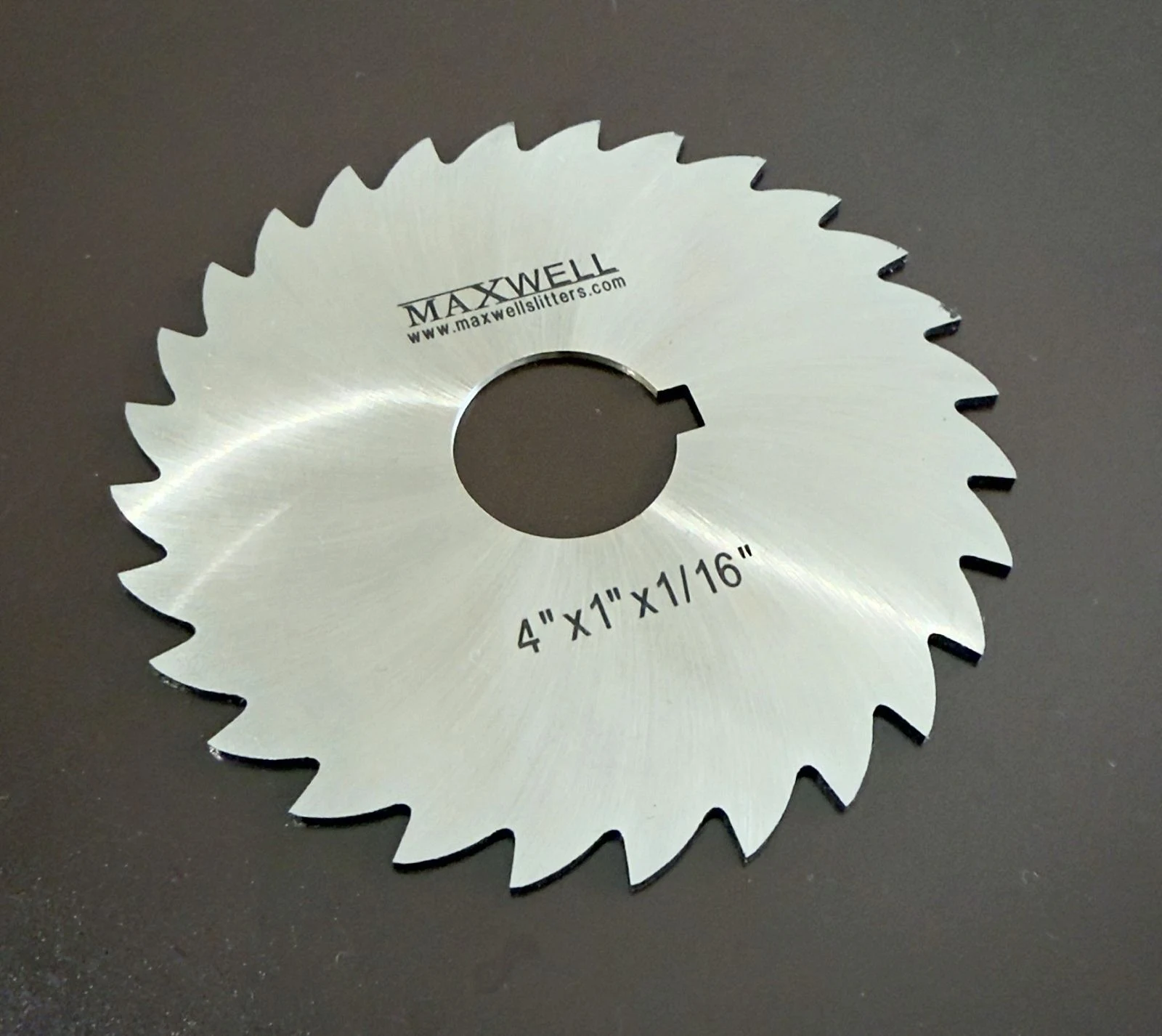
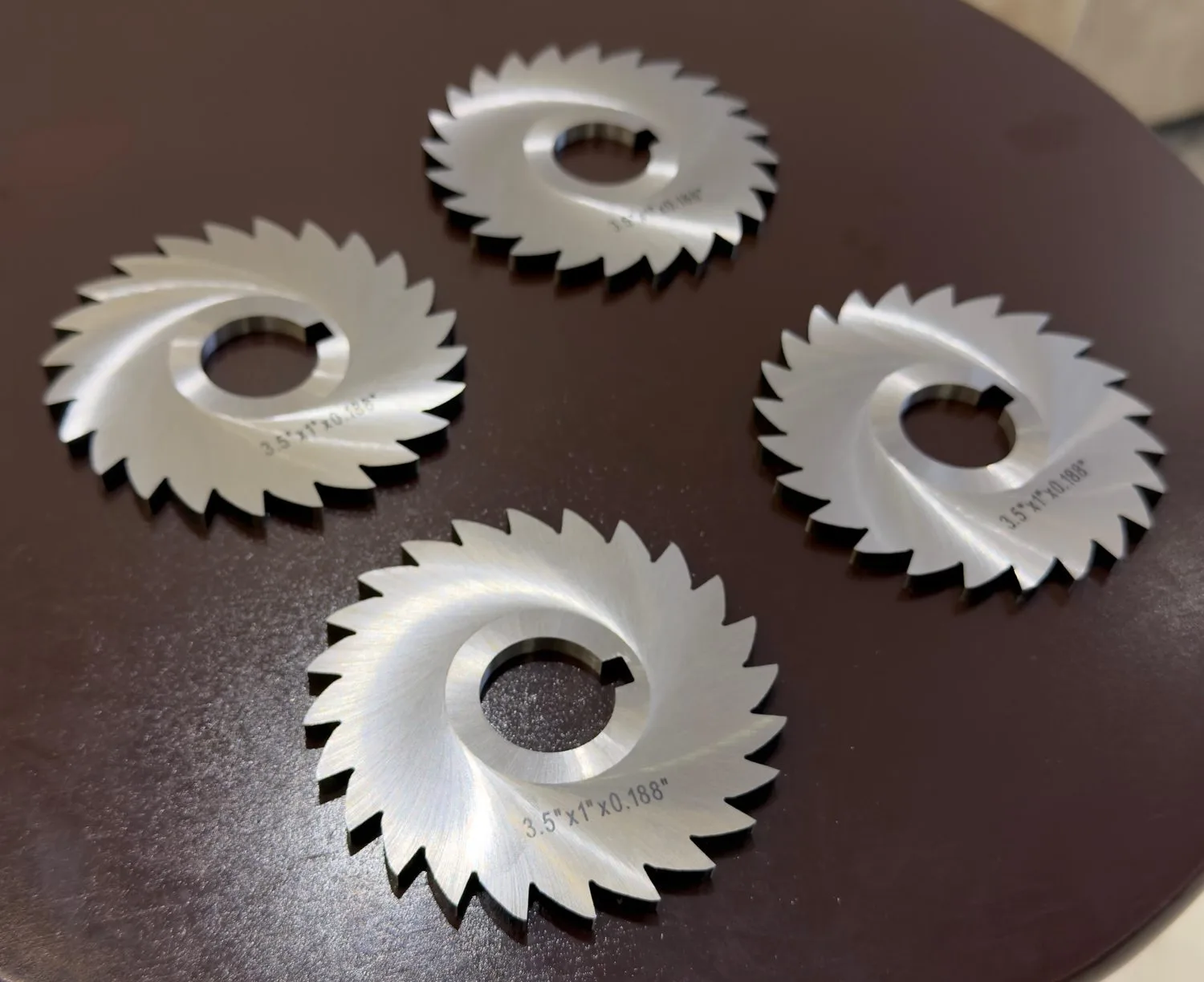
4 inch x 1 inch bore x 1/16 inch HSS metal slitting saw with keyway, laser-marked maxwellslitters.com, made by Maxwell Slitter Industries.
1976Manufacturing Since
100,000+Saws Delivered
30+Countries Shipped To
ISO 9001Quality Certified
What is a metal slitting saw?

A thin circular cutter for narrow, clean cuts in metal.

A metal slitting saw is a thin, circular, toothed milling cutter mounted on an arbor to cut narrow slots, grooves and cut-offs in metal with very little material loss. It runs on milling machines, screw machines and slitting lines, slicing through steel, stainless, aluminium and alloys to leave a clean, burr-free edge where a wider tool would waste material or distort the part.

Maxwell manufactures slitting saws in plain (fine), staggered-tooth and side-and-face forms, in HSS M2, cobalt M35, powder-metal and solid carbide, custom-ground to your diameter, thickness, bore and tooth count. Every saw is hardened in-house and inspected before dispatch.

Built in-house, not bought in

Slitting saws engineered for the cut, not the catalogue

Most suppliers sell you a shelf size and hope it fits. We grind the saw to your slot width, your material and your machine, so the cut is right the first time and the tool lasts.

Every Maxwell slitting saw is made at our Rajpura facility, from billet selection through vacuum hardening, tooth grinding and final lapping, with no sub-contracting at any stage. In-house vacuum hardening gives uniform hardness across the whole disc, which is what kills the soft-spot chipping and edge breakdown that plagues low-cost saws.

  • True running: concentricity and side runout held within 0.02 mm TIR.
  • Burr-free edges: tooth form and side relief matched to your material.
  • Longer between sharpens: correct grade and heat treatment, not generic stock steel.
  • Custom in 4 weeks: to drawing, DXF, sample or OEM part number.
  • Documented: material and dimensional certificates with every shipment.
Range of HSS metal slitting saws in different diameters and tooth counts from Maxwell Slitter Industries.
Tooth forms

Four slitting saw types, matched to depth and material

The tooth form, not just the size, decides cut quality. Each form below is made to standard and to custom geometry. Not sure which you need? Send the slot width, depth and material and we will recommend it.

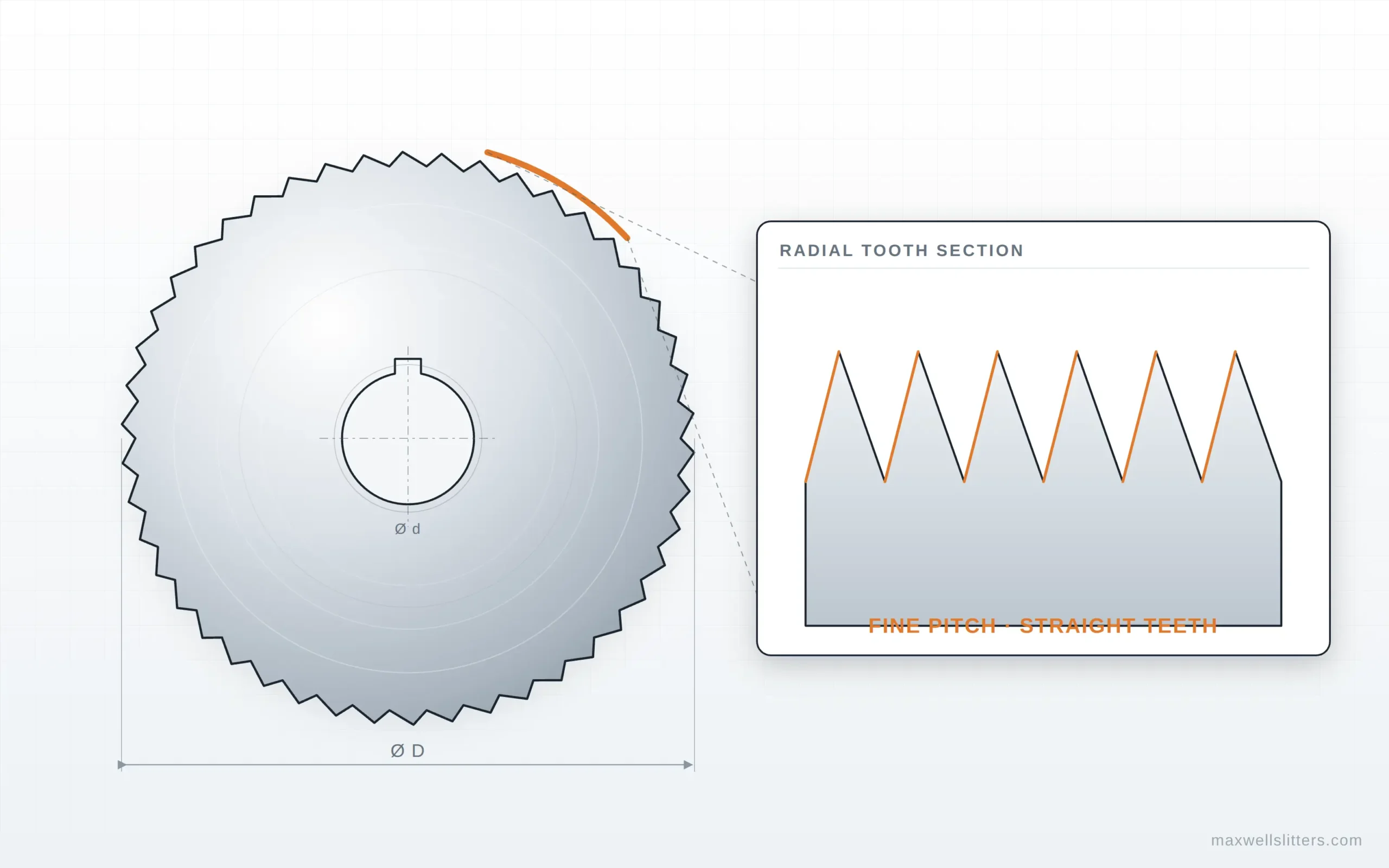
many small straight teeth with shallow gullets for thin, precise slots.

Plain (Fine-Tooth) DIN 1837

Straight peripheral teeth, hollow-ground for side clearance. The standard choice for thin, shallow, accurate slots and a fine surface finish.

Best for: narrow slots, screw slotting, electronics, shallow cuts in steel, brass and aluminium.
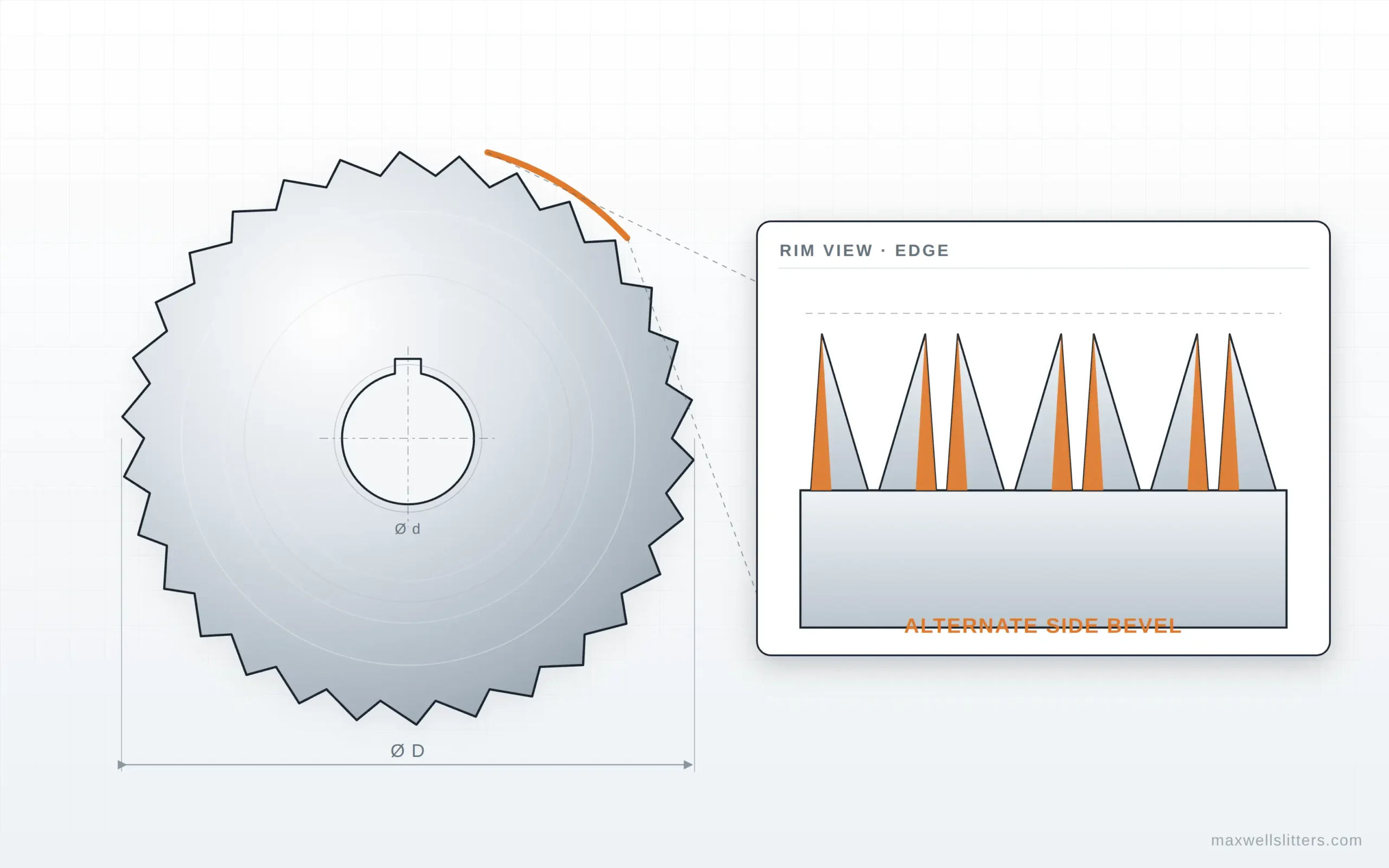
teeth alternately bevelled to each side for free cutting and chip clearance in deeper cuts.

Staggered-Tooth DIN 1838

Teeth bevelled alternately left and right for true side clearance and free chip flow. Cuts deeper and wider with far less rubbing and heat.

Best for: deep or wide slots, tougher and stainless steels, heavier stock removal.

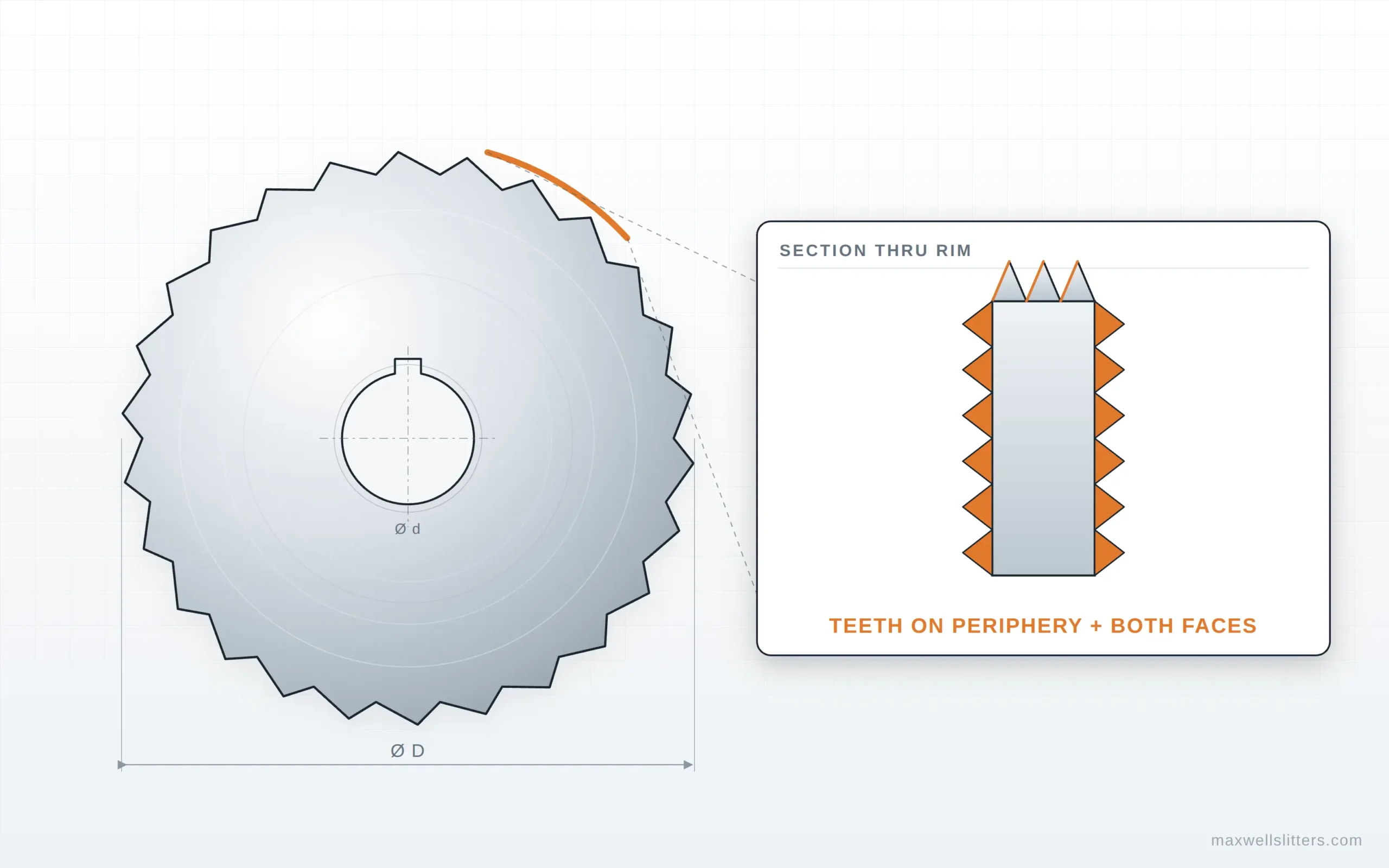
Diagram of a side-and-face slitting cutter with cutting teeth on the periphery and both side faces for slotting and shoulder work.

Side-and-Face Custom

Cutting edges on the periphery and both sides, supplied with a keyed bore for positive drive. Handles deep and wide slot cutting under load.

Best for: deep slotting, keyed-arbor work, ganged setups, side-trim and grooving.

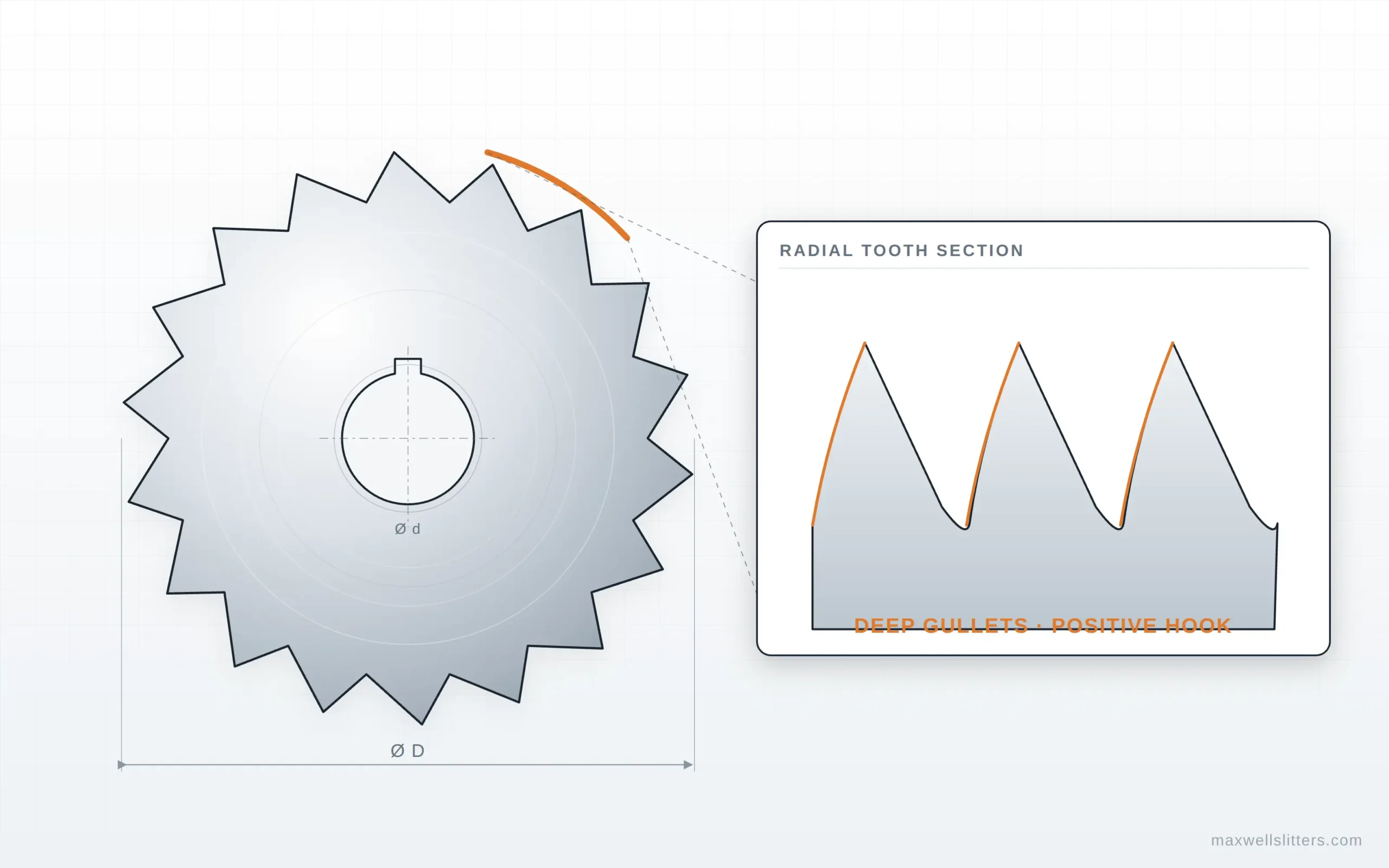
few large teeth with deep gullets for fast chip removal in deep cuts and softer metals.

Coarse-Tooth Cut-off

Fewer teeth and deep gullets for maximum chip room. The form to reach for on parting, cut-off and soft or gummy materials that load fine teeth.

Best for: parting and cut-off, aluminium, copper, plastics, deep single passes.

Tooth form Typical teeth Slot depth Finish Best material
Plain / fine 28-100+ Shallow Finest Steel, brass, aluminium (thin)
Staggered 18-40 Medium to deep Good Stainless, alloy & tool steel
Side-and-face 20-48 Deep / wide Good Heavy slotting, keyed drive
Coarse 18-28 Deep (single pass) Coarser Aluminium, copper, plastics, cut-off

Rule of thumb: keep at least two teeth engaged in the cut at all times. More teeth give a finer finish; fewer teeth give more chip room for deep cuts and soft metals.

Technical specifications

No guesswork. Every saw verified before it ships.

Material and dimensional certificates are included with every shipment at no extra cost. Below are the grades we run, the dimensional envelope we hold, and the standard inch sizes we keep moving, all of it custom on request.

Material selection guide, which grade for your job

Grade DIN / spec HRC Best application Edge life Lead time
HSS M2 1.3343 63-65 General purpose: mild steel, brass, aluminium 1.0× (baseline) 4 wks
HSS-Co M35 1.3243 64-66 Stainless, alloy steel, high-speed & hot cuts 1.6× 4 wks
PM (ASP-type) Powder metal 65-67 Abrasive alloys, long production runs, premium life 2.5× 6 wks
Solid carbide K10 / K20 n/a Hardened steel, thin precise slots, max speed 4-8× 5-6 wks
HSS + TiN/TiAlN Coated 63-66 Sticky/abrasive material, reduced friction & built-up edge 1.4× 5 wks

Edge life is indicative versus M2 baseline on comparable cuts. Carbide is brittle, it needs a rigid machine, secure arbor and coolant; for flexible or interrupted setups, M35 is usually the safer high-performance choice.

Dimensional & tolerance envelope

Outside diameter (OD) 25 mm to 315 mm (1 in to 12.4 in)
Thickness / kerf 0.3 mm to 6 mm (0.012 in to 0.250 in)
Bore (ID) Ground to H7, custom diameter, keyway to DIN 6885 on request
Slot-width tolerance ±0.01 mm standard, to ±0.005 mm on precision-ground orders
Flatness / dish Within 0.02 mm
Concentricity / side runout Within 0.02 mm TIR
Tooth count 18 to 200+, selected for slot width, depth & material
Hardness 63 to 66 HRC, multi-stage (triple) tempered
Surface finish Bright ground; polished sides on request
Standards DIN 1837 (fine), DIN 1838 (coarse/staggered), IS:5031, BS-122 Pt.1
Marking Laser-etched size, tooth count & brand on every saw
Treatments Cryogenic treatment & PVD coatings (TiN, TiAlN) optional

Popular standard sizes (inch), in stock geometry

Diameter Thickness (kerf) Bore Teeth Form
4" 1/16" (0.0625") 1" 28T Plain / fine
3.5" 1/8" (0.125") 1" 24-28T Staggered
3.5" 3/16" (0.188") 1" + keyway 22-24T Staggered / S&F
2.5" 1/32"-1/8" 7/8" 28T Plain / fine
2" 1/16"-1/8" 1/2" 28T Plain / fine
Custom 0.3-6 mm To spec 18-200+ Any form

Sizes specified the way you buy them: diameter × thickness × bore (with keyway) × teeth. Need metric, a non-standard bore, or a tooth count we have not listed? It is a custom grind, not a problem, send the spec.

Recommended cutting parameters

Starting speeds & feeds for HSS slitting saws

Use these as starting surface speeds for HSS, then tune to your machine, rigidity and finish. Slitting saws are thin: run light feed per tooth, flood with coolant and keep the setup rigid. For solid carbide, increase speed 2 to 3× on a rigid machine.

Material Surface speed (SFM) Surface speed (m/min) Coolant
Aluminium & alloys 250-400 75-120 Flood / mist
Brass / bronze 150-250 45-75 Flood
Copper 130-200 40-60 Flood
Mild / low-carbon steel 60-90 18-27 Flood
Alloy / medium-carbon steel 50-70 15-21 Flood
Tool / hardened steel 30-50 9-15 Flood (carbide advised)
Stainless steel (304/316) 40-60 12-18 Flood, high volume
Cast iron 50-80 15-24 Dry / air
Titanium alloys 30-50 9-15 Flood, generous

Feed per tooth runs roughly 0.0005" to 0.002" (0.013-0.05 mm) depending on diameter and thickness, use the lower end on thin or small-diameter saws. Climb-mill for finish on rigid, backlash-free machines; conventional-mill if the setup has play.

RPM = (3.82 × SFM) ÷ Diameterdiameter in inches
RPM = (318 × m/min) ÷ Diameterdiameter in mm
Example: 4" saw in mild steel at 75 SFM → ~72 RPM. Start low, listen to the cut, raise speed before feed.
How to order

Specify your slitting saw in 5 steps

Give us these five things and we will come back within one working day with a grade recommendation, tooth count, price and delivery date.

1

Material & thickness

What you are cutting and how thick, e.g. 304 stainless, 2 mm.

2

Slot width & depth

Finished kerf width (saw thickness) and depth of cut.

3

Diameter, bore & keyway

Required OD, arbor bore and keyway size, if any.

4

Tooth form & count

Plain, staggered or side-and-face, or let us advise.

5

Machine & speed

Machine type and spindle RPM, so geometry suits your setup.

Send a drawing, DXF or a used sample to [email protected] and skip the back-and-forth. We reverse-engineer from a worn saw routinely.

Start your RFQ
Applications

Select your job and configuration

Each card is a real application we supply, with the grade, tooth form and geometry we would recommend from production experience. Use "Quote this configuration" to pre-fill your enquiry.

Tube & pipe cut-off

Grade
M35 / Carbide
Tooth
Staggered
Typical
4" × 1/16" × 1"

Keep two teeth in the thin wall at all times; coolant clears chips from the kerf and prevents weld-back.

▸ Quote this configuration

Screw slotting & thin slots

Grade
M2 / Carbide
Tooth
Plain, fine
Typical
2"-3" × 0.5-1.5 mm

High tooth count and tight thickness tolerance give a clean, consistent slot on fasteners and small parts.

▸ Quote this configuration

Sheet & strip slitting

Grade
M2 / M35
Tooth
Plain / staggered
Typical
3.5"-6" × 1-3 mm

Flatness and runout drive edge quality on thin strip; we hold both within 0.02 mm.

▸ Quote this configuration

Deep slotting & grooving

Grade
M35 / PM
Tooth
Side-and-face
Typical
3.5"-8" × 3-6 mm, keyed

Side teeth and a keyed bore carry the load and resist dishing in deep, wide cuts.

▸ Quote this configuration

Stainless & hardened steel

Grade
M35 / Carbide
Tooth
Staggered
Typical
3.5"-5" × 1-3 mm

Lower SFM, rigid setup and chip clearance are essential; cobalt or carbide holds the edge under heat.

▸ Quote this configuration

Aluminium & non-ferrous

Grade
M2 / Carbide
Tooth
Coarse
Typical
3"-6" × 1-4 mm

Deep gullets stop soft material packing the teeth; high speed gives a bright finish.

▸ Quote this configuration
In-house manufacturing

From blank to blade, every stage under one roof

Six controlled stages at our Rajpura facility, with no sub-contracting. CNC turning, tooth grinding, in-house vacuum hardening and dimensional verification on every saw.

STEP 01

Raw material cut

Imported M2 / M35 / PM billet, cut to size with mill certs retained per heat.

STEP 02

CNC turning & profiling

Blank faced and turned to near-net OD, ID and thickness on CNC.

STEP 03

Tooth milling

Tooth form, count and side relief cut to DIN 1837 / 1838 or your drawing.

STEP 04

Vacuum hardening

In-house vacuum furnace, multi-stage hardening & tempering to 63-66 HRC.

STEP 05

Grinding & lapping

Sides and bore ground to final tolerance; teeth sharpened, edges honed.

STEP 06

Inspect & laser-mark

CMM and hardness check, then size, teeth & brand laser-etched on every saw.

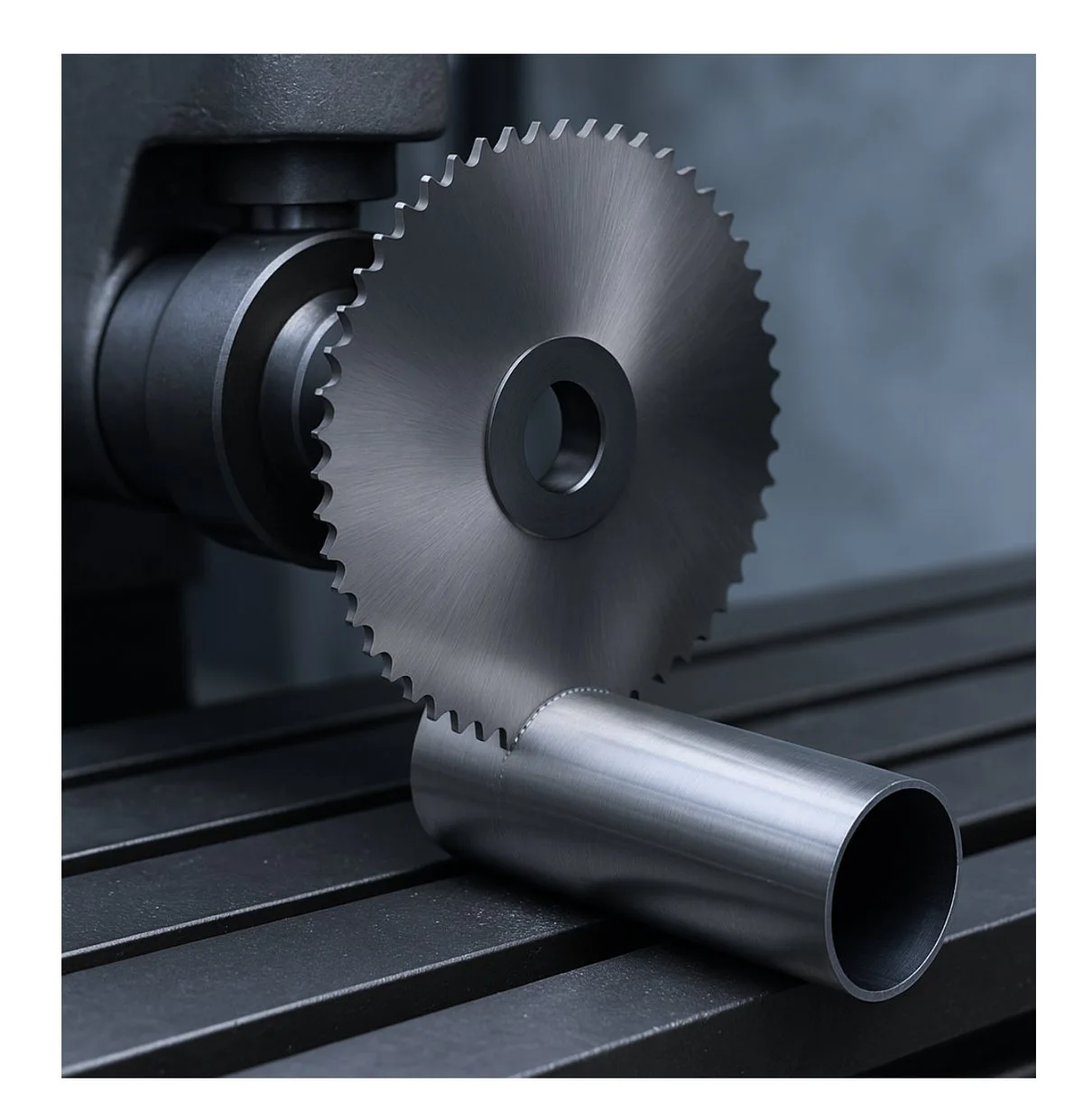
HSS metal slitting saw mounted on an arbor cutting a slot in a steel tube on a milling machine.
In the cut

Engineered to run true at speed, cut after cut

On a milling machine, screw machine or slitting line, a slitting saw only performs if it runs flat and concentric and clears its chips. That is exactly what our grinding and heat-treatment control deliver, the difference between a clean parted tube and a dished, burred, wandering cut.

  • Runs within 0.02 mm TIR for a straight, repeatable kerf
  • Tooth form matched to your material so chips clear, not weld
  • Uniform through-hardness, no soft spots, no surprise chipping
  • Re-sharpenable: extend HSS saw life over several regrinds
Why Maxwell

A precision tooling maker, not a reseller

Five decades of slitting-tool manufacturing, behind every saw.

Since 1976

Founded as a pioneer slitting-line tools maker; five decades of metallurgy and grinding know-how in every saw.

Made in-house

Billet to finished saw under one roof in Rajpura, vacuum hardening, tooth grinding and inspection, no sub-contracting.

Held to tolerance

±0.01 mm slot width and 0.02 mm runout, verified on CMM with certificates supplied per shipment.

Custom, fast

Any size, tooth form or bore to drawing or sample in 4 weeks, 2-week rush when you need it.

Right grade, right cut

M2, M35, powder-metal or carbide chosen for your material, not whatever is on the shelf.

Export-ready

30+ countries served, export packaging, mill and inspection certs, REACH/RoHS on request.

Export & logistics

Shipped to 30+ countries, quoted in your currency

Incoterms & transit

  • EXW, FOB Mundra / JNPT, CIF, DAP, DDP on request
  • Sea: 12-18 days to USA, EU, GCC, SE Asia
  • Air: 4-6 days to USA, EU, UK, GCC
  • HS Code: 8202.31 (circular saw blades) / 8207.70 (milling cutters), confirmed per shipment

Payment terms

  • T/T: 30% advance + 70% against shipping docs
  • L/C at sight on confirmed orders
  • INR, USD, EUR, GBP invoicing
  • Volume pricing from 25 pcs per line item

Documentation

  • Commercial invoice, packing list, certificate of origin
  • Mill test & dimensional inspection certificates
  • REACH / RoHS declarations on request
  • Export-grade anti-corrosion packaging
Answers

Metal slitting saw FAQ

The questions buyers and machinists ask us most. Need something specific? Just ask in your enquiry.

What is a metal slitting saw?

A metal slitting saw is a thin, circular, toothed milling cutter mounted on an arbor to cut narrow slots, grooves and cut-offs in metal with very little material loss. It runs on milling machines, screw machines and slitting lines and leaves a clean, burr-free edge where a wider tool would waste material or distort the part.

What is the difference between a metal slitting saw and a slitting cutter?

A metal slitting saw is a thin circular toothed cutter for narrow slotting, grooving and cut-off. "Slitting cutter" is the broader term that also includes side-and-face cutters, slotting cutters and disc cutters. For thin, precise slots, the slitting saw is the preferred tool.

What is the difference between a plain and a staggered-tooth slitting saw?

A plain (fine-tooth) saw has straight peripheral teeth and is used for thin, shallow, accurate slots and a fine finish. A staggered-tooth saw has teeth bevelled alternately left and right, giving side clearance and free chip flow, so it cuts deeper and wider with far less rubbing and heat. Use plain for thin shallow slots, staggered for deep or tough cuts.

Which is better, HSS or carbide slitting saws?

HSS saws (M2, M35) are tough, re-sharpenable and cost-effective for mild steel, brass and aluminium. Solid-carbide saws hold an edge far longer at high speed and are best for stainless, hardened steel, abrasive alloys and high-volume production, but they need a rigid machine and coolant. Choose HSS for general work, carbide for speed, hard material and long runs.

What sizes of metal slitting saw do you make?

Maxwell manufactures slitting saws from 25 mm to 315 mm (1 in to 12.4 in) outside diameter, 0.3 mm to 6 mm thick, with custom bores ground to H7 and keyways on request. Tooth count is selected to suit the cut. Inch and metric sizes, and fully custom geometry, are made to drawing or sample.

How thick is a metal slitting saw blade?

Thickness typically runs from about 0.3 mm to 6 mm. Thin saws cut narrow precision slots and lose less material; thicker saws suit deeper, heavier cut-off work. We grind custom thicknesses to a slot-width tolerance of ±0.01 mm standard, tighter on request.

Can a slitting saw cut hardened or stainless steel?

Yes. With the right grade (M35 or solid carbide), the correct tooth form, a rigid setup, flood coolant and reduced speed, slitting saws cut stainless and hardened steel cleanly. We recommend M35 or carbide, lower SFM and a staggered tooth for chip clearance on tough material.

How do I stop a slitting saw from wandering or dishing in the cut?

Wandering and dishing come from too much speed or feed, a flexible setup, or a saw that is too thin for the depth. Minimise arbor overhang, use a flanged arbor, keep the saw flat and concentric within 0.02 mm runout, reduce feed, flood with coolant, and step up to a staggered-tooth or thicker saw for deep cuts.

Should I climb-mill or conventional-mill with a slitting saw?

Climb milling gives a better finish and longer tool life on a rigid, backlash-free machine, the chip thins toward the exit and there is less rubbing. If the setup or table has any play, conventional-mill to avoid the saw grabbing. When in doubt on an older machine, conventional is the safer start.

What standards do your slitting saws meet?

Our saws are made to DIN 1837 (fine-tooth metal slitting saws), DIN 1838 (coarse and staggered tooth), and IS:5031 / BS-122 Part 1, in HSS M2 (1.3343), HSS-Co M35 (1.3243), powder-metal and solid carbide, and to your drawing where it differs from standard.

What is the minimum order and lead time?

Standard sizes ship in about 4 weeks, with a 2-week rush available. There is no high minimum for custom orders, and volume pricing applies from 25 pieces per line item. Send a drawing, DXF or sample and we reply within one working day with grade, price and delivery.

Do you supply internationally, and can you re-sharpen worn saws?

Yes to both. We export to 30+ countries for OEMs, distributors and engineering companies with export packaging and full certificates. HSS slitting saws can also be re-sharpened several times: we re-grind the teeth to the original form, re-inspect dimensions and hardness, and return the saw to working tolerance at a fraction of new-tool cost.

Request a quote

Tell us your cut. We will send a saw built for it.

Send the material, slot width, depth and quantity, or attach a drawing or a worn sample. You will hear back within one working day with grade, tooth count, price and delivery.

Get your slitting saw quote

No obligation. Your details are used only to prepare your quote.

Prefer to talk? Call +91 82646-21011 or message us on WhatsApp.