
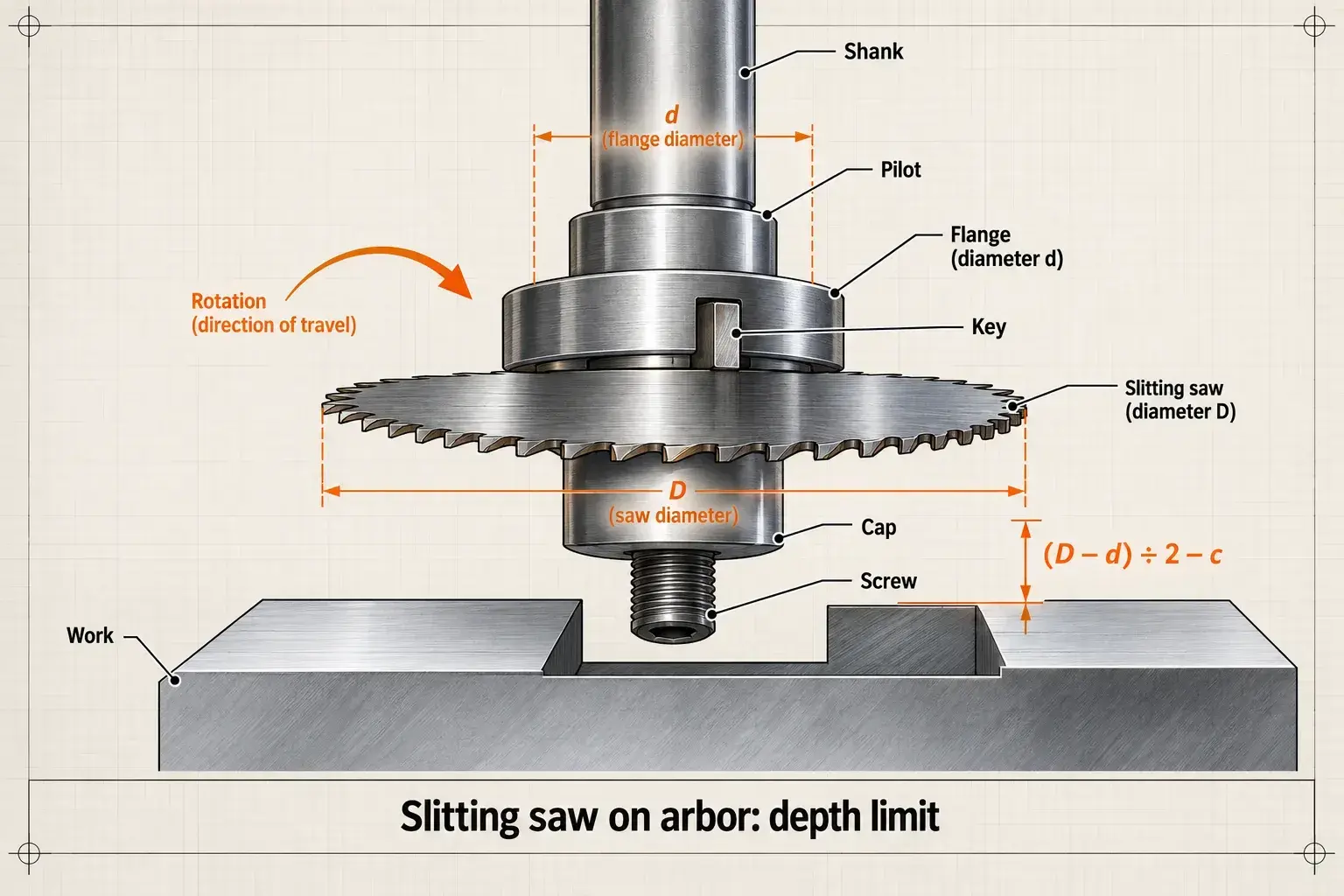
A slitting saw arbor is the short shaft that carries a slitting saw on the spindle, with the saw clamped between a flange and a cap. Choose it by your spindle: R8, Morse taper, CAT40, BT40, or a straight shank held in a collet. Then match its pilot to the saw’s bore, and size the flange so enough blade sticks out for the slot you need.
A lot of the trouble blamed on slitting saws starts at the arbor. A flange too big for the slot, a bore that rocks on its pilot, a saw fitted the wrong way round: none of them is the saw’s fault, and each one shows up as a bad slot or a broken blade. This guide covers choosing the arbor, keyed or keyless drive, mounting direction, the depth limit, and setup on manual mills, CNC machines, and in CAM.
What counts as a slitting saw arbor
“Arbor” and “holder” mean the same part in most catalogs. Four features decide how well it works:
- Shank: the part the spindle grips, matched to your machine.
- Pilot: the short diameter the saw’s bore slides onto.
- Flange: the shoulder the saw clamps against. Its diameter decides how much of the saw can cut.
- Clamp: a cap and screw, or a nut, that squeezes the saw against the flange. Some arbors also carry a drive key in the pilot.
Horizontal mills carry saws on a long arbor with spacing collars and an outboard support. Everything below is about the stub arbors used on vertical mills and machining centers.
Choose the shank to suit the spindle
| Machine | Arbor to use | What to know |
| Manual knee mill with an R8 spindle | R8-shank arbor, or a straight-shank arbor in an R8 collet | A straight shank lets you slide the saw up or down in the collet to set its height |
| Small mill or lathe with a Morse taper | MT2 or MT3 arbor held with a drawbar | Use the drawbar; a taper on its own can work loose under an interrupted cut |
| CNC machining center | CAT40, BT40, BT30 or HSK arbor with the shank built in | The stiffest choice, with the shortest overhang and no collet to slip |
| Any spindle with an ER chuck or side-lock holder | Straight-shank arbor | Flexible, but every extra joint costs stiffness, so grip as much of the shank as the collet allows |
Machinists on Hobby-Machinist often recommend the straight-shank route on manual mills for exactly that height adjustment. On any machine, the arbor sets the stiffness ceiling for the whole setup. Our speeds and feeds guide explains why a 1-1/4 in arbor is more than twice as stiff as a 1 in arbor, and why the collars should be as large as the cut allows.
Match the pilot to the saw’s bore
The saw should slide onto the pilot by hand and sit there without rocking. If it rocks, it runs out, and a few high teeth end up doing all the cutting. Maxwell grinds slitting saw bores to H7, so a pilot in good condition gives a close sliding fit.
Bore size follows saw diameter. These are the sizes you will meet most often:
| Saw diameter | Common bore |
| 40 mm | 8 or 10 mm |
| 50 mm | 13 mm |
| 63 mm | 16 mm |
| 80 to 125 mm | 22 mm |
| 160 mm | 32 mm |
| 2 in | 1/2 in |
| 2-1/2 in | 7/8 in |
| 3-1/2 to 4 in | 1 in |
Metric sizes are from Protool’s HSS slitting saw range, which follows the DIN pattern. Inch sizes are from Maxwell’s standard range.
Multi-step arbors that take several bores are handy, but indicate each step before you trust it. One member of a Hobby-Machinist thread scrapped his for runout and made single-size arbors instead.
Keyed or keyless: what actually decides it
There are two ways to drive the saw. On a keyless arbor, friction between the flange, the saw and the cap carries the cutting torque. On a keyed arbor, a key in the pilot engages a keyway in the saw’s bore and drives it positively.
Forum advice splits down the middle. Some machinists run keyless on purpose, so a jammed saw spins on the arbor instead of shattering. Others run keyed arbors for years without trouble, and one member of the Model Engineer forum points out that a thin saw that slips can cut straight through its key.
The mechanics settle most of the argument. Friction torque grows with clamp force and with the flange radius. Cutting torque grows with the cutting force and with the saw radius. So the saw that slips is a big saw on a small flange taking a heavy cut, which matches the Hobby-Machinist warning that a 4 in saw on a 1/2 in bore is likely to spin in a big cut.
Use a key when:
- the saw is large compared with its flange,
- the cut is deep or the material is tough,
- the job runs unattended on a CNC machine, where a slipping saw keeps rubbing until someone notices.
Run keyless when the saw is thin and small, the machine is manual, and you would rather it slip than break in a jam. Maxwell cuts keyways to DIN 6885 on request, so a saw can be ordered to suit a keyed arbor.
Maximum depth of cut: the flange sets the limit
Only the part of the saw outside the flange can cut. The geometric limit is:
Maximum depth of cut = (saw diameter − flange diameter) ÷ 2 − clearance
RobbJack’s arbor listings subtract 0.050 in (1.27 mm) of clearance from that figure, a sensible allowance for most setups.
- A 4 in saw on a 1-1/2 in flange: (4 − 1.5) ÷ 2 = 1.25 in, so about 1.20 in of usable depth.
- A 100 mm saw on a 40 mm flange: (100 − 40) ÷ 2 = 30 mm, so about 28.7 mm usable.
Turn the formula round to choose the saw: saw diameter = flange diameter + 2 × (slot depth + clearance). A 22 mm deep slot on a 40 mm flange needs at least 40 + 2 × 23.27 = 86.5 mm. An 80 mm saw falls short, and a 100 mm saw does the job.
Two cautions. A bigger flange stiffens the saw, so pick the largest flange that still clears the depth. And this figure is the geometric limit. The depth to take in one pass is smaller and depends on rigidity and saw thickness; our guide to why slitting saws break covers it.
Check what sits below the saw as well. The cap screw or nut on the underside limits how close the cut can run to a vise jaw or the bottom of a part, a point raised in a Model Engineer thread on saw arbors.
Which way does the saw go on the arbor?
Mount the saw so the cutting faces of the teeth lead in the direction the spindle turns. On a vertical mill running forward (M03, clockwise seen from above), stand at the front of the machine and look down at the saw. The teeth on the side nearest you should point to your left.
Turn the spindle slowly by hand before the first cut and watch the teeth come round. They should meet the work face first. A saw fitted backwards rubs instead of cutting, heats up and fails fast.
Reversing the spindle to suit a backwards saw also reverses the drag on the clamp. On a single-screw arbor that can tighten or loosen the screw depending on its thread, a point raised in the same Hobby-Machinist thread, so the safer fix is to take the saw off and turn it over.
Feed direction is a separate decision. Whether to climb or conventional mill depends on how well the machine holds its table, covered in our guide to climb or conventional milling with a slitting saw.
A mounting routine that catches problems before the first cut
- Clean the bore, the pilot and both flange faces. A chip under the flange tilts the saw and shows up as wobble.
- Fit the key if you use one, then slide the saw on by hand. It should not rock.
- Face the teeth for the spindle direction.
- Tighten the cap evenly, without pressing on the saw.
- Indicate the side face near the rim, then the teeth. Side wobble widens the slot and makes the saw wander; the Model Engineer thread above rates it as more harmful than radial runout. Our breakage guide gives limits for tooth runout.
- For deep slots, tram the head first. A tilted spindle tilts the saw against the feed, and the saw rubs and binds as the slot deepens.
- With the spindle stopped, bring the saw to full depth and check that the cap, nut and spindle nose clear the vise jaws and fixtures.
Setting up a slitting saw on CNC and in CAM
On a machining center the arbor is just another tool holder, but the CAM software needs the saw described properly or the simulation will miss collisions.
- Tool type: in Fusion 360, define a slitting saw as a slot mill. That is the answer given on Autodesk’s own forum when users ask.
- Hardware below the blade: the clamp screw or nut sits under the cutting edge, where a plain slot mill definition does not show it. Mastercam users work round this by building the arbor as a holder and placing it below the blade in the tool manager, as shown on the eMastercam forum in 2025.
- Tool length: set it from the same face the CAM definition uses as its reference, top or bottom of the blade. If the machine and the CAM disagree, the slot lands one saw thickness off.
- Coolant: flood coolant often cannot reach a saw buried in a fixture. Through-coolant arbors, which feed coolant out through the flanges, exist for that reason.
Ordering a saw to fit your arbor
Tell the saw maker about the arbor as well as the saw. Along with diameter, thickness, tooth count and the material you are cutting, send:
- the bore, and whether it needs a keyway (with the key size),
- the flange diameter, so the saw diameter can be checked against your slot depth,
- the spindle type and the RPM range you can run.
Maxwell grinds metal slitting saws to the bore, keyway and diameter your arbor needs. Send those details and we will confirm the saw clears your slot before we quote.
Frequently asked questions
One whose pilot matches the saw’s bore (16 mm for a 63 mm saw, 22 mm for 80 to 125 mm saws, 1 in is the usual bore for 3-1/2 to 4 in saws) and whose shank fits your spindle. Then choose the largest flange that still leaves enough blade for the slot.
Not always. Thin, small saws on manual mills often run keyless so they can slip in a jam. Large saws on small flanges, deep cuts and unattended CNC work are better keyed, because friction alone may not carry the cutting torque.
With the cutting faces of the teeth leading in the direction the spindle turns. On a vertical mill turning clockwise seen from above, the teeth nearest you point to the left.
The flange. The saw cannot cut deeper than (saw diameter − flange diameter) ÷ 2, less about 1.3 mm (0.050 in) of clearance. How much of that to take in one pass depends on rigidity and saw thickness.
Yes, if it has a straight shank. A collet lets you adjust the saw’s height, but it is less rigid than an integral R8 or CAT40 shank, so grip as much of the shank as the collet allows.
Yes. Catalogs use both names, and “slitting cutter holder”, for the same part.
Define it as a slot mill, describe the arbor hardware below the blade where the tool definition allows, and simulate before cutting so the clamp nut cannot hit the part.