
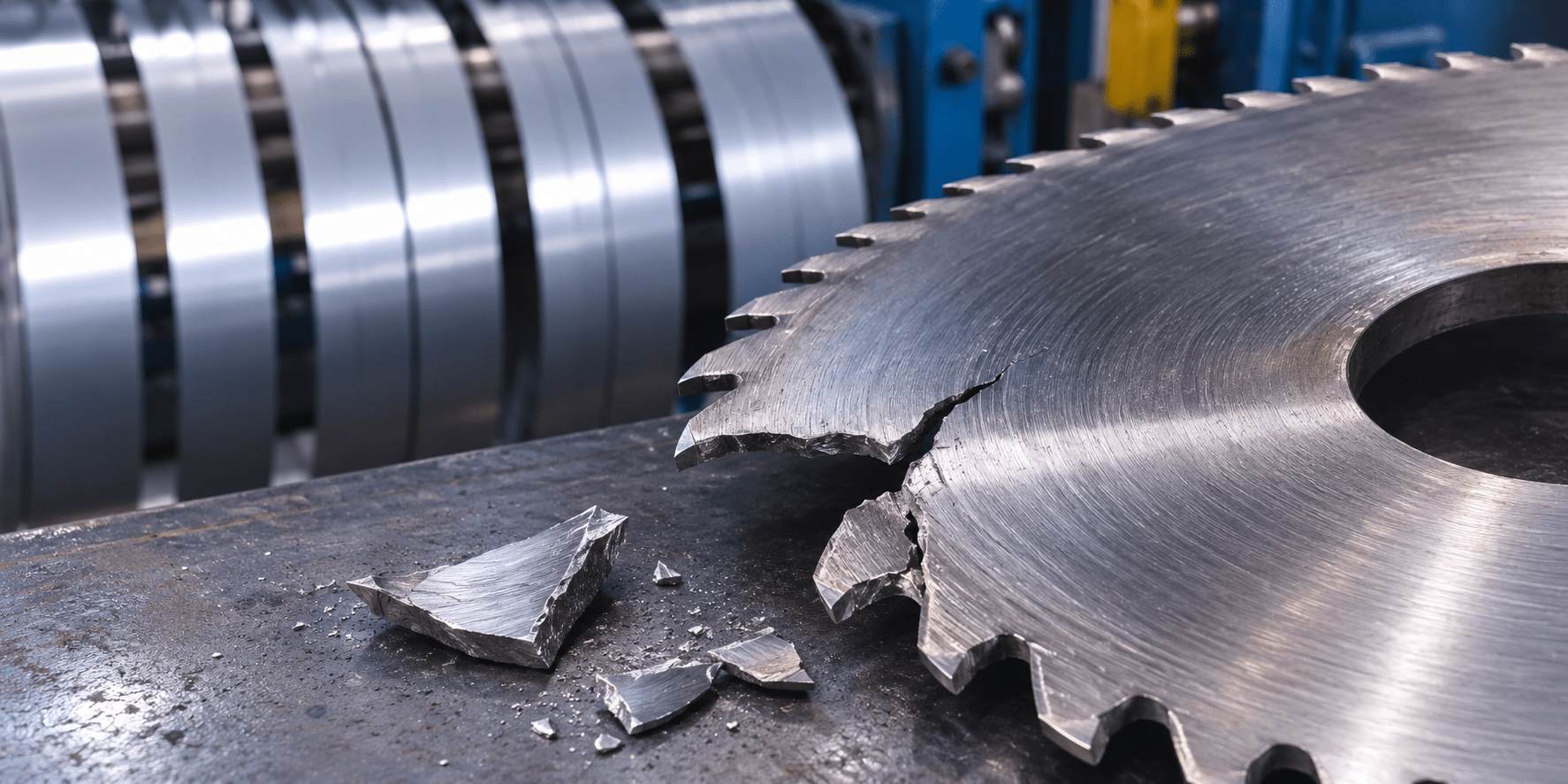
The Five Failure Modes, and How to Read the Broken Blade
Every shop has this conversation. Someone fishes a shattered disc out of the chip tray, says the saw was junk, and orders another one. Three weeks later: same tray, same conversation, same conclusion.
The saw usually was not junk.
A slitting saw is a thin disc that carries its entire cutting load in a single plane. That geometry gives it exactly two ways to die. Either the teeth stop turning and the arbor does not (torsional overload), or the disc leaves its plane and never comes back (lateral buckling). Every broken saw you have ever pulled out of a machine went one of those two ways. The five failure modes below are simply the five routes there.
The useful part is that each route leaves a different signature on the wreckage. You can diagnose the cause from the pieces in about thirty seconds, which is considerably cheaper than the alternative, which is guessing and buying another saw.
First, read the blade
Before you change anything, look at what you are holding. The failure told you what it was.
| What came out of the machine | Physics | Root cause | Section |
| Teeth stripped, rounded, or packed solid. Disc intact. | Torsional overload, gradual | Chipload or gullet packing | Mode 1 |
| Disc in two or three large pieces, clean radial break | Torsional overload, sudden | Grab (climb self-feed) | Mode 2 |
| Crack radiating out of the bore or keyway | Torsional overload at the drive | Runout, or a stalled blade | Mode 3 |
| Disc bent, dished, or curled. Slot is tapered or wavy. | Lateral buckling | Deflection or side load | Mode 4 |
| Fine on part 1, exploded on part 40. Nothing changed. | Torsional overload, sudden | The slot closed (pinch) | Mode 5 |
| Blued teeth, no fracture, slot getting tighter | Rubbing, not cutting | Feed too low, or blade dull | Mode 1 |
Mode 1: Your chipload is calculated off the wrong number
This is the most common failure in the list, and it starts with an honest mistake.
You have a 4 inch saw. You open a chipload table, find the column for a 4 inch cutter, and take the number. That number is wrong by roughly an order of magnitude, and the reason is that a 4 inch saw is not a 4 inch tool. It is a 0.062 inch tool with a 2 inch reach.
Chipload scales with the cutting section, not the swing. Look up your chipload against the thickness of the saw, not its diameter. A 4 inch by 0.062 inch saw should be fed like a 1/16 inch cutter, because from the tooth’s point of view, that is exactly what it is.
Then there is the gullet. A 100 tooth saw at 4 inches has gullets you could lose in a fingerprint, and every chip has to live inside its gullet for the entire time it is buried in the slot, which is half a revolution or more on a deep cut. When chip volume exceeds gullet volume, the chip stops being swarf and starts being a wedge. The wedge jacks the tooth away from the work, the torque spikes, and the teeth strip off the rim in sequence.
That is why the tooth count that gives you the prettiest finish is often the one that kills the saw. Fine teeth, fine finish, no chip room.
The fixes
- Chipload from thickness, never diameter. Verify against the slitting saw speeds and feeds math before you cut.
- Keep at least two teeth engaged at all times, or the saw hammers rather than cuts. Below two teeth, the blade catches, pulls, and releases, which is a grab in slow motion.
- Deep cut or gummy material: fewer teeth, not more. Give the chip somewhere to go.
- Blued teeth with no fracture means the opposite problem. You are rubbing, not cutting, because the feed is too low for the speed. Rubbing work-hardens the slot wall, then the next cut is into hardened material. Raise the feed before you lower the speed.
Mode 2: Climb milling on a machine that cannot hold its table
Search this question and you get two confident, opposite answers.
The most-cited machining resource on the internet says slitting saws are happier climb milling, because cutting forces are lower. The standard machining textbook says climb milling while slitting can triple the chipload and cause catastrophic failure of the saw. Ask ten working machinists and nine tell you they conventional mill at full depth and have not broken a saw in years.
They are all correct. They are answering different questions.
Climb milling does genuinely lower cutting force and reduce rubbing, and on a machine that can hold its table, it is the better cut. The problem is the machine that cannot hold its table.
In climb milling, the tangential cutting force acts in the same direction as the feed. It is actively trying to pull the table forward. On a ball-screw machine with a servo and verified backlash compensation, nothing moves and nothing happens. On a leadscrew machine with 0.004 inch of backlash, the table jumps forward 0.004 inch the instant the tooth bites, and the next tooth arrives at a chipload several times what you programmed.
An end mill usually survives that spike. It is a stiff cylinder loaded in torsion and it has margin. A slitting saw has no margin. It is a disc a sixteenth of an inch thick trying to transmit spindle torque through a one inch bore. The spike stalls the blade, the arbor keeps turning, and something gives: the teeth, the bore, or the disc.
That is the entire disagreement. Climb is better when the spike cannot happen. Conventional is better when it can. Nobody is wrong, they are just not telling you which machine they are standing in front of.
| Your setup | Cut this way | Why |
| CNC, ball screws, backlash compensation verified, runout indicated | Climb | Lower force, less rubbing, better finish and tool life |
| CNC with worn screws or backlash you have not measured | Conventional | You cannot prove the spike will not happen |
| Manual mill, leadscrew, no backlash eliminator | Conventional. No exceptions. | The spike is not a risk, it is a certainty |
| Any machine, on stressed or hot-rolled stock | Conventional | Conventional is less likely to clamp the blade |
And cut at full depth, in one pass. This one is counterintuitive enough that people argue with it, so here is the reasoning: every entry and every exit is a grab opportunity. One continuous cut gives you one entry and one exit. Stepping down in five “safe” passes gives you five entries and five exits, five chances for the blade to catch on a burr or a hardened wall. The shop floor settled this argument decades ago and settled it on the side of one pass.
Confidence note: the machine-dependent rule is solid and follows directly from the force geometry. The full-depth preference is strong shop consensus rather than published data, and it assumes adequate spindle power and gullet room. On a light machine that stalls, step down and accept the entries.
Mode 3: Runout, and why your chipload calculation is fiction
Here is the rule that costs shops the most saws, and almost nobody states it out loud:
If your total indicated runout is larger than your chipload per tooth, your chipload number is a work of fiction.
Work it through. You program a 40 tooth saw at 0.001 inch per tooth. That is 0.040 inch of feed per revolution, shared evenly across 40 teeth, but only if all 40 teeth sit on the same circle.
Now put 0.003 inch TIR on that saw, which is entirely ordinary for a bargain arbor. The high teeth are now 0.003 inch proud of the low teeth. The low teeth cannot reach the material at all, so they rub. The four or five teeth on the high side are taking the whole 0.040 inch of feed per revolution between them.
Your programmed chipload was 0.001 inch. Your actual chipload is nearer 0.010 inch. You are running the saw at ten times its rated load, most of your teeth are polishing rather than cutting, and your control is reporting that everything is fine right up until it is not.
This is why experienced machinists always say the same thing before they say anything else: put an indicator on the arbor. Not the saw. The arbor. Indicate the shank, then indicate the flange face. Most slitting saw failures blamed on the saw are arbor runout, and most arbor runout lives in the arbor.
The fixes
- Indicate the arbor before the saw ever goes on it. If the arbor is out, no saw will save you.
- Target TIR below your chipload per tooth. If you cannot get there, drop the tooth count so each remaining tooth has real chip room, rather than dropping the feed and rubbing.
- The veteran’s trick: face and turn the arbor flange in the spindle it will actually run in. Runout becomes zero by definition, because you just defined the axis.
- If the arbor indicates true and the saw still runs out, the saw is the problem, and that is a grinding and heat-treatment problem. Our custom-ground metal slitting saws are held to 0.02 mm TIR and verified on a CMM before dispatch, though even that only helps you if the arbor underneath is true.
- Never fit a saw over chips, burrs, or a nicked flange. A 0.002 inch chip trapped under a collar dishes the blade, and a dished blade is Mode 4.
Mode 4: The blade left its plane
A slitting saw has almost no stiffness perpendicular to its face. It resists in-plane load beautifully and side load hardly at all, which is exactly the tradeoff you accepted when you chose a tool that removes a sixteenth of an inch of material instead of a half inch.
Once the blade starts to wander it cuts a curve. Now a flat disc is trying to travel a curved path, the side load climbs with every millimetre, it work-hardens the wall it is rubbing, and the failure is only a question of when.
The dominant variable is tooth stickout: the unsupported ring between the outside diameter of your collar and the tips of the teeth. Deflection scales with roughly the cube of that unsupported length, so doubling your stickout is not twice the deflection, it is closer to eight times. This is why “use the biggest collars that will clear the work” is not fussiness, it is the single highest-leverage change available to you.
The fixes, in order of leverage
- Largest collars that clear the job. Cubic returns. Nothing else on this list pays as well.
- Smallest diameter saw that still reaches through the cut. Every extra inch of diameter is stickout you are paying for and not using.
- Thickest saw the slot tolerance allows. If the print says the slot can be 0.093 inch, do not cut it with a 0.062 inch saw to be conservative. You made it worse.
- Deep cut: staggered tooth, not plain. Plain teeth have no true side clearance, so they rub both walls in a deep slot and every bit of that rub is side load. Beyond roughly six times the saw thickness in total depth, staggered is not a preference, it is the requirement.
- Sharp teeth. A dull tooth cannot get under the chip, so it pushes it, and “pushes” means sideways.
On depth of cut, honestly: the published guidance conflicts. Conservative practice is one to two times the saw thickness per pass. Some carbide saw makers rate their tools to five times thickness on a rigid machine. Both are defensible because they assume different machines. Start conservative on an unknown setup and work up, and note that whatever number you pick, the collar has to clear the depth or the collar itself becomes the limit.
Mode 5: The slot closed on the blade
This is the failure that blindsides people, because nothing changed.
Part 1 through part 39 ran clean. Part 40 destroyed the saw, the fixture, and most of the afternoon. Nobody touched the program.
The material moved.
Hot-rolled bar, weldments, castings, flame-cut plate and anything that has been rolled, welded or heat-treated is carrying residual stress. Cutting a slot through it releases that stress and the part changes shape. If it opens, you never notice. If it closes, it clamps a disc a sixteenth of an inch thick in a vice made of the workpiece, and the clamping force goes straight into torsional overload.
It is intermittent because residual stress is intermittent. It varies bar to bar, heat to heat, and it will absolutely wait for the expensive part.
The fixes
- Expect it on anything hot-rolled, welded, or flame-cut. Expect it especially when you are slitting near a hole or an existing feature, where the stress has an edge to relax toward.
- Conventional mill. It is measurably less likely to clamp than climb.
- Wedge the slot open behind the blade. A shim or a tapered wedge dropped into the finished slot as the cut progresses is crude, free, and works.
- Relief cut first, then slit.
- If the slot starts closing mid-cut, back out along the toolpath and re-run it. Do not push through.
- Never stop the spindle with the saw in the cut. A stopped blade in a closing slot is a blade you throw away, and restarting one is worse: every tooth engages simultaneously from a dead stop at full chipload. If you have to stop, retract first, then stop.
The five minutes before you press cycle start
- Indicate the arbor shank and flange. TIR under your chipload per tooth, or fix it now.
- Chipload from the saw thickness, not the diameter.
- Start at a quarter to half the calculated RPM. A large-diameter thin disc rings, and resonance will find you. Bring the speed up once it sounds right.
- Biggest collars that clear. Smallest diameter that reaches. Thickest saw the print allows.
- Conventional unless you can prove the table cannot move. Full depth, one entry, one exit.
- Flood coolant into the kerf. Mist and air do not reach the bottom of a slot, and the bottom of the slot is the only place that matters.
- Note the spindle load at full engagement, set your limit about 5% over, and let the control catch the bind before the saw does.
- Stressed stock? Plan for the slot to close, because eventually it will.
What a broken saw actually costs
Worth saying plainly, because it changes how you buy.
When a saw lets go, the saw is the cheapest thing in the pile. You lose the part, which is usually a part with hours in it, because a slitting operation is nearly always the last operation. You lose the setup. You frequently lose the arbor. You lose the operator’s afternoon, and on a bad day you lose a guard or someone’s confidence in the process.
Against that, the difference in price between a saw ground properly and a saw ground approximately is rounding error. Uniform through-hardness with no soft spots, held flatness, and verified concentricity are not premium features. They are the things that decide whether the tool fails the way tools are supposed to fail, which is gradually, at the teeth, with warning, or the way they are not supposed to fail, which is all at once.
If your saws are failing in a pattern, the pattern is in this article somewhere. Read the blade, fix the cause, and stop paying for the same lesson.
Frequently Asked Questions
Because a slitting saw is a thin disc that carries load in one plane only, and it transmits full spindle torque through a small bore. Unlike an end mill, it has almost no margin for a load spike. It fails one of two ways: torsional overload (teeth stop, arbor does not) or lateral buckling (the disc leaves its plane). The five common causes are excessive chipload, climb-milling grab, runout, deflection, and the slot pinching closed.
It depends on your machine, which is why you see contradictory advice. Climb milling lowers cutting force and is better on a CNC with ball screws and verified backlash compensation. On a manual mill or any machine with leadscrew backlash, climb milling lets the cutting force pull the table forward, spiking the chipload several times over and breaking the saw. On anything with measurable backlash, conventional mill without exception.
Look up chipload against the saw’s thickness, not its diameter. A 4 inch by 0.062 inch saw should be fed like a 1/16 inch cutter, not a 4 inch cutter, because thickness is the cutting section. Typical starting values run 0.0005 to 0.002 inch per tooth, at the low end for thin or small-diameter saws.
As a working rule, total indicated runout must be smaller than your chipload per tooth, or the high teeth take the whole feed while the rest rub. With a 0.001 inch chipload, 0.003 inch TIR means a handful of teeth are absorbing roughly ten times the intended load. Precision-ground saws are held to about 0.02 mm (0.0008 inch) TIR, but the arbor must be indicated first because that is where most runout lives. Our slitting saw arbor guide covers choosing and mounting the arbor itself.
Published guidance conflicts because it depends on rigidity. Conservative practice is one to two times the saw thickness per pass. Some solid-carbide saws are rated to five times thickness on a rigid machine with adequate power. Beyond roughly six times the thickness in total depth, use a staggered-tooth form rather than plain, because plain teeth rub both slot walls.
Wandering is lateral deflection, and the biggest driver is tooth stickout, the unsupported distance from the collar edge to the tooth tips. Deflection scales with roughly the cube of that distance. Fit larger collars, use the smallest diameter that reaches, use the thickest saw the print permits, switch to staggered teeth for deep cuts, and check that the teeth are sharp, because a dull tooth pushes sideways instead of cutting.
Almost always residual stress. Hot-rolled, welded and flame-cut material relaxes as you cut it, and if the slot closes rather than opens, it clamps the blade. It is intermittent because stress varies bar to bar. Conventional mill, wedge the slot open behind the cut, and never stop the spindle with the blade in the slot.
No. A cracked or shattered disc is scrap and running one is a safety problem. A saw that is merely dull or worn, however, is a different matter: HSS saws can be re-sharpened several times, with the teeth reground to the original form and dimensions and hardness re-verified, at a fraction of new tool cost.