
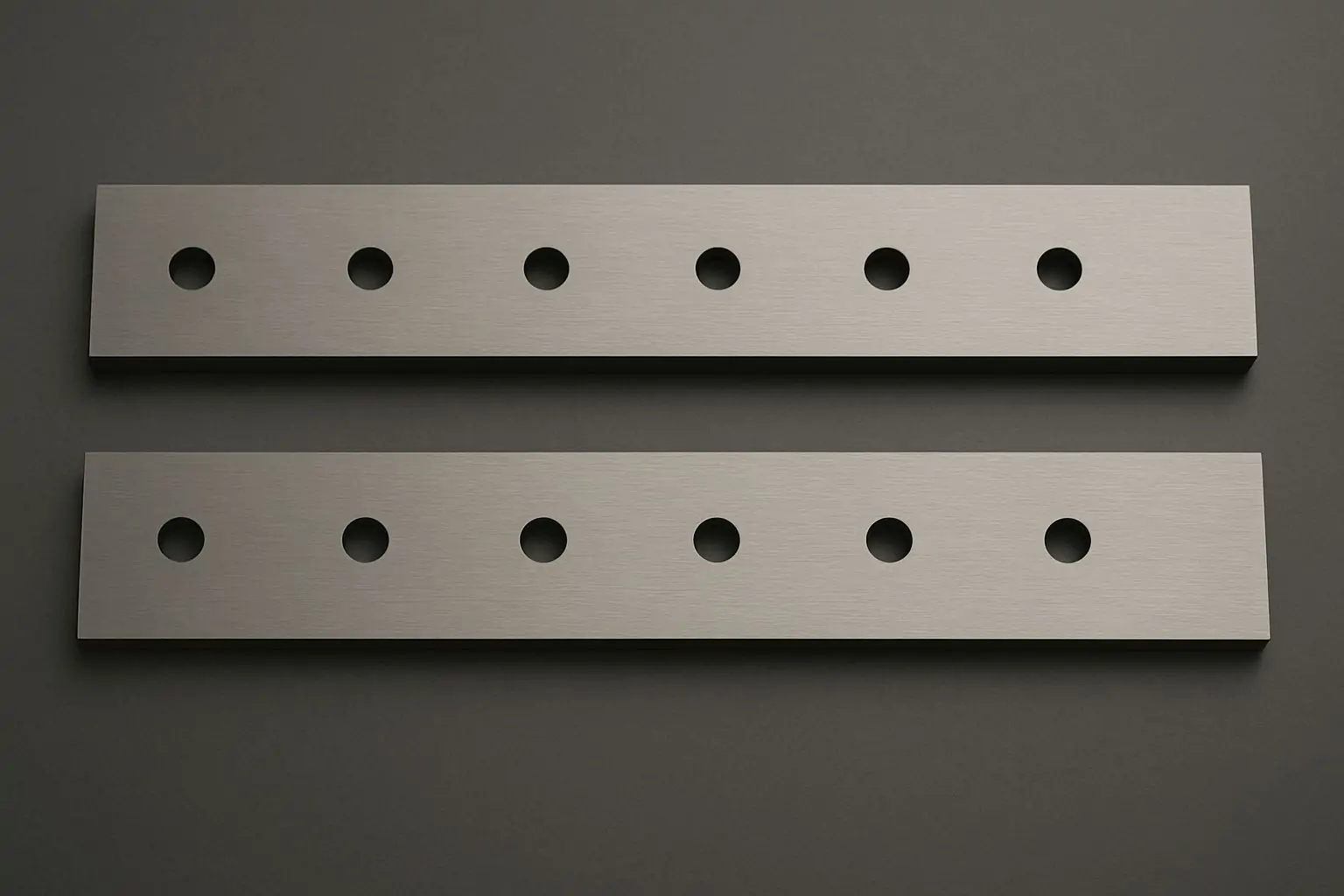
Nine times out of ten, the issue isn’t the machine. It’s the material the shear blade is made from — or the heat treatment behind it.
Shearing blades sit at the point where metallurgy meets force. Pick the wrong grade, and you’ll burn through tools, compromise edge quality, and pay in downtime what you saved on the purchase order. Pick the right one, and a single set of blades can run hundreds of thousands of cuts before the first regrind.
This guide walks through the main shear blade material grades used in steel cutting, where each one fits, and how to match the blade to your actual workload, not the one in the brochure.
The Short Answer
For most cold shearing of carbon steel and stainless steel up to medium thickness, D2 (Cr12MoV) is the go-to. It balances wear resistance, edge retention, and cost better than almost anything else.
For hot shearing — billets, slabs, hot bar cropping — H13 is the industry standard because it holds hardness at red heat.
For high-volume, high-wear, or abrasive cutting, M2 HSS or tungsten carbide-tipped shear knives are worth the premium.
Everything below explains why and which grade belongs in your line.
Why Shear Blade Material Actually Matters
A shear blade has to do three things at once: stay hard enough to cut, stay tough enough not to crack, and stay dimensionally stable under load and heat. No single grade wins on all three.
Cutting a 2 mm CR strip on a slitting line is a completely different job from cropping a hot billet at 900 °C. One is an abrasive, high-cycle task. The other is a high-impact, high-temperature one. Put a D2 blade on a hot crop shear, and it’ll anneal in hours. Put H13 on a cold slitter, and it’ll wear fast because its cold hardness isn’t where you need it.
That’s why the “best” shear blade material isn’t a single grade — it’s the one matched to your material, thickness, temperature, and cut frequency.
For steel plants and fabricators, the right material directly affects:
- Tool life and changeover frequency
- Edge quality and burr formation
- Machine load and alignment stability
- Downtime and maintenance costs
- Overall cost per cut
Choosing the correct metal shear blades is less about price and more about total lifecycle performance.
The Main Shear Blade Material Grades
D2 / Cr12MoV / 1.2379 — The Workhorse
D2 is the single most common shear blade material for cold steel cutting, and for good reason. The high chromium content (around 12%) forms dense carbides that resist abrasion exceptionally well.
- Typical hardness: HRC 58–62
• Best for: Cold shearing CR, HR, stainless, silicon steel sheet, galvanized strip
• Thickness range: Thin to medium gauge (up to ~12 mm comfortably)
• Trade-off: Hard but less tough — not ideal for heavy impact or hot work
If you’re running a coil processing line, a slitting line, or a hydraulic guillotine for sheets up to 10–12 mm, D2 is usually the first material to consider for your shearing blades.
H13 / SKD61 / 1.2344 — The Heat Champion
H13 is a hot work die steel. Its defining property is red hardness — it holds its strength at temperatures up to 600 °C, where other tool steels start to soften.
- Typical hardness: HRC 48–54
• Best for: Hot shearing, crop shears, billet and slab shearing, thick HSLA plate
• Trade-off: Lower room-temperature hardness, so not ideal for cold, high-abrasion work
If your shear knives are running in a rolling mill environment or cutting heated stock, H13 isn’t a choice; it’s a requirement.
M2 / HSS (W6Mo5Cr4V2) — The High-Speed Option
M2 is a high-speed steel with a strong mix of tungsten, molybdenum, and vanadium. It carries high hardness and excellent wear resistance, and it keeps a sharper edge at higher cutting speeds than D2.
- Typical hardness: HRC 62–65
• Best for: High-speed slitting, precision shearing, cutting abrasive or hard strip
• Trade-off: More expensive, and tougher to regrind
For steel service centers running high-volume CR slitting or cutting hardened stainless, M2 shearing blades often pay for themselves in extended life between changes.
A2 / A8 — The Tough Middle Ground
A2 and A8 air-hardening tool steels strike a balance D2 can’t. They’re slightly less wear-resistant, but meaningfully tougher — which matters when the blade takes impact.
- Typical hardness: HRC 57–60
• Best for: Medium-production shears, blanking dies, heavy-gauge sheet where chipping has been a problem
• Trade-off: Shorter life than D2 in pure-abrasion situations
9CrSi / 6CrW2Si — The Cost-Effective Alloys
These low-alloy tool steels are widely used for general-purpose shear blades on carbon steel and mild steel plates. Hardness typically lands around HRC 56–60.
They don’t match D2 or HSS for premium applications, but for standard mild steel shearing at moderate volumes, they offer strong value.
Tungsten Carbide — The Premium Option
Solid or tipped carbide shearing blades sit at the top of the range. Hardness goes well beyond what tool steel can reach, and life between changeovers can be 3–5× that of HSS on the same job.
- Best for: Extremely abrasive materials, very high-volume production, tight-tolerance work
• Trade-off: Significantly higher cost, more brittle, handling, and regrinding need more care
For a fabricator running occasional cuts, carbide is overkill. For a large mill in continuous operation on hard or abrasive stock, it’s often the lowest cost-per-cut option available.
Powder Metallurgy Steels (ASP 2030, ASP 2053, ASP 23)
PM tool steels are the modern premium grade. The powder metallurgy process gives a finer, more uniform carbide distribution than conventional HSS, which means better edge retention and toughness at the same hardness.
For demanding slitting lines cutting advanced high-strength steels (AHSS) and electrical steels, PM shear knives are worth a hard look.
Matching Shear Blade Material to Your Application
The fastest way to narrow down is to start with what you’re actually cutting:
- Mild steel plate under 6 mm, moderate volume — 9CrSi or 6CrW2Si is enough
• CR, HR, or GI strip on a slitting line — D2 is the safe starting point
• Stainless steel or silicon steel — D2 minimum, move to M2 for high volume
• Thick plate above 15 mm — A2 or A8 for toughness
• Hot shearing and billet cutting — H13 or H13K
• AHSS or electrical steel — PM grades or tungsten carbide
Steel plants typically prioritize durability and uptime, while fabricators often focus on flexibility and cost. Matching the shear blade material to production goals helps balance both. Electing the correct blade grade is only one part of optimization; alignment with the right slitter tooling for metal processing also plays a major role in tool life and cut quality.
Heat Treatment Is Half the Blade
Two shear blades made from the same grade can perform very differently. That’s because the material is only half the story; heat treatment is the other half.
Quenching temperature, tempering cycles, and finish grinding all decide whether a D2 blade hits HRC 60 with the right core toughness, or chips early.
Vacuum heat treatment delivers better dimensional stability, reduced distortion, improved wear resistance, and longer regrind life. This level of precision is critical not just for shearing blades but also for other high-load steel mill components such as work rolls.
When sourcing metal shear blades, always ask about heat treatment — not just steel grade.
Cost per Cut vs Blade Price
Many buyers compare only the blade price. But the correct metric is cost per cut.
A cheaper blade may:
- Wear faster
- Require frequent changeovers
- Increase downtime
- Reduce product quality
A higher-grade shear blade material often reduces total operating cost even if initial pricing is higher.
Choosing the Right Shearing Blades for Your Operation
There’s no universal answer to the best shear blade material — only the best match for your material, thickness, temperature, and production volume. D2 covers most cold work. H13 owns hot shearing. M2 and PM steels earn their place where volume or wear demand it. Carbide delivers when nothing else can.
If you’re running a steel plant or fabrication line and the numbers aren’t adding up, too many changeovers, burrs creeping in, inconsistent edge quality — the fix usually isn’t a better brand. It’s the right grade, heat-treated right, and ground right.
Maxwell manufactures precision shearing blades in D2, H13, M2 HSS, and custom tool steel grades with vacuum heat treatment and precision grinding, built to match real production conditions. Send your drawing or application details and choose the grade that delivers the lowest cost per cut.
Frequently Asked Questions
For most cold steel cutting applications, D2 provides the best balance of wear resistance, toughness, and cost. For hot shearing, H13 is preferred.
Most shearing blades fall between HRC 55–62. Higher hardness improves wear resistance but reduces toughness.
They serve different purposes. D2 is ideal for cold cutting, while H13 performs better in hot applications.
Carbide blades are best for high-volume, abrasive materials, and tight tolerance applications.
Typically 8–15 times depending on material grade and application.
D2 is suitable for moderate volumes, while M2 or PM steels perform better for high production runs.
Yes. Steel plants often prefer H13, PM steels, or carbide for durability, while fabricators commonly use D2 or A2, depending on workload.