
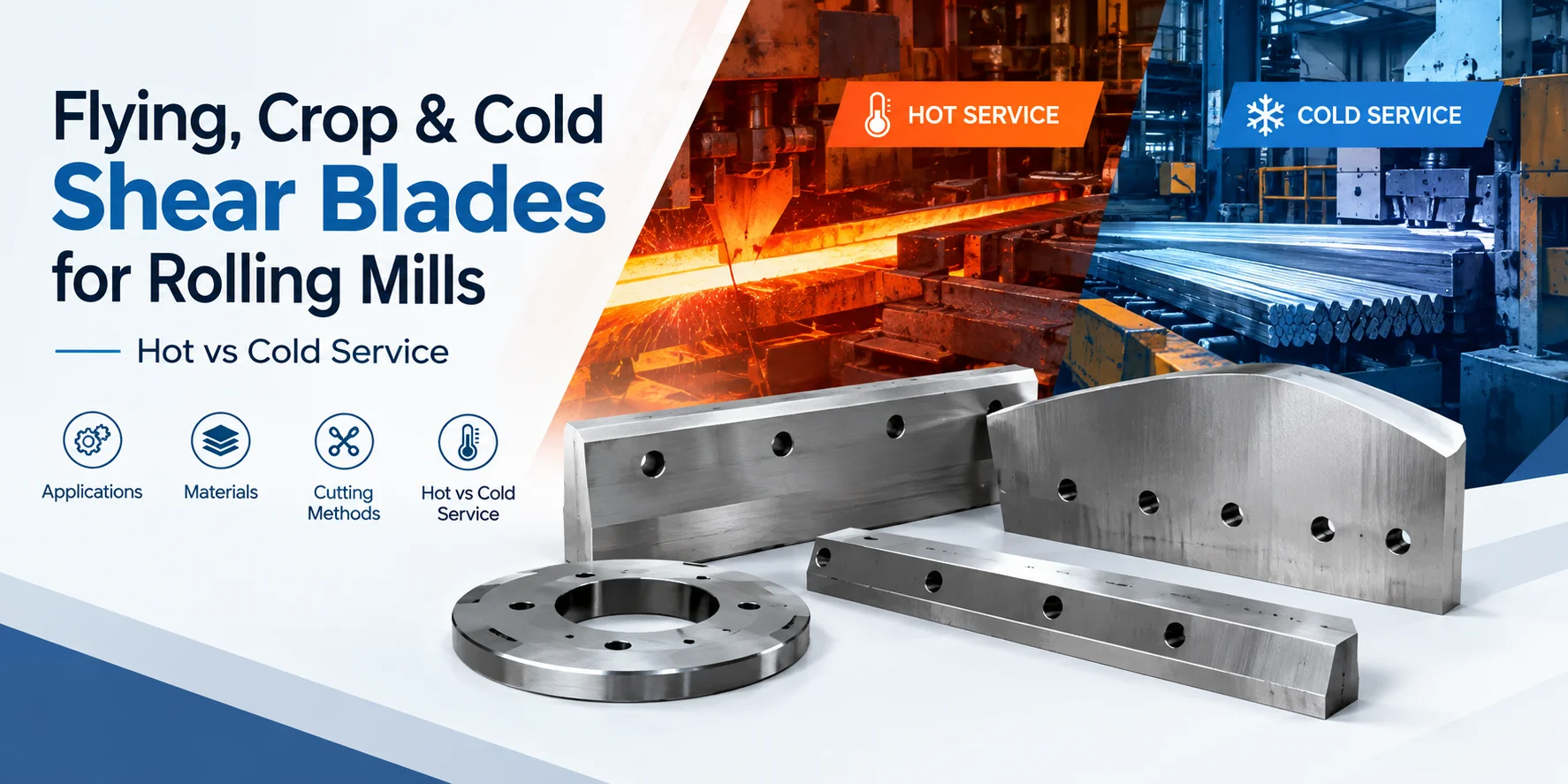
Rolling mill shear blades (shear knives, in much of the US and Europe) fall into two families, and the split follows the temperature of the steel at the cut. Blades on the crop, dividing and other flying shears in the hot line cut stock that can be above 1,000°C, and are sprayed with water between cuts. They are made from hot-work tool steel, H13 (1.2344) or H11 (1.2343), hardened to the low 50s HRC. Blades on the cold shear after the cooling bed cut a whole layer of bars once it has cooled. They are made from cold-work tool steel and sized to the load of that layer.
Get the split wrong and the failure is predictable. A cold-work blade on a hot shear softens and cracks. A cold shear blade chosen for hardness alone starts chipping when the mill moves up to heavier bar.
Where each shear sits in the mill
Steel mill rolls shape the section. The shears decide where each piece starts and ends. In a bar or TMT rebar mill, they work at three stations: crop shears between stand groups, a dividing shear in front of the cooling bed, and a cold shear after it. Hot strip mills have their own crop shear, and billet shears sit upstream of the rolling line.
| Shear | Where it sits | Stock at the cut | Usual mechanism | What the blade has to survive |
|---|---|---|---|---|
| Crop shear | After the roughing stands, often again after the intermediate stands | Hot, the heaviest sections in the line | Crank, rotary or combination flying shear | Heat, scale, colder head ends and cobble chopping |
| Dividing shear | Behind the finishing mill (and the quench box in a TMT mill), in front of the cooling bed | Hot, finished section at full mill speed | Rotary or combination flying shear | High cut frequency and repeated heat cycles |
| Cold shear | After the cooling bed | Cold or warm, a whole layer of bars at once | Stationary mechanical or hydraulic shear | Full-strength steel and a high load at every bar |
| Drum crop shear | Hot strip mills, between the roughing and finishing mills | Hot transfer bar | Two counter-rotating drums carrying the knives | Heat and scale along a cut across the full bar width |
| Billet shear | At the caster where shears replace torches, or cutting billets to length for rolling or forging | Hot or cold, large square sections | Stationary shear | Heat on hot billets, very high force on cold ones |
The crop shear takes the irregular head and tail off the bar so the next stands bite cleanly. When there is a cobble downstream, it chops the bar into scrap, a job some mills give to a separate scrap chopper. The dividing shear cuts the finished bar into lengths that fit the cooling bed, normally multiples of the saleable length. The cold shear then cuts the cooled layer to those saleable lengths.
Crank, rotary and combination flying shears
A flying shear cuts stock that is still moving, so the blades have to travel with the bar while they cut. The machine type decides how.
- Crank shears carry the blades on crank-driven holders that close on the bar while moving along with it. They suit the heavier sections and lower speeds at the crop shear positions.
- Rotary shears mount the blades on two counter-rotating drums or arms. They run faster on lighter sections, which is why many dividing shears are rotary.
- Combination shears switch between crank and rotary operation, so one machine can cover a wide product range.
The blade drawing follows the machine. Rotary blades cut along an arc, so the edge profile and the overlap between upper and lower blades are set by the shear maker, and a replacement has to match the drawing exactly. Blade speed also has to match bar speed at the moment of the cut. If it does not, the bar end gets marked or bent, however good the blade is.
Hot service versus cold service
The two duties load a blade in almost opposite ways.
| Factor | Hot shear blade | Cold shear blade |
|---|---|---|
| Stock at the cut | Roughly 850 to 1,100°C in the rolling line; cooler at a dividing shear behind a quench box | Ambient to warm |
| Cutting load | Moderate, because hot steel has lost most of its strength | High: full tensile strength, many bars at once |
| What ends blade life | Heat: softening and heat checking | Load: chipping and edge wear |
| Steel family | Hot-work tool steel: H13, H11 | Cold-work tool steel: D2 class, tougher grades for heavy sections |
| Typical hardness | About 50 to 54 HRC | About 54 to 60 HRC |
| Property that matters most | Temper resistance and resistance to thermal fatigue | Toughness balanced against wear resistance |
| Cooling | Steady water spray | None needed |
| What limits each regrind | Depth of the heat checks | Depth of chips and edge wear |
The tempering margin
Hardness on a blade certificate is measured cold. On a hot shear, what decides how long that hardness lasts is the gap between the temperature the edge reaches in service and the temperature the blade was last tempered at. Tool steel holds the hardness its final temper gave it only while it stays below that temperature. Run it hotter, and it carries on tempering in service, softening as it goes.
Cincinnati Tool Steel’s H13 data sheet turns this into a working rule: a hot-work tool should be tempered at least 50°F (about 28°C) above the highest temperature it will reach in use. Published tempering data for the two steels most often argued over on hot shears shows what happens beyond that point.
| Tempering temperature | D2 (HRC) | H13 (HRC) |
|---|---|---|
| 204°C (400°F) | 60 | 54 |
| 538°C (1,000°F) | 56 | 52 |
| 593°C (1,100°F) | 48 | 46 |
| 649°C (1,200°F) | 40 | 36 |
Typical values after hardening from about 1,010°C (1,850°F) and air cooling. D2 figures from Speedy Metals’ published tempering table, H13 figures from Cincinnati Tool Steel’s data sheet. Use them for comparison only.
Read across the table, and the hot shear problem is plain. A D2 blade supplied at 61 or 62 HRC was tempered low, below about 200°C. Its edge passes that temperature on the first cut into hot steel, and from then on the steel near the edge drifts down toward the lower figures in the table. That is how a blade that measured over 60 HRC on delivery comes off a hot shear with a rolled, soft edge.
Tempering D2 high, in its secondary hardening range of roughly 480 to 520°C, buys margin. It does not make D2 a hot-work steel. D2 gets its wear resistance from a large volume of hard chromium carbides, and the same structure leaves it with far less toughness than H13 or H11. Under the heat-and-quench cycle of a hot shear, those carbides are where cracks begin.
H13 has limits too. Tempered at around 540°C to land near 52 HRC, it has little margin above that temperature, and the data shows it at 46 HRC after a 593°C temper. Crucible’s guidance for H13 puts the working limit at about 540°C (1,000°F), with only brief excursions toward 595°C (1,100°F). Keeping the edge below its tempering temperature, cut after cut, is the real job of the cooling water on a hot shear.
H11 or H13
Both are 5% chromium hot-work steels. H11 carries less vanadium, which gives it higher impact toughness in exchange for some wear resistance and temper resistance. Latrobe’s H11 data sheet describes that trade, and hot shear blades appear among the standard uses suppliers list for it. In practice, H11 fits positions where impact and thermal shock dominate, such as crop shears that meet colder head ends and cobbles. H13 fits positions where scale wear and edge temperature decide life, such as dividing shears cutting at high frequency.
Blade steel and hardness by shear type
Uddeholm’s tool steel selection chart is a useful outside reference here because it separates shear knives by duty. For hot shear knives it lists hot-work grades such as Orvar 2 Microdized (an H13 type) and Dievar at 52 to 54 HRC. For cold shearing it splits thin stock, where it lists the D2-type Sverker 21 at 58 to 60 HRC, from thick stock, where it moves to tougher grades at 54 to 58 HRC. The table below maps that logic onto mill shears and the grade numbers buyers usually order against.
| Shear | Duty | Usual steel | Typical hardness | What decides the choice |
|---|---|---|---|---|
| Crop and cobble shears | Hot, heavy sections, impact | H11 (1.2343) or H13 (1.2344) | 50 to 54 HRC, lower end | Cracking from cobbles and cold head ends |
| Dividing shear | Hot, high cut frequency | H13 (1.2344) | 52 to 54 HRC | Scale wear and edge temperature |
| Drum crop shear | Hot, full-width cut | H13 (1.2344) | 50 to 54 HRC | Heat checking along a long edge |
| Hot billet shear | Hot, very large sections | H11 (1.2343) or H13 (1.2344) | 50 to 54 HRC, lower end | Toughness first |
| Cold shear, lighter bar | Cold, light to medium layers | D2 (1.2379) | 58 to 60 HRC | Edge wear |
| Cold shear, heavy bar and sections | Cold, heavy layers | Tougher cold-work grades: A2 types, 8% chromium steels, shock-resisting steels | 54 to 58 HRC | Chipping at each bar |
| Cold billet shear | Cold, very high force | Tougher cold-work or shock-resisting steels | 54 to 58 HRC | Chipping and gross cracking |
Two points in that chart are easy to miss. Hardness comes down as the stock gets heavier, and the steel changes before the hardness does. Dropping a D2 blade a couple of points buys only a modest gain in toughness, because the carbides that give D2 its wear resistance also cap its toughness. Niagara Specialty Metals’ comparison data shows how wide the gap between steel families is: in the same impact test, D2 at 60 HRC absorbs about 28 J, A2 at 60 HRC about 53 J, and S7 at 57 HRC about 165 J.
For a side-by-side look at D2, H13, and the other steels used for shear blades, see our grade-by-grade shear blade material guide.
HCHCr, D2 and D3 on the purchase order
In India, D2 and D3 are often ordered simply as HCHCr (high carbon, high chromium). They are not interchangeable on a cold shear. D3 (1.2080) carries more carbon and no molybdenum, so it gives up toughness for wear resistance. For a cold shear cutting bar layers, put D2 or 1.2379 in the order by name. Chinese suppliers will know D2 as Cr12MoV and D3 as Cr12.
Sizing a cold shear: force per bar layer
A cold shear in a rebar mill cuts every bar in the layer in one stroke, so the peak load is close to the sum of the loads for each bar. A working estimate:
F = n × (π × d² ÷ 4) × k × Rm
Here n is the number of bars in the layer, d is the bar diameter in mm, Rm is the tensile strength in N/mm², and k is the ratio of shear strength to tensile strength. F comes out in newtons. Divide by 1,000 for kN, or by 9,807 for tonnes-force.
The table uses k from 0.6 to 0.75 and Rm from 565 N/mm², the IS 1786 minimum for Fe 500D, up to an assumed 650 N/mm² for bar on the strong side of its test certificate. The low figure in each range is 0.6 × 565 and the high figure is 0.75 × 650. Blades are assumed flat, with no rake, which is the worst case.
| Bar layer | Total area (mm²) | Peak force (kN) | Tonnes-force | Load per bar (kN) |
|---|---|---|---|---|
| 30 × 12 mm | 3,393 | 1,150 to 1,654 | 117 to 169 | 38 to 55 |
| 20 × 16 mm | 4,021 | 1,363 to 1,960 | 139 to 200 | 68 to 98 |
| 14 × 20 mm | 4,398 | 1,491 to 2,144 | 152 to 219 | 107 to 153 |
| 10 × 25 mm | 4,909 | 1,664 to 2,393 | 170 to 244 | 166 to 239 |
| 6 × 32 mm | 4,825 | 1,636 to 2,352 | 167 to 240 | 273 to 392 |
Worked example. A mill cuts layers of 20 bars of 16 mm Fe 500D, and its test certificates show about 610 N/mm². The area is 20 × 201.1 = 4,021 mm². At k = 0.6, the force is 4,021 × 0.6 × 610 = 1,472 kN, about 150 tonnes-force. At k = 0.75, it is 1,840 kN, about 188 tonnes-force. The shear needs a rating above the upper figure, with headroom to spare.
The last column is the one that explains chipping. Six 32 mm bars need only about 40% more total force than thirty 12 mm bars, but each 32 mm bar loads the edge about seven times harder than a 12 mm bar does. Chipping starts where load concentrates, so a blade that runs well on 12 mm can start chipping when the mill switches to 32 mm, even with the shear well inside its rating.
Shear ratings are quoted for a stated tensile strength, and capacity falls in proportion as the bar gets stronger. A shear rating of 550 N/mm² steel cuts about 10% less bar area when the bar tests at 610 N/mm². For ASTM A615 Grade 60 (620 N/mm² minimum tensile) or IS 1786 Fe 550D (600 N/mm² minimum), work from the certificate figure with the formula rather than reading off the table.
Spread the layer across the blade. A layer bunched at one end loads that end of the blade and its bolts far harder than the rest, and that is where wear and chips show up first.
Hot shears are a different calculation. Steel near 1,000°C has lost most of its strength, so the cutting load on a crop or dividing shear is modest next to a cold shear cutting the same section. What limits a hot shear blade is heat, which is why grade and cooling matter more there than force.
Reading a failed blade
A worn or broken blade usually shows what went wrong. Start with what you can see, then work through the causes in order.
| What you see | Likely cause | What to check | What to change |
|---|---|---|---|
| A fine network of cracks on the edge and faces (heat checking) | Thermal fatigue: heating by hot stock, then quenching by spray water, thousands of times over | Spray pattern and flow; blades running dry then flooded; blade steel | Hot-work grade; steady, even cooling; regrind below the crack depth early |
| Edge rolled over or flattened, softer than the body | Edge running above its tempering temperature: cold-work steel on hot duty, a low temper, or lost cooling | Hardness at the edge and in the body; tempering temperature on the heat-treatment record; nozzles | Hot-work grade tempered above the edge’s working temperature; restore cooling |
| Chips along the edge | Too hard or too brittle for the load per bar; clearance too tight; blade not seated flat; layer bunched; cold ends or cobbles through a hot shear | Seat flatness and cleanliness; bolt torque; clearance; where the chips sit against the layer | Change to a tougher grade, as lower hardness alone does little; clean and true the seat; spread the layer |
| A crack running across the blade | Overload from a cobble or an oversize layer; poor seating; grinding burn from an earlier regrind; a stress raiser at a bolt hole or sharp corner | Where the crack starts: edge, hole or corner; regrind records; seat condition | Review hole positions and corner radii on the drawing; regrind with light passes; check the heat treatment for decarburisation |
| Bent, crushed or burred bar ends | Worn edge; clearance too wide; blades out of parallel; on flying shears, blade speed not matched to bar speed, or too little overlap | Edge condition; clearance along the full length; timing and overlap against the shear maker’s settings | Regrind or replace; reset clearance and overlap; retime the shear |
| Fast, even wear with no cracks | Scale abrasion on hot shears; blade too soft for the duty | Hardness; cuts or tonnes between regrinds | A more wear-resistant grade within the toughness limit; a shorter regrind interval |
| Wear concentrated on one part of the edge | Layer always fed to the same part of the blade; seat or holder not flat; blades not parallel | Wear pattern against layer position; seat flatness | Move the layer position if the line allows; rotate reversible blades; true the seat |
| Blade shifting in its seat, fretting marks on the back face | Bolts under-torqued or stretched; worn seat | Torque against the shear maker’s value; bolt condition | New bolts of the specified grade; restore the seat; re-torque after the first shift |
Mounting, clearance and cooling
Seating and bolting
Before blaming the steel for a cracked blade, check the seat. A flake of scale under one end turns a fully supported blade into a beam loaded at a single point. At every blade change, clean the seat back to bare metal, check it with a straightedge and feeler gauge, and replace any bolts that have stretched. Tighten to the shear maker’s torque in sequence, then check again after the first shift.
Change upper and lower blades as a matched set and keep regrind removal equal between them, so overlap and clearance stay where the shear maker set them. Make up lost height with the shims or adjustment the machine provides.
Clearance and overlap
Clearance works the same way on a mill shear as on a sheet shear. Too tight, and the edges touch or crush the stock, chipping both blades. Too wide, and the bar bends and tears before it separates, which leaves burrs and loads the edge sideways. Mill stock differs in being round or profiled rather than flat, and on a flying shear the gap has to hold while the blades are moving. Use the shear maker’s setting for each product range. Our guide to shear blade clearance covers how gap, burr and edge life trade off against each other.
On rotary shears, overlap matters as much as clearance. Every regrind takes height off the blade, and if that height is not made up, overlap shrinks until the bar is no longer cut cleanly through.
Cooling hot shear blades
Cooling water on a hot shear has to keep the edge below its tempering temperature without adding more thermal shock than it prevents. That points to a steady, even spray on the blade faces for the whole run. Intermittent flooding, or an extra hose aimed at the edge between cuts, widens the temperature swing on every cycle, and the size of that swing is what drives heat checking. Keep nozzles clear. A blocked nozzle leaves a hot band on the blade that softens and checks ahead of the rest.
A new blade going straight into hot stock takes the harshest thermal shock of its life on the first cut. Hot-work die practice is to preheat tools before they meet hot metal, and the same reasoning applies to hot shear blades wherever the mill can warm them before production starts.
Regrinding mill shear blades
Regrind a hot shear blade on condition, when heat checks, a rolled edge or poor bar ends call for it. These rules protect blade life:
- Grind past the heat checks. Checks left in the new edge keep growing. A dye penetrant check after grinding shows whether any remain.
- Take the minimum that clears the damage. Every millimetre removed comes off the blade’s life, and the shear maker’s minimum height or width decides when the blade is scrap.
- Avoid grinding burn. Light passes, a free-cutting wheel and plenty of coolant stop the grinder from over-tempering or re-hardening the edge. A nital etch shows burn the eye cannot.
- Check hardness after grinding. If the edge area reads well below the body, the blade overheated in service. Grinding cannot restore hardness. The blade needs a full re-heat-treatment, normally with an anneal first, or it needs replacing.
- Regrind in matched sets and record the removal on each blade.
On cold shears with two or four cutting edges, use every edge before sending a set for regrinding. For the point where a regrind stops paying for itself, see our guide on when to regrind or replace a shear blade.
What to send a blade maker, and what to ask back
A blade maker can only quote the right steel and hardness if it knows the duty. Without that, the quote copies the old blade, faults included.
Send:
- The blade drawing, or a used blade if there is no drawing. A flying shear blade drawing should show the bolt hole pattern and counterbores, the edge geometry, the number of usable edges, flatness and parallelism of the seating faces, and the steel and hardness.
- The shear type and position: crop, dividing, cold, drum or billet shear, and crank, rotary or stationary.
- The stock: steel grade, largest section, bars per layer on a cold shear, and temperature at the cut.
- The current blade: steel, hardness, life in cuts or tonnes between regrinds, and photos of a worn edge and a failed one.
- On hot shears, how the blades are cooled.
Ask for:
- A material certificate naming the grade and the steel maker.
- The heat-treatment route: vacuum, salt bath or open furnace, the number of tempers, and the tempering temperature. The tempering temperature tells you the blade’s margin on a hot shear. For why the furnace matters, see vacuum hardening versus salt bath.
- Hardness readings, with where on the blade they were taken.
- Flatness and parallelism of the seating faces.
- For H13 and H11, whether the steel is ESR (electroslag remelted). ESR steel is cleaner and more uniform, which helps thermal fatigue life, and it costs more.
For customs, knives and cutting blades for metal-working machines fall under HS 8208.10, which is HSN 8208 10 00 in India. The US tariff schedule adds a statistical suffix, 8208.10.00.30, for blades over 30.5 cm long used in metal shearing machines.
Mill shear blades from Maxwell Slitter Industries
Maxwell Slitter Industries has made shear blades since 1976 at its plant in Rajpura, Punjab, India. We make them in D2, D3, H11 and H13, and harden every blade in our own vacuum furnace: 58 to 62 HRC for the cold-work grades, 50 to 56 HRC for H11 and H13. Blades are made to drawing or from a sample, up to 6,000 mm in a single piece, with one, two or four cutting edges, custom hole patterns and parallelism held to ±0.01 mm. Mill test reports are available on request.
We also regrind shear blades, ours and other makers’, at 40 to 60% of the price of a new blade, with a turnaround of 5 to 7 working days.
For heavy cold shears where D2 keeps chipping, the tougher steels in our range are H11 and H13. Whether one of them will outlast D2 on your line depends on the section and how much wear you can accept, so send the details listed above before you order. If the duty needs a grade we do not make, we will say so.
To get a quote for rolling mill shear blades, send a drawing or a used blade through our page on shear blades made to drawing.
Frequently Asked Questions
Flying shears in the hot line, such as crop and dividing shears, use hot-work tool steel: H13 (1.2344) or H11 (1.2343), hardened to about 50 to 54 HRC. Cold-work steels such as D2 soften and crack when they cut red-hot steel and are water cooled between cuts.
About 50 to 54 HRC is the usual range for H13 and H11, and Uddeholm’s selection chart gives 52 to 54 HRC for its hot shear knife grades. Stay toward the lower end where cobbles and cold ends are the main risk, and check that the tempering temperature sits above the temperature the edge reaches in service.
D2 (1.2379) at 58 to 60 HRC suits lighter bar layers. For heavy bars and sections, tougher cold-work grades at 54 to 58 HRC are the safer choice, because D2 chips once the load at each bar gets high.
The usual causes are a blade too hard or too brittle for the load at each bar, a blade not seated flat, wrong clearance, or a layer bunched at one end of the blade. Bar size changes the picture quickly: one 32 mm bar loads the edge about seven times harder than one 12 mm bar.
A crop shear cuts the irregular head and tail off the bar between stand groups, and chops the bar into scrap when there is a cobble downstream. A dividing shear sits in front of the cooling bed and cuts the finished bar into lengths that fit the bed, usually multiples of the saleable length.
Multiply the total bar area by the shear strength of the steel: F = n × (π × d² ÷ 4) × k × Rm, with k at about 0.6 to 0.75. Twenty 16 mm Fe 500D bars at 610 N/mm² need roughly 1,470 to 1,840 kN, or 150 to 188 tonnes-force, with flat blades.
Knives and cutting blades for metal-working machines, shear blades included, are classified under HS 8208.10. In India, that is HSN 8208 10 00.