
The line is running. The web is tracking straight, tension is stable, and the operator has just changed over to a new slit pattern. Ten minutes in, the edges start shedding. Fine dust collects on the idler rolls. One strip is winding with a slightly ragged edge that the customer will reject.
Nobody touched the knives. The knives are new. So what changed?
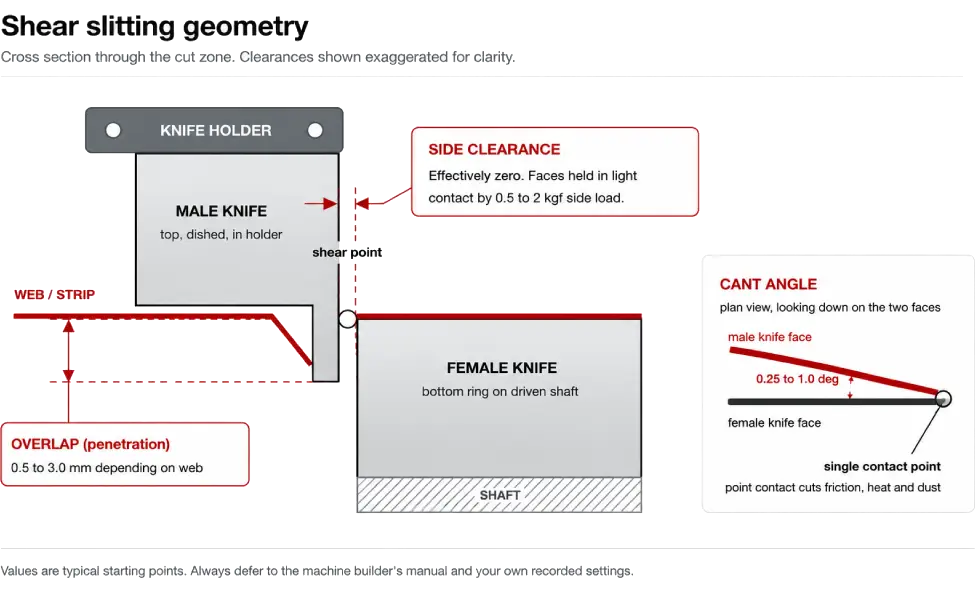
In most cases the answer is not the knife at all. It is the geometry between the male knife, the female knife and the holder that carries them. Three settings decide whether a shear slit cuts cleanly or grinds its way through the web: overlap, side clearance and cant angle. Get them right and a set of knives will run for weeks. Get them wrong and you will be regrinding in days while blaming the steel.
What “Male” and “Female” Actually Mean
In shear slitting, two rotary knives cut like a pair of scissors.
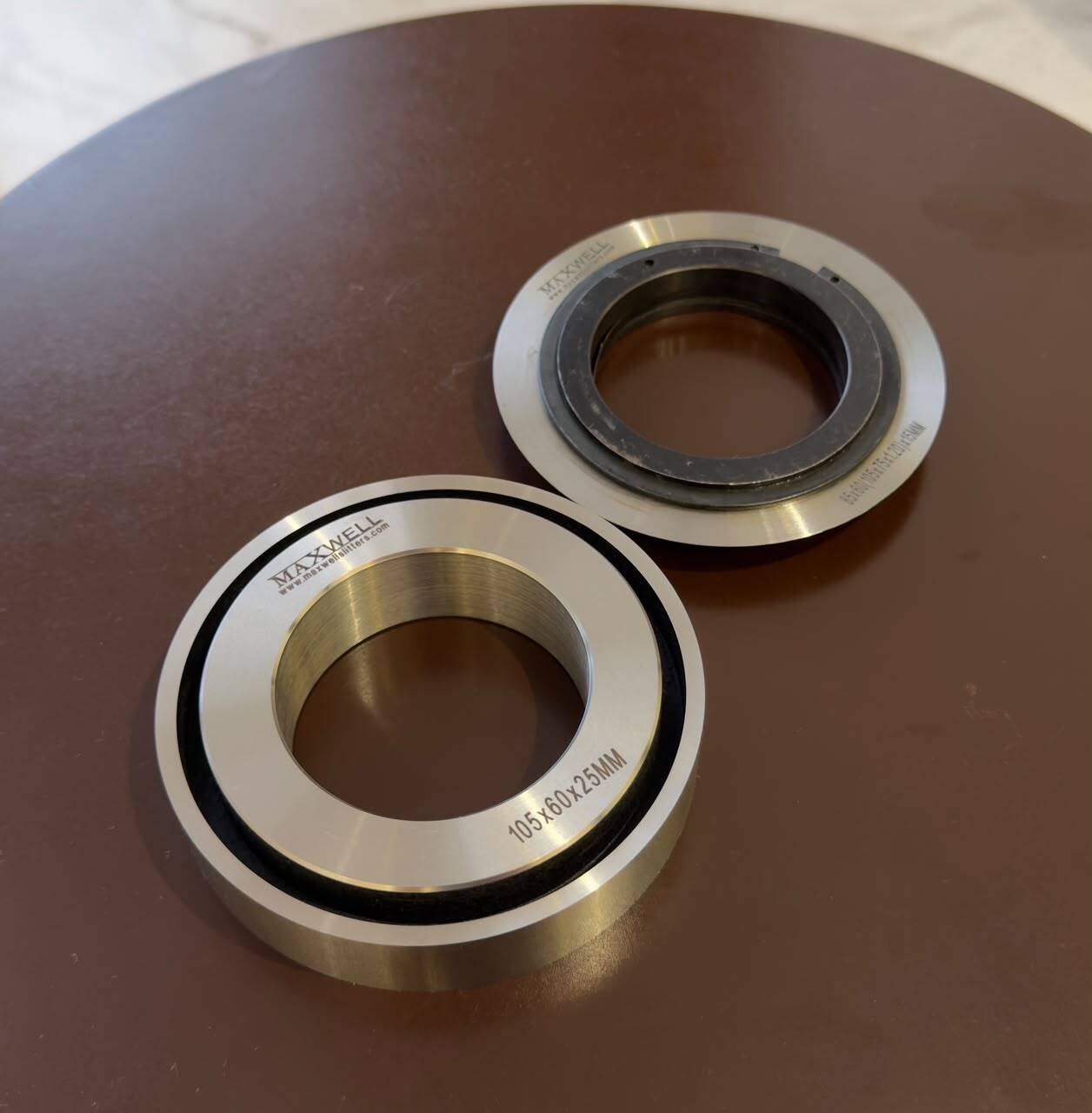
The male knife is the top knife. It is usually dished, meaning the body is formed into a shallow cone so the cutting edge sits proud and the body acts as a light spring. It is mounted in a knife holder, which locates the knife, carries the bearings, and provides the adjustment for depth and side load.
The female knife is the bottom knife. It is a plain or grooved ring, typically mounted in a gang on a driven shaft with spacers between rings to set the slit widths.
The web passes between them. The male knife penetrates past the plane of the female knife, and the two edges shear the material at their point of contact. That is the whole principle. Everything else is about controlling where and how hard those two edges meet.
The terminology carries across to coil slitting, where the upper and lower arbors are also called male and female sides, though the geometry there is set differently. More on that below.
The Three Settings That Decide Edge Quality
1. Overlap (also called penetration or depth)
Overlap is how far the male knife extends past the cutting plane of the female knife, measured vertically.
Typical starting ranges:
| Web type | Typical overlap |
|---|---|
| Thin plastic film, foil, metallised film | 0.5 to 1.0 mm |
| Paper, label stock, coated stock | 1.0 to 1.5 mm |
| Nonwovens, laminates, heavier board | 1.5 to 3.0 mm |
The rule is to use the least overlap that produces a complete, clean cut. Every extra tenth of a millimetre is extra contact length, extra friction, extra heat and faster edge wear.
Too little overlap and the web is torn rather than sheared, producing a fibrous or feathered edge and, on film, angel hair. Too much and you get accelerated wear on both knives, heat build-up, and dust generated by the knife bodies rubbing rather than the edges cutting.
2. Side Clearance (the gap)
Side clearance is the horizontal gap between the face of the male knife and the face of the female knife.
For most shear slitting the target is effectively zero. The male knife is loaded laterally against the female knife so the two faces stay in light contact throughout the cut. This is what makes the scissor action work. A measurable gap, even 0.05 mm, lets the web fold into the gap instead of shearing, which is the classic cause of a wavy or turned-over edge.
The load is what matters, not a dimension you can set with a feeler gauge. Typical side loads sit between 0.5 and 2 kgf depending on the holder and the web. Light films need the lightest load the holder can hold consistently. Heavier or abrasive webs need more.
Two things ruin side clearance in practice:
- Bearing play in the holder. Radial play above roughly 0.02 mm lets the male knife wander laterally under cutting load. The gap opens and closes once per revolution, and you see periodic edge defects at a spacing that matches knife circumference.
- Knife runout. Total indicated runout on the mounted male knife should stay under about 0.01 mm. Above that, the contact point moves in and out of the female knife face on every turn.
Both problems look identical to a worn edge. Neither is fixed by fitting a new knife.
3. Cant Angle (tilt)
Cant is the small angle by which the male knife is tilted out of parallel with the female knife, typically between 0.25 and 1.0 degree.
The purpose is to make the two knives touch at a single point rather than face to face. Point contact means far less rubbing area, far less heat, and far less dust. It also lets the dished body of the male knife provide consistent side load through its own spring action.
Many holders build cant in as a fixed feature. Others allow it to be set. If your holders allow adjustment and nobody in the plant knows what they are set to, that is worth an afternoon with a dial indicator. Zero cant is a common and expensive default.
What the Holder Actually Does
A knife holder is not a bracket. It is the component that holds all three settings stable while the web tries to push them apart.
A holder is doing its job when it delivers:
- Repeatable depth setting, ideally with a calibrated knob so a setting can be recorded and returned to
- Consistent, adjustable side load that does not drift as the knife wears
- Bearings with low radial play, protected from dust ingress
- A knife seat that locates concentrically so runout does not change every time a knife is swapped
Holders are rated by line speed. A standard shear cut male knife holder typically tops out around 3,500 feet per minute, while high speed designs are built for around 10,000 feet per minute. Running a standard holder above its rating does not fail dramatically. It fails as bearing heat, then play, then edge defects that nobody traces back to the holder.
Choosing Male Knife Material
The male knife does most of the work and takes most of the wear, so material selection matters more on the top knife than the bottom.
| Grade | Best for | Notes |
|---|---|---|
| HSS M2 | General paper, plain films, label stock | Cost effective, easy to regrind, good baseline |
| HSS M35 | Higher speeds, warmer running applications | Cobalt content improves red hardness |
| PM grades (ASP2030 class) | Filled films, laminates, abrasive coatings | Fine, uniform carbide structure takes a keener edge and holds it far longer |
| Tungsten carbide | Highly abrasive webs, long runs | Longest life, but brittle and unforgiving of impact or misalignment |
One point is often missed: on the male knife, surface finish matters as much as hardness. A knife body with a coarse ground finish drags against the web and generates dust regardless of how sharp the edge is. This is why lapping the faces is worth paying for on dust-sensitive work. We have covered the finish question in detail in Grinding vs Lapping Slitter Knives.
How This Maps to Metal Coil Slitting
If you run a coil slitting line rather than a converting line, the same male and female language applies but the numbers do not transfer.
- Horizontal clearance on a coil line is set as a percentage of strip thickness, commonly in the range of 5 to 12 percent, opened up for higher tensile materials such as stainless and closed for soft aluminium.
- Vertical overlap is generally small and positive for thin gauges and reduces toward zero as thickness increases.
- The knives sit on arbors with spacers, stripper rings and separator discs rather than in individual holders, so accumulated stack error replaces bearing play as the main enemy.
The principle is identical: control the geometry at the point of contact, not the sharpness of the tool.
Troubleshooting: Symptom to Cause
| Symptom | Most likely cause | First check |
|---|---|---|
| Dust or fuzz along the edge | Excess overlap, or poor male knife face finish | Reduce overlap to minimum clean cut, inspect knife body finish |
| Feathered or torn edge | Insufficient overlap | Increase depth in 0.25 mm steps |
| Wavy or turned-over edge | Side clearance opened up | Check side load and holder bearing play |
| Periodic defect at fixed spacing | Knife runout or bearing play | Indicate the mounted knife, target under 0.01 mm TIR |
| Rapid edge wear on new knives | Zero or lost cant, or excessive side load | Measure cant, reduce side load to minimum that holds contact |
| Heat marks on knife body | Face-to-face contact instead of point contact | Set cant, verify holder is not seized |
| Slit width drifting across the set | Female knife spacer stack error | Audit spacers, check for damaged or mixed sets |
When to Regrind and When to Replace
Male knives are reground on the face and re-dished as required. The practical limit is the point at which regrinding takes the knife outside its usable diameter or thickness tolerance, at which point the geometry no longer matches the holder seat.
Signs it is time to pull a male knife:
- Visible edge rounding under a loupe, before the operator complains about the edge
- Chipping anywhere on the cutting edge
- Diameter reduced past the point where overlap can be set within the holder’s adjustment range
- Any bluing or heat discolouration on the body
Running past the point of dull is a false economy: a dull male knife raises cutting force, which loads the holder bearings, which opens side clearance, which damages the female knife too. One worn top knife takes the bottom ring with it.
Get the Geometry Right First
Slitting problems are almost always geometry problems wearing a knife problem’s clothes. Before you change steel grade, change supplier or blame the material, measure the three settings: overlap, side clearance and cant. Record them. Make them part of the changeover sheet so the next shift is not guessing.
Maxwell manufactures male and female slitter knives and matched holders to customer drawings, with vacuum heat treatment, CMM verification, and lapped faces where surface finish is critical. If you are diagnosing an edge quality problem and want a second opinion on the setup, send us the material spec, the current settings and a photo of the edge.
Frequently Asked Questions
The male knife is the top knife, usually dished, mounted in an adjustable holder. The female knife is the bottom knife, a plain or grooved ring mounted on a driven shaft with spacers. The male knife penetrates past the female knife and the two edges shear the web between them like scissors.
Use the minimum that gives a complete cut. Typical starting points are 0.5 to 1.0 mm for thin films and foils, 1.0 to 1.5 mm for paper and label stock, and 1.5 to 3.0 mm for nonwovens and heavier laminates. Excess overlap is the most common cause of dust and premature knife wear.
Effectively zero. The male knife should be loaded laterally against the female knife so the faces stay in light contact, typically with 0.5 to 2 kgf of side load depending on the holder and web. A measurable gap lets the web fold instead of shear, producing a wavy or turned-over edge.
Cant is a small tilt, usually 0.25 to 1.0 degree, applied so the male and female knives touch at one point rather than across their faces. Point contact reduces friction, heat and dust, and lets the dished knife body supply consistent side load.
The two most common causes are excess overlap and a coarse surface finish on the male knife body. Reduce overlap to the minimum that cuts cleanly, then inspect the knife faces. Lapped faces significantly reduce dust on sensitive webs.
Pull the knife when the edge shows rounding under magnification, when any chipping is visible, when heat discolouration appears on the body, or when the diameter has reduced past the range in which the holder can still set correct overlap. Running past dull damages the female knife as well.
Yes. Standard shear cut male knife holders are typically rated to around 3,500 feet per minute and high speed designs to around 10,000 feet per minute. Running above rating causes bearing heat and play, which shows up as edge defects rather than obvious holder failure.