
Maxwell Slitter Industries | Precision manufactured since 1976 | ISO 9001:2015
Grinding shapes a slitter knife. Lapping finishes it. They are two different jobs, and the difference is the reason a knife slits a clean, burr-free edge at line speed instead of tearing, dishing, or building a burr that fails your QC. This is a practical guide to what lapping actually does on a rotary slitter knife, how it differs from grinding, and which flatness, parallelism, and surface finish numbers you should be checking before you buy.
The short answer
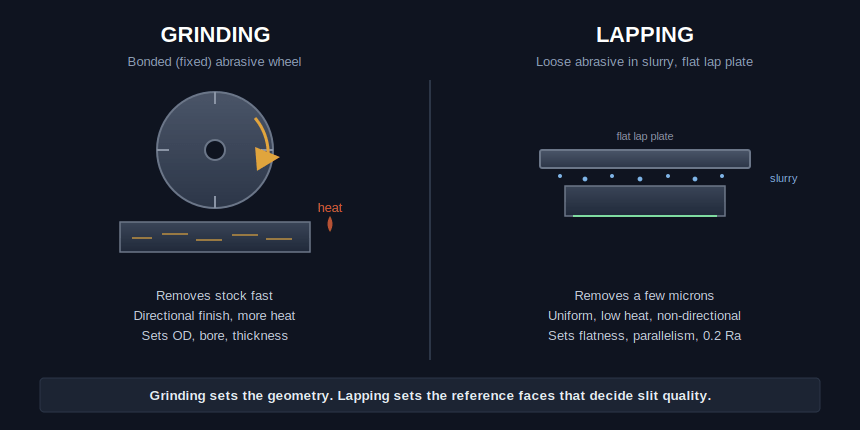
Grinding removes stock fast and brings a slitter knife close to its final outer diameter, bore, and thickness using a bonded abrasive wheel. It is a cutting process. Lapping comes after, and it is a finishing process: loose abrasive in a slurry runs between the knife face and a flat lap plate, taking off a few microns to deliver true flatness, parallelism between the two faces, and a low surface roughness (typically 0.2 Ra on a precision slitter knife). Grinding gets the geometry right. Lapping gets the surface and the flatness right. A production slitter knife needs both, because the two faces of the knife are the reference surfaces that decide slit width consistency, stack stability on the arbor, and edge quality.
What lapping actually is
Lapping is an abrasive finishing process. Instead of a bonded grinding wheel where the abrasive grit is glued into a fixed matrix, lapping uses free abrasive grain suspended in a liquid carrier (the slurry). The knife face is pressed against a rotating lap plate, usually cast iron, and the loose grains roll and micro-cut between the two surfaces. Because the abrasive is not fixed and the removal rate is deliberately slow (a few microns), lapping transfers the flatness of the lap plate onto the workpiece with very little heat and very little subsurface stress.
That last point matters for a hardened tool steel disc. A slitter knife in D2, HSS M2, M35, or a powder metal grade like ASP 2030 is heat treated to 60 HRC and above. Aggressive single-side grinding puts heat and stress into a thin hardened disc, which is exactly what warps it. Lapping does the opposite: it corrects the face at near-ambient temperature and leaves a clean, uniform, non-directional finish.
Grinding vs lapping: they solve different problems
The mistake is treating lapping as just a finer grind. It is a different mechanism with a different purpose. Here is the practical comparison for slitter knife manufacturing:
| Attribute | Grinding | Lapping |
| Abrasive | Bonded (fixed) in a wheel | Free grain suspended in slurry |
| Primary job | Remove stock, set OD, bore, thickness | Deliver flatness, parallelism, surface finish |
| Material removed | Bulk (tenths of a mm and up) | A few microns |
| Heat and subsurface stress | Higher, needs coolant | Low, near-ambient |
| Resulting finish | Directional scratch pattern | Uniform, non-directional, low Ra |
| Flatness and parallelism | Good, but single-side grinding can distort thin discs | Excellent, both faces referenced flat and parallel |
| Where it sits | Before finishing | Final finishing stage |
The one-line rule: grinding decides how big and how thick the knife is. Lapping decides how flat, how parallel, and how smooth the two faces are. On a slitter knife, those faces are the reference surfaces, so lapping is what governs slit quality, not just cosmetics.
Why a slitter knife specifically needs lapping
A rotary slitter knife is not cut by a single edge in isolation. It is one disc in a stack of knives and spacers clamped on an arbor, working against a matched lower knife. Its two large faces do three jobs at once, and each depends on the face being lapped:
1. Parallel faces keep thickness consistent, which keeps slit width consistent
The knife thickness is what positions the next spacer and the next knife across the arbor. If the two faces are not parallel, thickness varies around the disc, tolerances stack up across a wide arbor, and slit widths drift. Lapping brings parallelism between the faces into a tight band (Maxwell holds within 0.005 mm TIR), so a stack of many knives still lands on width.
2. Flat faces sit fully against the spacers, which kills wobble and runout
If a face is dished or bowed, the knife does not seat cleanly against the adjacent spacer. That gap becomes axial runout, the edge wobbles as it turns, and you get inconsistent penetration and edge quality. A lapped, genuinely flat face (Maxwell holds flatness to plus or minus 0.001 mm) seats fully and turns true.
3. A smooth face near the edge shears cleanly instead of tearing
Slitting is a controlled shear and fracture, not a scissor cut. The material is stressed between the upper and lower knife until it fractures across the gap. A rough face near the cutting edge drags on the strip, adds friction and heat, and promotes galling and burr, worst on sticky materials such as aluminium, stainless, and coated coil. A lapped face at 0.2 Ra lets the strip shear and release cleanly, which is a direct lever on burr height. Burr is a bigger topic with several causes: knife gap, overlap, edge wear, and material condition all play in.
The numbers that matter, and what to ask your supplier
If a supplier says a knife is lapped, ask them to put numbers to it. Vague claims of a mirror finish are
marketing. These are the three specifications that actually control slit quality on a precision slitter knife:
| Specification | What it controls | Precision slitter knife target |
| Surface finish (Ra) | Clean shear, low burr, low galling | 0.2 Ra micron (0.1 Ra on request) |
| Flatness | Full seating, no wobble or runout | Within 0.001 mm |
| Parallelism between faces | Consistent thickness and slit width | Within 0.005 mm TIR |
Two more questions worth asking: is the finish verified with a surface roughness tester per batch, and is flatness checked on a granite surface plate or CMM rather than by eye. A finish number is only meaningful if it is measured and documented on the inspection report that ships with the knife.
The numbers that matter, and what to ask your supplier
Lapping is the last precision step, not the first. On a hardened slitter knife the typical order is: cut the blank, turn it close to size, vacuum harden and temper to the target HRC, grind the outer diameter, bore, and thickness, then flatten and lap the faces to final flatness, parallelism, and finish. The reason lapping is last is simple: it removes only microns, so everything ahead of it has to be close already. It cannot fix a knife that is badly out of geometry, it perfects one that is nearly there. This is also why lapping quality is a fair proxy for the discipline of the whole process behind it.
Does the lapped finish wear off, and can it be restored
Yes and yes. In service the edge wears and the lapped faces pick up wear and micro-scoring, which is why cut quality drifts over time even before the edge looks dull. A worn knife does not have to be scrapped. During a regrind, the faces are re-ground to recover geometry and then re-lapped back to the original finish and flatness, which restores the knife to its original slitting performance for several more cycles at a fraction of the cost of a new knife. If you are running local knives that were never properly lapped to begin with, a re-lap on a worn set is often the cheapest quality improvement available to you.
Maxwell lapped slitter knives, and re-lapping for worn sets. Every Maxwell rotary slitter knife is lapped to 0.2 Ra, flatness within 0.001 mm and parallelism within 0.005 mm TIR, verified per blade and documented on the inspection report. We also re-lap worn Maxwell and non-Maxwell knives to restore original finish and flatness. See our rotary slitter knives at maxwellslitters.com and request a quote.
Frequently Asked Questions
Grinding sets the geometry (outer diameter, bore, thickness) but leaves a directional finish and can distort a thin hardened disc. Lapping is a low-heat finishing process that delivers true flatness, parallelism between the two faces, and a low surface finish. Those face properties are what control slit width consistency, seating on the arbor, and burr, so a production slitter knife needs both grinding and lapping.
Grinding uses bonded abrasive fixed in a wheel to remove stock quickly and shape the part. Lapping uses free abrasive suspended in a slurry between the part and a flat lap plate to remove only a few microns and perfect flatness, parallelism, and surface finish. Grinding is a cutting process, lapping is a finishing process, and precision parts often use both in sequence.
A precision rotary slitter knife is typically lapped to 0.2 Ra micron, with 0.1 Ra available on request for demanding materials. A lower Ra near the cutting edge helps the strip shear cleanly and reduces burr and galling, which matters most on aluminium, stainless steel, and coated coil.
Not directly. Lapping perfects the flat faces and their finish, it does not create the cutting edge on its own. The edge is formed by the ground bevel geometry meeting a flat, lapped face. A properly lapped face makes that edge cleaner and more consistent, and lapping is part of restoring edge performance during a regrind.
Yes. During a regrind the faces are re-ground to recover geometry and then re-lapped to the original finish and flatness. This restores slitting performance for several more cycles at a fraction of the cost of a new knife, and it applies to both previously lapped knives and local knives that were never lapped correctly.