
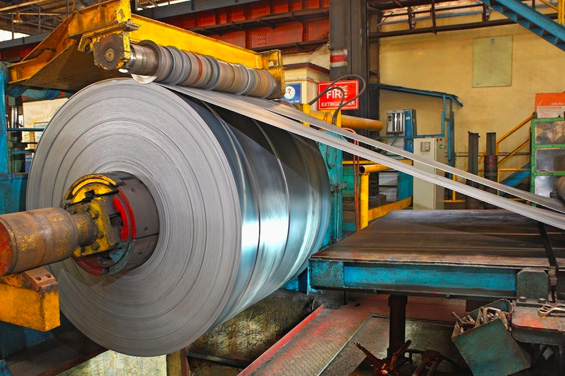
By passing the material through a set of rotary slitting knives, a wider master coil is slit (cut) into a
number of thinner coils in the process known as coil slitting. A mult refers to each smaller coil. Mults
can be made to your precise width and/or weight requirements and packed appropriately.
The uncoiler, slitter arbors/rotary knives, and a recoiler are the three major components of a slitter.
Uncoiler: At the machine’s entrance, the master coil is loaded onto the uncoiler. The uncoiler then
grabs the master coil by its interior diameter using an expanding mandrel. The coil’s head is
threaded into the machine’s edge guides as it rotates off the mandrel.
Slitter: The material is fed into the slitter head’s two parallel arbors lengthwise. A specialized set of
rotary-slitting knives and rubber stripping rings are used to attach these parallel arbors. While the
knives pierce the steel, causing the material to break or fracture, rubber rings to aid in pulling the
material through the slitter arbors.
The setting is crucial for a successful precision coil slitting process. The best slit edges are
guaranteed with Maxwell Rotary Slitter knives.
Recoiler: The main function of the recoiler is to coil the slit coils back into a coil form for shipping
and packaging. Width alone does not define a finished coil. Edge condition, camber, and burr form the rest of the slit coil specification the customer will inspect against on arrival.
Check out Rotary Slitter cutters for coil slitting?
Frequently Asked Questions
Coil slitting is a metal processing method in which a wide master coil is cut into multiple narrower coils using rotary slitting knives. The resulting smaller coils are customized for specific industrial applications.
The process involves three main steps:
- Uncoiling the master coil
- Slitting using circular knives
- Recoiling into smaller strips
This ensures precise width control and efficient material handling.
A coil slitting line is an automated system that unwinds, slits, and rewinds metal coils into narrower strips with high precision and consistency for further processing.
Coil slitting is commonly used for:
- Steel (hot rolled, cold rolled, galvanized)
- Aluminum
- Copper
- Stainless steel
- Plastic films and laminates
Key components include:
- Uncoiler
- Slitter head (rotary knives)
- Recoiler
These components work together to ensure accurate and continuous slitting operations.
“Mults” refer to the narrower coils produced after slitting, which can be customized based on required width and weight specifications.
Coil slitting is essential because it:
- Improves material utilization
- Enables precise width control
- Supports high-speed production
- Reduces waste in downstream processes
Coil slitting is widely used in:
- Automotive manufacturing
- Construction and infrastructure
- Electrical and appliance industries
- Tube and pipe manufacturing
- Slitting: Cuts coils into narrower strips (longitudinal cutting)
- Cut-to-length: Cuts coils into flat sheets (cross cutting)
Both serve different manufacturing needs.
It enhances efficiency by:
- Allowing continuous processing
- Producing uniform strip widths
- Reducing handling time
- Minimizing material waste