
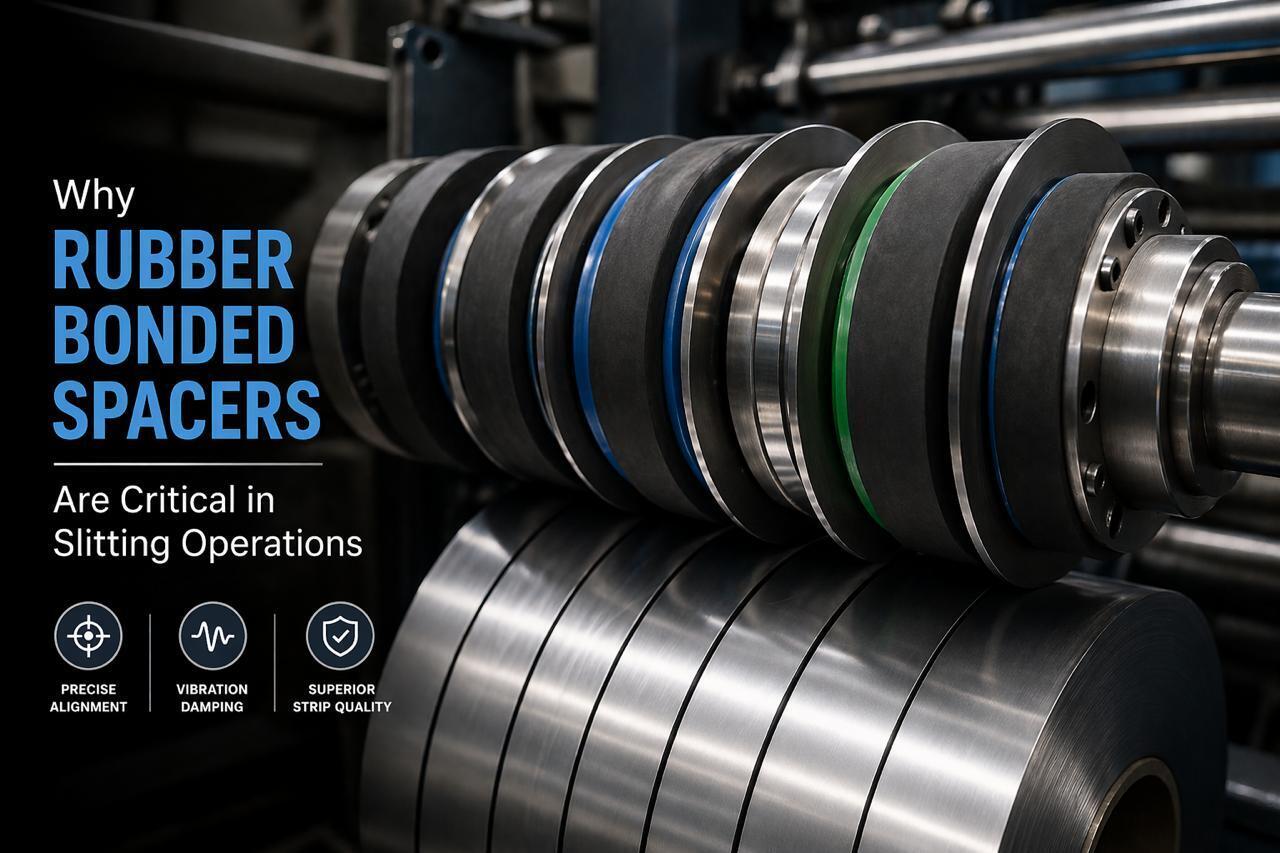
In many cases, the answer is sitting right there on the arbor, sandwiched between the knives: the spacers.
Specifically, rubber bonded spacers that are worn down, hardened from age, or simply the wrong type for the material being run. It sounds like a small thing, but in precision slitting operations, these components directly influence strip width accuracy, edge quality, and surface finish.
For slitting line operators, understanding how spacers influence alignment, vibration control, and durability can prevent costly coil rejections and unnecessary downtime.
What Are Rubber Bonded Spacers?
Rubber bonded spacers are precision-manufactured components used on the slitter arbor alongside rotary slitter knives. They consist of a hardened steel core, typically EN31 or EN8 alloy tool steel, with a synthetic rubber layer vulcanized directly onto the outer surface.
That rubber layer is load-bearing in ways most operators don’t initially consider. It contacts the coil strip as it travels through the knife assembly, stripping the material off the blades, absorbing vibration, and maintaining consistent lateral pressure on the strip.
The steel core provides dimensional accuracy, while the rubber layer adds controlled flexibility that pure metal spacers cannot offer. High-quality rubber bonded spacers are manufactured to tight tolerances, often within ±0.001 mm, ensuring precise arbor setup and repeatable performance.
Without this combination of rigidity and flexibility, slitting geometry becomes unstable during operation, even when the knife setup appears correct.
Alignment: The Hidden Role of Rubber Spacers
Slitting geometry is not just about knife clearance. It’s a three-dimensional alignment system that depends on every component of the arbor maintaining its position under load.
When rubber spacers wear unevenly or compress without recovery, knives drift laterally during cutting. These shifts occur in fractions of a millimeter too small to see visually, but the impact appears immediately in strip width variation and inconsistent edge quality.
Worn spacers can also allow knives to rock slightly under cutting force. This alters the effective clearance during shear, leading to inconsistent burr height. One edge may appear clean while the opposite edge shows a rough fracture zone.
The rubber layer maintains radial contact pressure on the strip while allowing it to release cleanly from the blade face after the cut. This release function prevents lateral dragging. Dragged strips are one of the most common causes of width deviation that cannot be traced to knife setup errors.
Vibration Control: A Critical Yet Overlooked Function
Steel slitting lines often run at speeds where mechanical resonance becomes a real operational issue. At high speeds, the rotating arbor assembly generates harmonic vibration that amplifies through the knife stack.
If every component in that stack is rigid metal, vibration transfers directly into the cutting zone. The result is chatter marks, periodic wave patterns on strip edges that correspond to the resonant frequency of the system.
Rubber bonded spacers act as vibration dampers. The rubber compound absorbs and dissipates harmonic energy before it reaches the knife edge. This reduces chatter marks, improves edge consistency, and stabilizes cutting performance at higher line speeds.
Operators often notice that edge quality deteriorates when running faster speeds on the same material. In many cases, worn or hardened spacers are transmitting vibration rather than absorbing it.
Nitrile vs Polyurethane: Choosing the Right Spacer Material
Not all rubber bonded spacers use the same compound, and the selection matters depending on the application.
Nitrile Rubber (NBR)
Nitrile is commonly used in steel slitting operations due to its oil resistance. Since strip surfaces and arbor components are typically lubricated, NBR maintains its properties in oily environments. With hardness ranging from 70 to 85 Shore A, nitrile spacers work well for carbon steel, CRCA, and galvanized materials.
Polyurethane (PU)
Polyurethane spacers provide higher abrasion resistance and hardness. They are ideal for stainless steel, high-tensile materials, and high-speed lines. PU spacers maintain contact pressure longer and generate less heat under heavy cutting loads.
Choosing the right compound improves spacer life and ensures stable strip handling across different materials.
Surface Defects Often Originate from Spacers
Light scratches or score lines that do not originate from knife edges often come from the spacer surface condition.
A spacer with hardened or glazed rubber becomes abrasive. Instead of yielding, it slides against the strip surface. This causes cosmetic defects, particularly on bright-finish cold-rolled or coated materials.
Replacing worn spacers often resolves these issues without adjusting knife clearance. This is a common misdiagnosis in slitting operations. Operators adjust knives while the real problem lies in spacer degradation.
Durability and Service Life Considerations
Spacer life depends on line speed, material thickness, cutting forces, and handling practices. Handling damage during arbor assembly often shortens service life more than operational wear.
Rubber bonded spacers should be:
- Stored flat
- Kept clean
- Not used as leverage during assembly
- Protected from excessive heat exposure
Signs that spacers need replacement include:
- Rubber compression that does not recover
- Surface glazing
- Cracks at the rubber-to-steel interface
- Dimensional variation beyond ±0.003 mm
- Rubber layer separation
Running degraded spacers increases the risk of strip rejection, which costs significantly more than replacing tooling.
What to Look for When Selecting Rubber Bonded Spacers
When sourcing rubber bonded spacers, key specifications include:
Thickness Tolerance
Tighter tolerances reduce cumulative error across the knife stack.
Steel Core Material
EN31 provides high hardness and dimensional stability. EN8 suits lighter-duty applications.
Rubber Bond Integrity
Vulcanized bonding ensures durability under thermal cycling.
Hardness Specification
75–85 Shore A suits most steel slitting. Higher hardness works for high-tensile materials.
Color Coding
Visual differentiation between male and female sets reduces setup errors.
How Rubber Spacers Work with Other Slitting Tooling
Rubber bonded spacers do not work in isolation. They function alongside precision tooling such as slitter knives and separator discs. Proper interaction between these components ensures stable strip tracking, consistent clearance, and clean separation.
When spacers lose elasticity, separator discs may not maintain proper strip separation. Similarly, even high-quality knives cannot perform consistently if spacer pressure varies across the arbor.
Maintaining balanced tooling across knives, spacers, and separators is essential for optimal slitting performance.
The Right Spacers Make Everything Else Work
Slitter knives often receive attention when quality issues appear, but spacers silently influence alignment and vibration control. When spacers degrade, strip quality problems emerge even if knives remain sharp.
High-quality rubber bonded spacers improve strip width consistency, reduce surface defects, and stabilize slitting performance. When combined with properly maintained knives and separator discs, they form a balanced tooling system that supports efficient production.
For slitting line operators, paying attention to spacer condition is one of the simplest ways to reduce rejections and maintain consistent output. As a complete slitting tooling manufacturer, Maxwell provides precision-engineered components designed to work together across the entire arbor assembly.
Frequently Asked Questions
Metal spacers set the lateral distance between slitter knives and are rigid. Rubber bonded spacers serve a different function: they contact the strip surface, strip the material away from the knife face after the cut, damp vibration in the rotating assembly, and protect the strip surface from scratching. Most slitting lines use both types together.
For stainless steel or high-tensile materials, polyurethane rubber spacers are generally preferred over nitrile because they handle higher contact forces and generate less heat.
Using standard NBR spacers on stainless at high speeds will shorten spacer life and can affect strip surface quality.
Check for rubber compression that doesn’t spring back when unloaded, surface glazing or cracking visible on the rubber face, dimensional drift beyond ±0.003 mm, and any separation at the rubber-to-steel bond line. On the production side, unexplained strip width variation and surface marking on the strip are strong indicators.
For standard steel slitting applications (CRCA, HR, GI, PPGI), a hardness of 75 to 85 Shore A is appropriate. For high-speed lines or hard alloy materials, spacers in the 85 to 90 Shore A range or polyurethane compounds are more suitable.
Male and female spacer sets have different outer diameters. Color coding allows operators to identify the correct set during arbor assembly without measuring every piece, which reduces setup errors on multi-cut configurations and speeds up changeover.
Not directly, but worn spacers affect knife stability during the cut, which changes the effective clearance at the moment of shear. This is why spacer condition is part of a complete arbor audit whenever edge quality problems appear.