
MAXWELL SLITTER INDUSTRIES PRECISION SLITTING TOOLS SINCE 1976
On a coil slitting line, the price of a slitter knife is almost never the real cost. The real cost is the line standing still while you change it. That single fact is why the two-piece, or bi-parted, knife exists, and why it quietly earns its place on the lines a solid knife would slow down.
Key Takeaways
- A bi-parted slitter knife is one knife, made in two matched halves that bolt together around the shaft.
- It is removed and refitted in place, without pulling the arbor or breaking down the knife and spacer stack.
- The benefit is time: one worn position is changed in minutes instead of a full strip-down.
- It earns its keep on large or heavy rings, and on lines that re-tool often.
- Cut quality depends on matched grinding and a capable maker, not on whether the knife is one piece or two.
What is a bi-parted slitter knife?
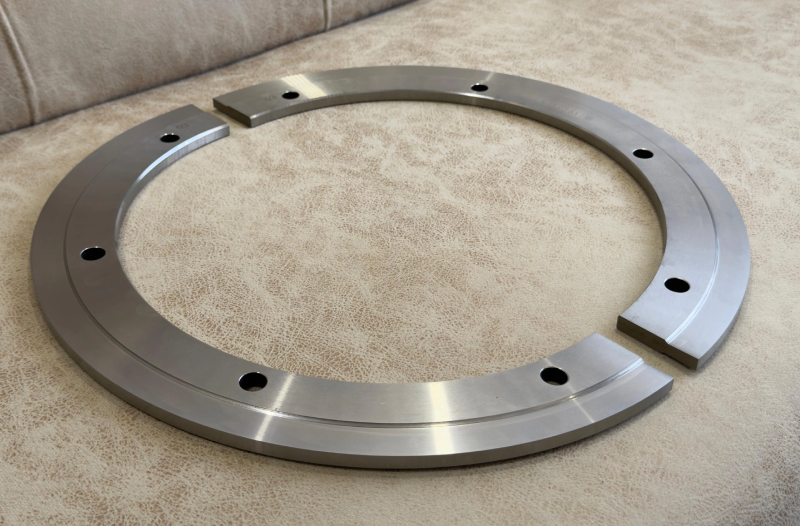
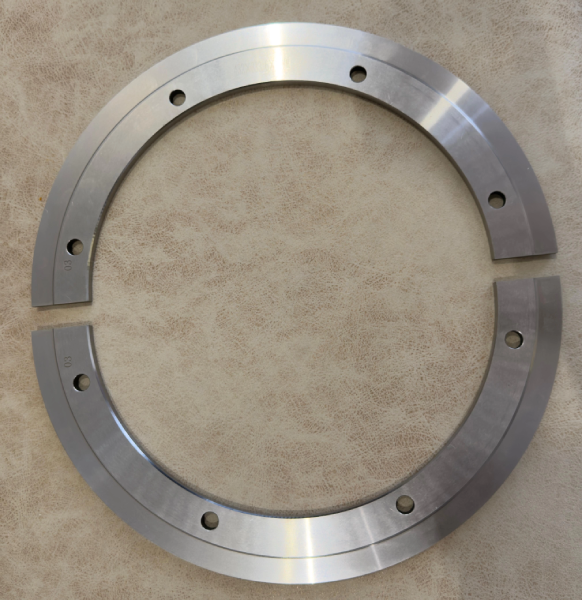
A bi-parted slitter knife, also called a split, two-piece or segmented knife, is a circular slitting knife made in two matched halves rather than a single solid ring. The halves are machined together, then bolted around the shaft to form one continuous cutting circle. Because the knife does not have to be threaded over the end of the arbor, it can be lifted off and refitted exactly where it sits in the stack.
The halves are match-marked (you can see the paired “08” stamps in the photograph above) so the correct pieces always run together. That marking is not cosmetic. The two halves are finish-ground as one assembly, so the running edge stays true only when each half is paired with its partner.
The hidden cost of a one-piece ring
Picture a wide slitting line set up with a dozen knives, spacers and separators stacked along the arbor. One position chips or wears. On a solid knife, that single fault cannot be reached without dismantling everything outboard of it: each knife, each spacer, each separator comes off, the faulty ring is replaced, and the whole stack is rebuilt and re-shimmed to bring clearances back. On a heavily loaded line that is not minutes. It is hours, and they are hours of a line not producing.
Now multiply that by how often it happens. A line running abrasive or hard material, or one that changes width frequently, pays that penalty again and again. The knife was cheap. The stoppage was not.
How the split design removes the penalty
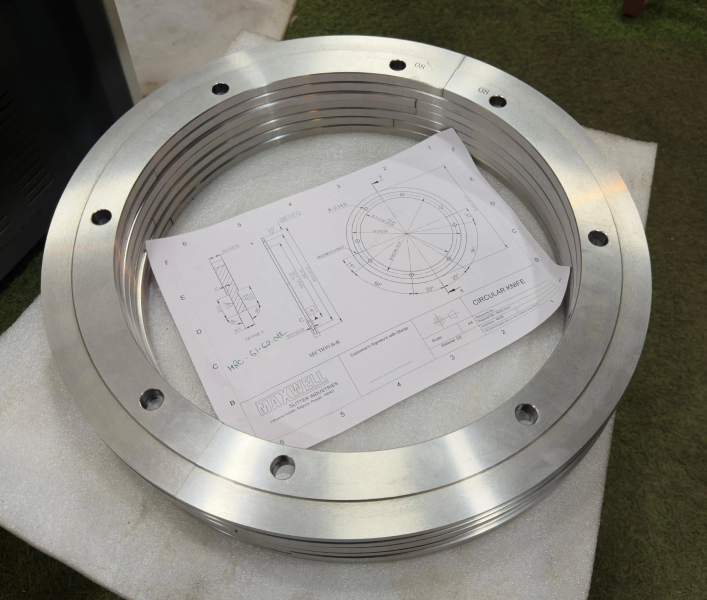
A bi-parted knife turns that strip-down into a swap. The two halves unbolt, the worn ring lifts away on its own, a fresh one bolts into the same place, and the surrounding tooling is never disturbed. Clearances across the rest of the set stay exactly where they were. What was a planned shutdown becomes a short pause.
This is the whole economic argument for the design, and it is worth stating plainly: the saving is not in the knife, it is in the changeover. The bigger and busier the line, the larger that saving becomes.
When does a two-piece knife pay for itself?
A split knife costs more to make than a solid one, because it is two matched, separately machined and jointed pieces instead of a single ring. So the honest question is not whether it is better, it is when it is worth it. Four conditions tip the balance:
- Large or heavy rings. Above roughly 300 to 400 mm, a solid knife becomes awkward and slow to handle on and off the arbor. A split knife is handled in halves.
- Frequent changes. If a position is changed often, through wear or through width changes, the time saved per change adds up quickly.
- High downtime cost. The more a stopped line costs you per hour, the faster a quicker changeover repays the higher knife price.
- Hard-to-reach positions. Knives buried deep in a long stack are the most expensive to reach on a solid set, and the biggest beneficiaries of a split design.
If none of these apply, that is, light, small, infrequently changed positions, a solid knife is usually the better value. A good supplier will tell you that, rather than sell you complexity you do not need.
| Consideration | Solid (one-piece) knife | Split (bi-parted) knife |
|---|---|---|
| Changing one position | Strip down the arbor to reach it | Unbolt and swap it in place |
| Rest of the knife set | Clearances reset across the stack | Left undisturbed |
| Best ring size | Small to medium | Medium, large and heavy |
| Best for | Light, infrequent changes | Frequent changes, high-value lines |
| Unit price | Lower | Higher |
| What really drives cost | Downtime to change it | Less downtime to change it |
What about cut quality? The question buyers actually ask
The most common hesitation about a two-piece knife is whether the joint affects the cut. It is a fair question, and the answer is that, made properly, it does not. The reason is in how it is made. The halves are bolted and then finish-ground as a single assembly, so the outer cutting circle is continuous to the same tolerance as a solid knife. The joint runs radially across the face between the bolt positions, not as a gap at the cutting edge. Tight jointing, matched grinding and match-marked pairs are exactly what keep the running edge clean.
This is also the clearest reason the maker matters. A poorly jointed or separately ground split knife can leave a periodic witness mark on the strip; a properly manufactured one will not. The design is only ever as good as the grinding behind it.
Materials, hardness and tolerance
A bi-parted knife is specified the same way as any quality slitter knife, by matching the steel and hardness to the work:
- D2 cold-work tool steel for general hot-rolled, cold-rolled and galvanised coil slitting.
- HSS M2 and M35 for stainless, silicon and high-speed lines.
- Powder grades such as PM ASP 2030 for premium, long-life applications.
- H11 and H13 where impact toughness matters more than peak hardness, as in hot-rolled and side-trim work.
Maxwell hardens these in-house by vacuum, with multi-stage tempering for uniform hardness through the section, then grinds and laps to a 0.2 Ra finish and a thickness tolerance of ±0.0015 mm. Every knife is inspected and supplied with material, hardness and dimensional certificates, and the halves are match-marked as a set.
How to specify yours so the quote is right first time
The fastest route to an accurate quotation is a drawing, a DXF, or an old worn knife. If you are starting from scratch, five details cover almost everything:
- The material and the thickness you are slitting.
- The required slit width and the acceptable edge tolerance.
- Your arbor outer diameter, inner diameter and thickness, plus the bolt pattern.
- Line speed and the number of cuts per shift, if known.
- The failure you want to eliminate: chipping, burr, edge wear or dishing.
With that, the right grade, geometry and split configuration can be confirmed in a single exchange.
In short
A bi-parted slitter knife does not cut better than a good solid knife. It changes faster. On large, heavy or frequently re-tooled coil lines, where every hour of downtime has a number attached to it, that is usually the more valuable property. On light, simple lines it is not. Choosing well means being honest about which line you are running.
Talk to Maxwell about your line
Send us a drawing, a DXF or a worn knife, and we will recommend a grade, a split configuration and a price, usually within one working day. Rotary slitter knives, shear blades and separator discs, in split and solid designs, made to drawing and exported to more than 30 countries since 1976.
Frequently Asked Questions
A bi-parted (split) slitter knife is a circular slitter knife manufactured in two matching halves that bolt together around the shaft instead of being made as a single solid ring. Once assembled and ground, it performs like a one-piece knife while allowing installation and removal without threading it over the end of the arbor. The terms split, two-piece, 2-piece, and bi-parted refer to the same design.
Split slitter knives reduce changeover time. A solid knife located within a loaded arbor requires removal of all knives and spacers positioned outside it. A split knife can be unbolted and removed independently, allowing quick replacement while the remaining setup stays intact. This significantly reduces downtime on busy production lines.
Yes. When manufactured correctly, the two halves are bolted together and finish-ground as a single assembly. This creates a continuous cutting edge with tolerances comparable to a solid knife. The joint is positioned across the face rather than the cutting edge, ensuring clean cuts when properly matched and ground.
Choose a split slitter knife when the knife is large or heavy, when frequent replacements are required, or when downtime is costly. Choose a solid slitter knife for smaller, lighter, and infrequently changed positions where lower cost is a priority. Many operations use a combination of both depending on accessibility and maintenance needs.
Yes, if it is a split or bi-parted slitter knife. The two halves can be unbolted and removed from the arbor without disturbing adjacent knives, spacers, or separators. A solid knife requires dismantling the stack to access and replace the worn component.
Slitter knives are commonly manufactured from hardened tool steels such as D2, HSS M2, M35, powder metallurgy grades like PM ASP 2030, and toughness-focused grades such as H11 and H13. Tungsten carbide is also used for highly abrasive materials and high-volume production applications.
The lifespan of a slitter knife before regrinding depends on factors such as material type, strip gauge, line speed, and edge geometry. Consistent hardness and precise edge quality help extend service life and increase the number of regrinds a knife can withstand. Split and solid slitter knives are reground using the same process.
Yes. Split slitter knives can be manufactured from customer drawings, DXF files, worn samples, or machine specifications. Custom knives can be produced in D2, HSS, and powder metallurgy steels with precise tolerances, matched sets, and supporting material, hardness, and dimensional certifications.