
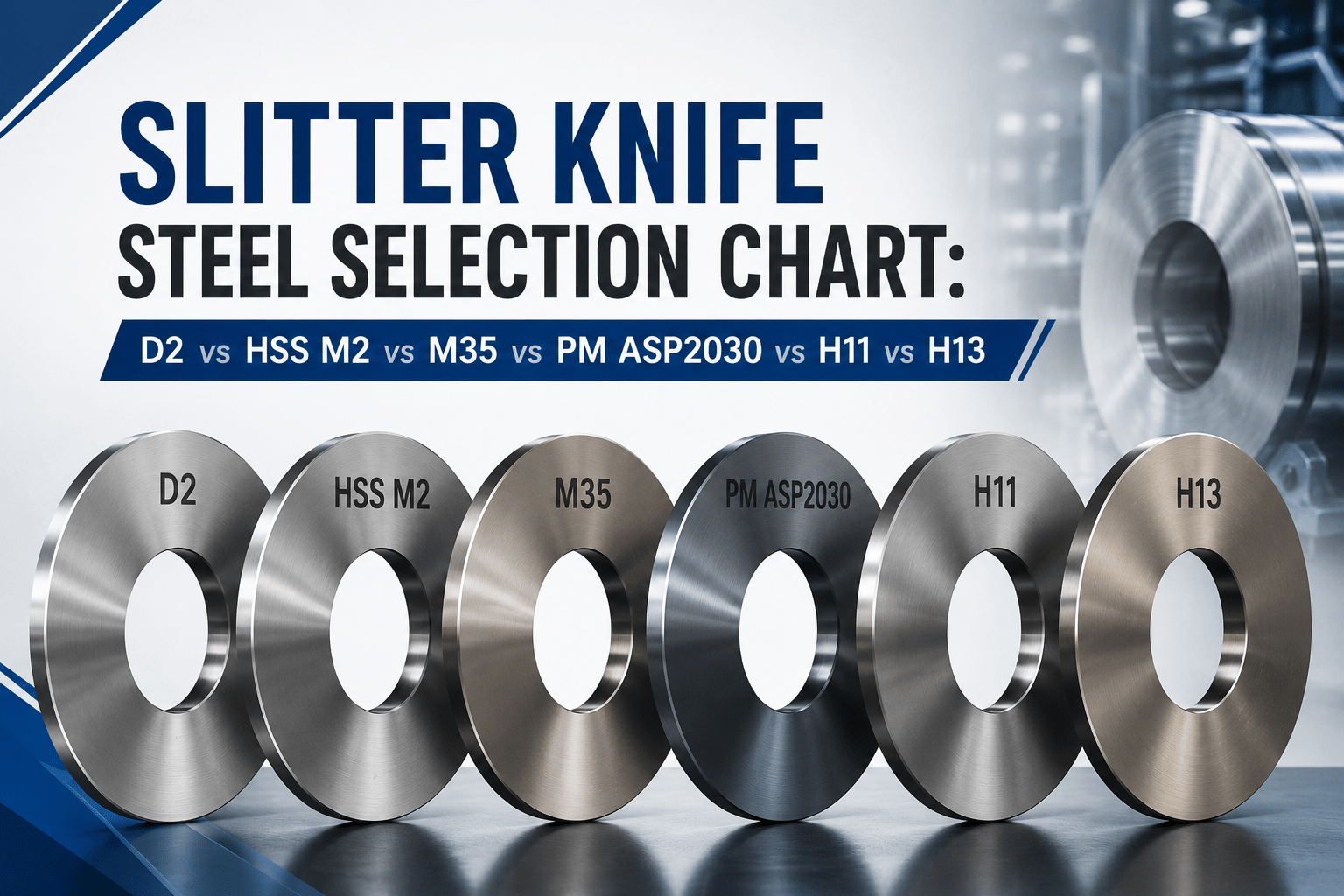
Cutting tool performance often fails long before the machine itself. Premature edge wear, chipping, cracking, and loss of dimensional accuracy are common failure modes that reduce productivity, increase tooling costs, and cause unplanned downtime. Choosing the right tool steel grade is one of the most effective ways to improve cutting performance and extend blade life. In this article, we will compare D2, HSS M2, M35, PM ASP2030, H11, and H13 steels, explain where each one performs best, and help you choose the right material for your slitting application.
Slitter Knife Steel Comparison Table
| Grade | HRC | Wear Resistance | Toughness | Best For |
| D2 | 60–62 | High | Medium | Paper, board, film, light gauge materials |
| HSS M2 | 62–64 | High | Medium–High | Mild steel, galvanised steel, coated materials |
| HSS M35 | 63–65 | Very High | Medium–High | Stainless steel, HSLA steel, high-strength materials |
| PM ASP2030 | 64–66 | Very High | High | Electrical steel, battery foil, abrasive stock |
| H11/H13 | 50–55 | Medium | Very High | Heavy gauge materials, interrupted cuts |
D2 Steel: A Reliable Choice for General Slitting
D2 remains one of the most widely used options in Slitter knife steel selection because it offers a strong balance between wear resistance and cost. Its high carbon and chromium content helps the edge stay sharp for long production runs. Many manufacturers choose D2 when they need dependable performance without moving to premium powder metallurgy grades.
Here is where D2 performs best:
- Excellent wear resistance for long cutting cycles
- Good dimensional stability after heat treatment
- Suitable for paper, plastic, rubber, and light-gauge steel
- Lower cost than powder metallurgy steels
- Easy to regrind and maintain
D2 performs well in dry cutting conditions where abrasion is the main concern. It is less suitable for heavy impact loads because it can chip under excessive shock. For many converting lines, however, it offers an excellent balance between performance and operating cost.
HSS M2 Steel: Built for High-Speed Production
HSS M2 is a common slitter knife material used in demanding production environments. It keeps its hardness even when cutting generates significant heat. That makes it a dependable option for continuous production where blade temperature rises during long operating hours.
Here’s why manufacturers often choose HSS M2:
- Excellent hot hardness
- Better toughness than D2
- Strong wear resistance during continuous cutting
- Suitable for stainless steel and coated materials
- Longer intervals between sharpening
Manufacturers using Maxwell Slitters often select HSS M2 for applications where production speed is as important as blade life. The steel maintains a clean cutting edge over extended production cycles, helping reduce burr formation, and this improves finished product quality while lowering maintenance frequency.
M35 Steel: Higher Hardness with Added Cobalt
M35 builds on M2 by adding approximately 5% cobalt, which improves heat resistance and hardness. This extra alloy content makes it suitable for demanding cutting jobs where ordinary high-speed steel reaches its limits, and it also performs well when cutting materials that generate higher friction.
The following advantages make M35 popular:
- Higher red hardness than M2
- Better resistance to edge softening
- Improved wear life
- Suitable for high-strength stainless steel
- Consistent cutting accuracy during long production runs
When selecting a Slitter Knife Material for difficult alloys, M35 often provides a practical balance between premium performance and cost. It offers a longer service life than standard HSS without the investment required for powder-metallurgy grades, making it a strong choice for manufacturers processing hard metals every day.
PM ASP2030 Steel: Premium Performance for High-Volume Precision
PM ASP2030 is a powder metallurgy steel designed for demanding industrial cutting. Its manufacturing process produces a fine, uniform carbide structure that improves wear resistance and edge stability. This makes it a preferred option for production lines where precision and long tool life are priorities.
Here’s where PM ASP2030 delivers its biggest advantages:
- Outstanding wear resistance for extended production runs
- Excellent edge retention with minimal chipping
- High compressive strength under heavy cutting loads
- Suitable for battery foils, electrical steel, and precision strip materials
- Longer service intervals compared to conventional tool steels
Powder metallurgy steel also provides more predictable performance because the carbide distribution is uniform throughout the blade. That consistency helps maintain cleaner cuts across long production cycles. Many manufacturers choose Maxwell Slitters when specifying premium slitting solutions that require advanced powder metallurgy grades for demanding applications.
H11 Steel: Built for Toughness and Heavy Impact
H11 is designed for applications where impact resistance matters more than maximum wear resistance. It absorbs shock well and reduces the risk of cracking during demanding cutting operations. This makes it a dependable option for thick materials and heavy-duty industrial processing.
The following characteristics make H11 suitable for demanding environments:
- Excellent toughness under impact loads
- Good resistance to thermal cracking
- Stable performance during repeated stress cycles
- Suitable for thick metal coils and heavy-gauge materials
- Easy to machine and heat treat
H11 may require sharpening sooner than high-wear steels such as D2 or M35, but it performs better when cutting conditions involve repeated impact. Its ability to resist cracking often results in lower replacement costs over time. For operations that prioritize durability over maximum edge life, H11 remains a practical choice.
H13 Steel: Reliable Performance Under High Heat
H13 shares many characteristics with H11 but offers better resistance to heat during continuous production. It maintains hardness at elevated temperatures and performs well where friction creates constant thermal stress. That makes it suitable for demanding industrial slitting applications involving high operating temperatures.
The key strengths of H13 include:
- Excellent hot hardness
- High resistance to thermal fatigue
- Strong toughness under continuous operation
- Good dimensional stability after heat treatment
- Suitable for hot-working and high-temperature cutting applications
H13 is commonly selected when cutting conditions combine heat and long production hours. Although it does not match powder metallurgy steels for wear resistance, it provides dependable performance where thermal stability is the primary requirement. This balance makes it a trusted material for many industrial slitting operations.
How to Make the Right Slitter Knife Steel Selection
The best slitter knife steel selection depends on your production goals rather than selecting the hardest steel available. You should consider the material being cut and maintenance schedule before choosing a blade material. Also, matching the steel grade to your application helps reduce downtime while improving cut quality and tool life.
As a general guide:
- Choose D2 for general-purpose converting and moderate wear applications.
- Select HSS M2 for high-speed production and continuous cutting.
- Use M35 when cutting harder alloys that generate more heat.
- Pick PM ASP2030 for premium precision, maximum wear resistance, and high-volume production.
- Choose H11 when impact resistance is the top priority.
- Select H13 for applications involving continuous heat and thermal stress.
Every production line has different requirements, so there is no single steel that fits every application. Reviewing cutting conditions before selecting a blade helps improve productivity and lowers long-term operating costs. Working with Maxwell Slitters can help you choose the right steel grade for consistent cutting performance.
Tips to Extend Slitter Knife Life
The service life of a slitter knife depends on more than the steel grade. Proper handling, regular maintenance, and correct machine settings all help maintain cutting performance and reduce replacement costs. Following a few simple practices can also improve cut quality and minimize unexpected downtime.
Here are some practical ways to extend the life of your slitter knives:
- Regrind blades before heavy edge wear develops. Early regrinding restores the cutting edge with less material removal, helping extend the knife’s overall service life.
- Maintain the correct knife overlap and clearance. Proper setup reduces unnecessary stress on the cutting edge and produces cleaner cuts.
- Keep blades clean during operation. Remove adhesive, dust, and material buildup regularly to prevent uneven wear and maintain cutting accuracy.
- Inspect blades for burrs and edge damage. Routine inspections allow you to address minor issues before they affect product quality or cause blade failure.
- Store knives in a clean, dry environment. Proper storage helps prevent corrosion, accidental edge damage, and contamination when the knives are not in use.
Regular maintenance improves the performance of any slitter knife material, regardless of the steel grade. Combining the right maintenance practices with proper slitter knife steel selection helps maximize blade life, improve cut consistency, and reduce long-term operating costs.
Conclusion
Selecting the right slitter knife material is an important step in improving cutting accuracy and extending blade life. Each steel grade offers different advantages, from the wear resistance of D2 and M35 to the high-temperature performance of H13 and the premium edge retention of PM ASP2030. Understanding your production materials and maintenance requirements will help you make a more informed selection of slitter knife steel.
While steel grade plays a major role, factors such as heat treatment and regular maintenance also influence long-term performance and evaluating all of these factors together helps achieve consistent cutting results and lower operating costs. Maxwell Slitters manufactures industrial slitter knives in multiple tool steel grades to suit different slitting applications.
Frequently Asked Questions
The best steel depends on your application. D2 works well for general-purpose cutting, while PM ASP2030 offers the longest wear life for precision and high-volume production.
D2 provides excellent wear resistance at a lower cost, while HSS M2 offers better toughness and maintains hardness at higher operating temperatures.
M35 is a better choice when cutting hard alloys or stainless steel because its cobalt content improves heat resistance and edge retention.
Among the steels compared, PM ASP2030 generally provides the longest service life because of its powder metallurgy structure, which offers exceptional wear resistance and edge stability.