
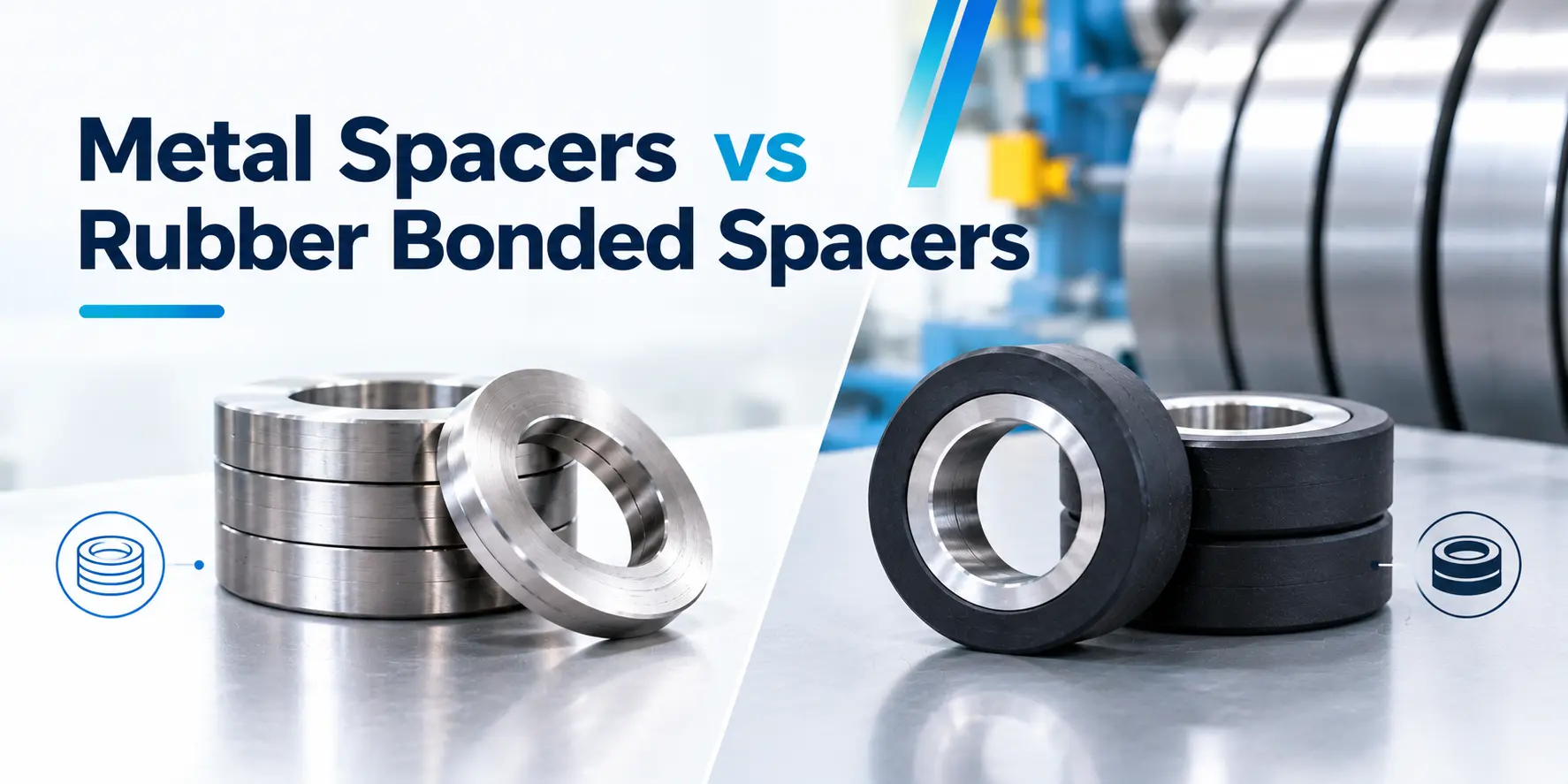
You’re setting up an arbor for a new slit pattern. The knives are ready, and the clearances are calculated. But the spacer stack is where a lot of operators pause and ask the same question: metal or rubber bonded? Both sit on the same arbor. Both look similar from a distance. But they do different jobs, and picking the wrong one, or the wrong mix, shows up later as width variation, surface scratches, or knife wobble. This guide breaks down what each spacer type actually does, so your next arbor setup gets it right the first time.
What Are Metal Spacers?
Metal spacers are rigid steel rings placed between slitter knives on the arbor. Their job is simple: hold a fixed lateral distance between knives so the slit width comes out exact, every time.
They don’t touch the strip surface directly in most setups. Their role is purely dimensional. Stack the right thickness combination on the arbor, and the knife positions follow.
Precision metal spacers are usually made from hardened alloy tool steel with stainless steel characteristics. At Maxwell, our metal spacers are manufactured from EN 31 and EN 19 grades, available in thicknesses from 3mm to 100mm, ground and lapped to a tolerance of up to ±0.0005mm.
Key characteristics of metal spacers:
- Rigid, non-deforming construction
- Set exact lateral knife spacing.
- Available in a wide range of thicknesses for custom stack combinations
- Lapped and polished lateral surfaces for flush contact
- Long service life with minimal wear under normal load
What Are Rubber Bonded Spacers?
Rubber bonded spacers look similar at first glance, but they carry out a completely different function. They consist of a hardened steel core, usually EN31 or EN8, with a synthetic rubber layer vulcanized onto the outer surface.
Unlike metal spacers, rubber bonded spacers make direct contact with the strip. As the strip travels through the knife assembly, the rubber layer strips the material off the blade face, absorbs vibration from the rotating arbor, and applies steady lateral pressure to keep the strip tracking straight.
This rubber layer typically falls between 75 and 85 Shore A hardness for standard steel slitting, with tighter builds manufactured to a tolerance of around ±0.001mm.
Key characteristics of rubber bonded spacers:
- Steel core for dimensional stability, rubber layer for flexibility
- Direct contact with the strip surface
- Absorbs vibration and reduces chatter marks at high speed
- Helps strip release cleanly from the knife after the cut
- Available in different rubber compounds (nitrile, polyurethane) for different materials
Metal Spacers vs Rubber Bonded Spacers: Key Differences
Here’s a side-by-side look at metal spacers vs rubber-bonded spacers and how the two compare on the points that matter most to slitting line operators.
| Factor | Metal Spacers | Rubber-Bonded Spacers |
| Primary function | Set exact lateral distance between knives | Strip separation, vibration damping, strip guidance |
| Contact with strip | Minimal to none | Direct contact with strip surface |
| Material | EN 31, EN 19 alloy tool steel | Steel core (EN31/EN8) with bonded rubber layer |
| Flexibility | Rigid, no deformation | Controlled flexibility from rubber layer |
| Thickness range | 3mm to 100mm | Varies by design and application |
| Typical tolerance | Up to ±0.0005mm | Around ±0.001mm |
| Vibration control | None | Absorbs harmonic vibration at high speed |
| Wear pattern | Slow wear, mostly dimensional over time | Rubber compression, glazing, and cracking over time |
| Common use case | Precise width setting on the arbor | High-speed lines, thin strip, surface-sensitive materials |
EN31 vs EN19: Steel Grades Used in Precision Metal Spacers
The steel grade used in a metal spacer has a direct effect on how it performs under repeated arbor assembly and cutting loads.
EN31 is a high-carbon chromium steel, equivalent to AISI 52100 and DIN 100Cr6. According to West Yorkshire Steel’s technical specification for EN31, the grade is supplied in the annealed, machinable condition and, once heat-treated, delivers high hardness along with strong compressive strength and abrasion resistance. This makes it a common choice for components that face constant friction and load, including bearings, gauges, and precision spacers.
EN19 is a chromium-molybdenum alloy steel, equivalent to AISI 4140. Per Smith Metal’s EN19 datasheet, the grade combines good ductility with shock resistance and suits high-loading applications, while still being easy to machine to close tolerances. This makes EN19 well suited to spacers that need to hold their shape under repeated mechanical handling, not just static load.
Maxwell manufactures its metal spacers from both EN 31 and EN 19, choosing the grade based on the thickness, application, and expected handling conditions on your line. Neither grade is universally “better.” EN31 tends to suit high-hardness, wear-focused applications. EN19 tends to suit spacers exposed to more mechanical stress during handling and assembly.
When to Use Metal Spacers
Metal spacers are the right choice when your priority is exact, repeatable knife spacing. Reach for metal spacers when:
- You need a precise, fixed slit width across a production run.
- The material being cut doesn’t require additional surface protection from the tooling stack.
- You’re building a custom stack combination using multiple thicknesses.
- The line runs at moderate speed where vibration isn’t a major factor.
- You need long-term dimensional stability with minimal maintenance.
When to Use Rubber Bonded Spacers
Rubber bonded spacers earn their place when strip quality and line stability depend on more than just spacing. Use rubber bonded spacers when:
- You’re slitting bright-finish, cold-rolled, or coated material where surface scratching is a concern.
- The line runs at high speed and chatter marks have shown up on strip edges.
- Strip drag or lateral shifting has caused width variation that isn’t traced to knife setup.
- You need the strip to release cleanly from the knife face after each cut.
- You’re processing stainless steel or high-tensile material, where polyurethane rubber compounds hold up better than standard nitrile.
Can You Use Both Together?
Yes, and on most production slitting lines, that’s exactly how the arbor is built. Metal spacers and rubber bonded spacers aren’t competing products. They work together as part of the same tooling stack, each handling a different part of the job.
Metal spacers set the geometry. Rubber-bonded spacers manage what happens where the strip actually meets the tooling. A stack that leans too heavily on one or the other usually shows the gap somewhere: either in width accuracy or in surface and edge quality.
How to Choose the Right Spacer Type for Your Slitting Line
Before finalizing your arbor setup, run through these checks:
- Identify your priority: width precision, surface protection, or vibration control.
- Check your line speed. Higher speeds increase the need for rubber-bonded spacers.
- Review the material finish. Bright, coated, or polished surfaces need rubber contact points.
- Confirm your required tolerance and match it to the spacer’s manufactured tolerance.
- Match the rubber compound (nitrile or polyurethane) to the strip material.
- Inspect existing spacers for wear before assuming a new spacer type is needed.
- Work with a tooling supplier who can advise on combined stack design, not just individual parts.
Getting this combination right at the design stage saves far more time than troubleshooting width or surface issues after production has already started.
Frequently Asked Questions
Metal spacers are rigid components that set the exact lateral distance between slitter knives. Rubber bonded spacers have a steel core with a bonded rubber outer layer, and they make direct contact with the strip to control vibration, strip separation, and surface protection.
No. They serve different functions. Metal spacers control spacing, while rubber bonded spacers manage strip contact and vibration. Most slitting lines use both types together as part of the same arbor stack.
EN 31 and EN 19 are commonly used grades. EN31 offers high hardness and abrasion resistance after heat treatment, while EN19 offers strength and shock resistance with good machinability.
High-quality metal spacers are typically ground and lapped to tolerances as tight as ±0.0005mm, which is important for maintaining consistent slit width across a production run.
Yes, generally. Rubber compounds compress, glaze, or crack over time with repeated contact and load, while metal spacers wear much more slowly since they’re not in constant direct contact with the strip.
Rubber bonded spacers are usually more important at higher speeds, since they absorb harmonic vibration that can otherwise cause chatter marks on the strip edge. Metal spacers still handle the spacing role in the same setup.
It depends on your material, line speed, required tolerance, and surface finish requirements. A tooling supplier familiar with your specific line setup, like Maxwell, can help design the right spacer combination for consistent output.
Metal spacers and rubber-bonded spacers aren’t a choice between one or the other. They’re two parts of the same system, and getting the combination right is what keeps strip width consistent and surface quality clean, run after run. If you’re setting up a new arbor or troubleshooting recurring width or surface issues, Maxwell manufactures both precision metal spacers and rubber-bonded spacers designed to work together across your slitting line.