
Shear Blades: Guillotine, CTL & Scrap Shear Knives, Custom Made
Precision ground machine shear blades engineered for hydraulic guillotine shears, cut to length lines, and heavy duty metal shearing. Manufactured to ±0.01 mm tolerance, vacuum hardened to 58 to 62 HRC, and shipped to 30+ countries since 1976
▶ Up to 6000 mm single piece
▶ 2 hour technical response
▶ 4 Week Lead, 2 Week Rush Available
▶ Mill test reports on request
▶ Re-grinding service available
▶ OEM and aftermarket replacements
50
YEARS OF MANUFACTURING
30+
COUNTRIES SERVED
500+
CUSTOM BLADE PROFILES
6000mm
MAXIMUM SINGLE PIECE
PRODUCT OVERVIEW
What Are Shear Blades?
Shearing blades, also called guillotine shear knives or machine shear blades, are precision ground cutting tools used in guillotine and shear cutting machines for straight line cutting of metal sheets, plates, coils, and other materials. These blades are engineered to provide accurate cuts across a wide range of materials including mild steel, stainless steel, aluminium, silicon steel, rubber, paper, and plastic
Maxwell has manufactured shear blades since 1976. Every blade is CNC ground to ±0.01 mm tolerance and vacuum heat treated to 58 to 62 HRC. With advanced manufacturing techniques and in-house heat treatment, our shearing blades maintain sharpness and durability across millions of cuts, meeting the rigorous demands of industrial applications.
Whether you are running a steel service centre, a coil cut to length line, or a structural fabrication plant, Maxwell delivers shear blades built to outlast generic alternatives and reduce your cost per tonne cut.
| Product Code | MXS 03 |
| Material Grade | D2 / D3 / H13 / H11 |
| Hardness | 58 to 62 HRC |
| Heat Treatment | Vacuum Hardened |
| Edge Options | Single, 2-Edge, 4-Edge |
| Max Length | 6000 mm single piece |
| Tolerance | ±0.01 mm |
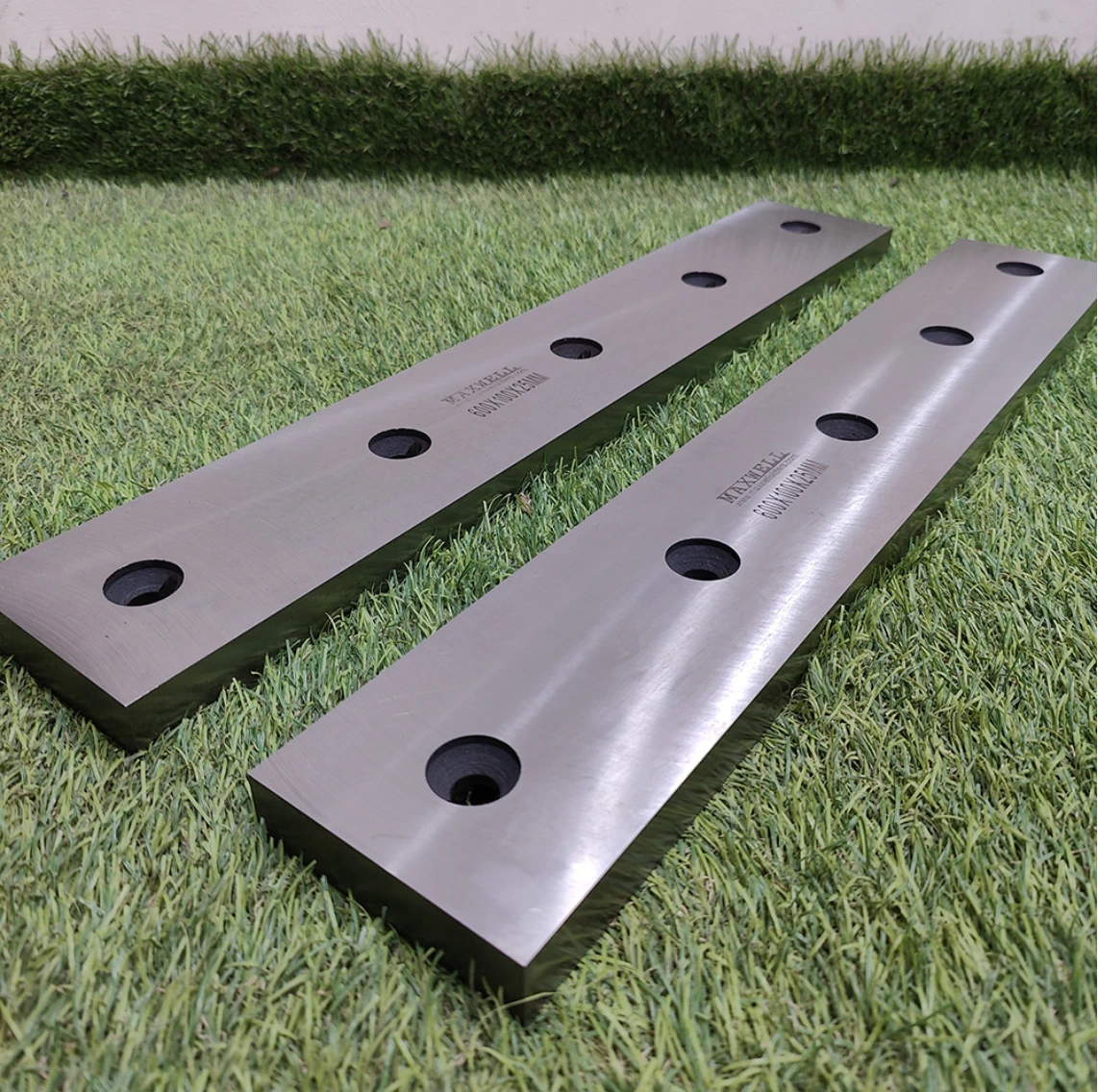
| Hole Pattern | Round, Slotted, Custom |
| Custom Orders | Drawing or Sample |
PRODUCT RANGE
Types of Shear Blades
Maxwell Slitter Industries offers a wide range of shearing blades in three core configurations. Each is built to match a specific
cutting line or shearing application. All types are available in D2, D3, H13, and H11 grades.
TYPE 01 · FLAT
Flat & Straight Shear Blades
Ideal for cutting metal sheets, plates, and coils with precision and smoothness. Available in single, two-edge, and four-edge configurations for hydraulic and mechanical guillotine shears, press brakes, and CTL exit shears, with rotatable edges to extend service life.
Best for: Sheet metal, CTL lines, blanking lines, and structural plate cutting.
TYPE 02 · SLOTTED
Slotted-Hole Shear Blades
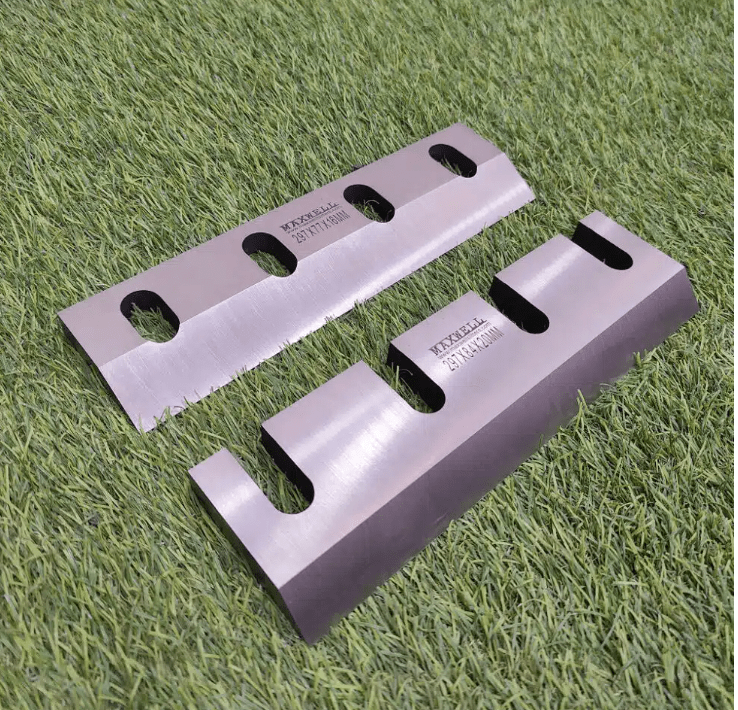
Oval bolt holes allow ±5 mm adjustment for quick changeovers and precise blade alignment after re-grinding, with anti-loosening hardware included for heavy-duty shearing applications in steel mills, recycling plants, and processing plants.
Best for: Scrap shears, alligator machines, recycling plants, and press shops.
TYPE 03 · CUSTOM
Custom & OEM Replacement Shear Blades
Any length up to 6000 mm with custom hole patterns, bevel angles, or stepped profiles. Includes circular saw knives for slicing and cutting in metal processing and paper production, along with horizontal shear knives for heavy-duty steel mill applications. Obsolete blades can be reverse engineered from samples or drawings.
Best for: OEM replacements, legacy machines, and custom shearing applications.
TECHNICAL REFERENCE
Shear Blade Anatomy and Clearance Guide
The seven dimensions every plant engineer and purchase manager should specify before placing an order. Use this as a quick reference when sharing requirements with our team.
| Dimension | Range | Notes |
|---|---|---|
| Length (L) | 100 to 6000 mm | Single piece |
| Width (W) | 30 to 300 mm | Per machine |
| Thickness (T) | 10 to 100 mm | Per machine |
| Bevel Angle (α) | 1° to 3° | Standard or custom |
| Clearance (C) | 5 to 15% | Of sheet thickness |
| Hardness | 58 to 62 HRC | After vacuum HT |
| Edge Count | 1, 2, or 4 | Cost saving option |
| Material Thickness (mm) |
Mild Steel Clearance |
Stainless Steel Clearance |
Aluminium Clearance |
|---|---|---|---|
| 0.5 | 3–5% of thickness | 5–7% of thickness | 2–4% of thickness |
| 1 | 4–6% | 6–8% | 3–5% |
| 2 | 5–7% | 7–9% | 4–6% |
| 3 | 5–8% | 8–10% | 5–7% |
| 5 | 6–8% | 8–10% | 5–7% |
| 8 | 6–9% | 9–11% | 6–8% |
| 10 | 7–9% | 9–12% | 6–8% |
| 12 | 7–10% | 10–12% | 7–9% |
| 16 | 8–10% | 10–13% | 7–10% |
| 20 | 8–12% | 11–14% | 8–10% |
| 25 | 10–12% | 12–15% | 8–12% |
What is the correct shear blade clearance?
Clearance equals 5 to 15 percent of material thickness. For 3 mm mild steel, set 0.15 to 0.45 mm. Too little causes blade wear and burrs. Too much causes torn edges. Maxwell engineers recommend the exact clearance for your machine and material on request
ENGINEERING
Key Features of Metal Shear Blades
Six reasons our shear blades outlast generic alternatives. Engineered for plants that count cost per tonne cut, not unit price.
01
Mill-Certified Tool Steel
Manufactured using premium D2, D3, H13, and H11 steel alloys for enhanced strength and longevity, with mill test reports available on request and consistent microstructure maintained batch to batch.
02
Precision Engineering
Advanced CNC surface grinding ensures exact specifications and superior cutting accuracy, with parallelism maintained to ±0.01 mm for proper clearance and burr-free cuts.
03
In-House Vacuum Heat Treatment
Hardened in our own vacuum furnace to a uniform 58 to 62 HRC across the full blade length, ensuring zero decarburisation, zero distortion, and zero outsourced variability.
04
2-Edge and 4-Edge Configurations
Rotate edges instead of replacing blades. Four-edge geometry delivers up to four times the working life of a single-edge blade at only a fraction of the additional cost.
05
Re-Grinding Service
Worn blades are restored to original dimensional tolerances, with both Maxwell and competitor blades accepted for regrinding. Save 40 to 60 percent compared to new blades, with turnaround completed in 5 to 7 working days.
06
Custom Configurations
Available in any size, hole pattern, and design up to 6000 mm in a single piece. From single pairs to full production runs with no minimum order quantity, and engineering responses provided within 2 business hours.
INDUSTRIES
Applications of Shearing Blades
Built for production lines where downtime costs the most. From sheet metal service centres to flying shears in continuous rolling mills, Maxwell shear blades deliver precision cutting where production cannot stop.
01
Metal Processing
Cutting steel sheets, aluminium plates, stainless steel, and other metals for the automotive and construction industries.
02
Cut to Length Lines
Entry and exit shear blades for CTL coil processing lines, delivering precision cutting to programmed lengths in steel service centres.
03
Recycling & Scrap
Alligator shears, crocodile shears, and baling line knives designed for ferrous and non-ferrous scrap metal processing plants.
04
Paper Production
Circular saw knives for trimming and cutting paper rolls into precise sizes for packaging and printing applications.
05
Rubber and Plastic
Efficiently slicing rubber sheets, molded components, plastic films, and other non-metallic sheet materials for converting industries.
06
Structural Steel
Heavy plate shearing, H-beam, and angle iron cutting for structural fabrication plants and steel service centres.
MACHINE COMPATIBILITY
OEM Replacement Blades for Every Major Brand
Share your blade dimensions or machine model number, and we will match the geometry, hole pattern, and material grade exactly for both current and legacy machine lines.
LVD
BELGIUM
Trumpf
GERMANY
Safan Darley
NETHERLANDS
Ursviken
SWEDEN
Adira
PORTUGAL
Haco
BELGIUM
Durma
TURKEY
Amada
JAPAN
Prima Power
FINLAND
+ Any OEM
CUSTOM MATCH
MACHINE COMPATIBILITY
OEM Replacement Blades for Every Major Brand
Share your blade dimensions or machine model number, and we will match the geometry, hole pattern, and material grade exactly for both current and legacy machine lines.
LVD
BELGIUM
Trumpf
GERMANY
Safan Darley
NETHERLANDS
Ursviken
SWEDEN
Adira
PORTUGAL
Haco
BELGIUM
Durma
TURKEY
Amada
JAPAN
Prima Power
FINLAND
+ Any OEM
CUSTOM MATCH
Guillotine Shearing Blades: Essential for Metal working Operations
Share your blade dimensions or machine model number, and we will match the geometry, hole pattern, and material grade exactly for both current and legacy machine lines.
Guillotine shearing blades, also known as shear blades or cut-off blades, are used to cut through sheet metal, plate metal, and other materials with precision and ease. In this article, we will discuss:
- The importance of using high-quality guillotine shearing blades
- The different types available
- How to properly maintain them to extend their lifespan
Why Use High-Quality Guillotine Shearing Blades?
One of the main benefits of using guillotine shearing blades is their ability to produce clean, precise cuts with minimal effort. This is especially important in industries such as automotive manufacturing, where precise cuts are essential for producing parts that meet high standards of quality and safety. Using low-quality shear blades can lead to rough, uneven cuts that may not meet these standards and can even pose a safety hazard.
Types of Guillotine Shearing Blades
There are several types of guillotine shearing blades available, each designed for specific materials and applications:
- High-speed steel (HSS) blades are suitable for cutting through softer materials such as aluminum, brass, and copper.
- Tungsten carbide blades are better suited for cutting through harder materials such as steel and stainless steel.
Proper Maintenance of Guillotine Shearing Blades
Proper maintenance of guillotine shearing blades is essential to extend their lifespan and ensure they continue to produce precise cuts. This includes:
Types of Guillotine Shearing Blades
There are several types of guillotine shearing blades available, each designed for specific materials and applications:
- Regular cleaning and lubrication.
- Sharpening or replacing the blades as needed
It is also important to follow the manufacturer’s recommendations for use and maintenance to ensure optimal performance and extend the life of the blades.
TOTAL COST OF OWNERSHIP
Why Choose Maxwell's Shearing Machine Blades?
Purchase managers calculate cost per tonne cut, not unit price. A blade that costs 20 percent more but lasts three times longer delivers far greater value for your annual spend. Here is the complete cost picture.
2 to 5×
Longer blade life
Mill-certified tool steel and in-house vacuum heat treatment reduce changeovers and minimise line stoppages during every shift.
4×
Life per blade set
Specify 4-edge geometry and rotate the edges as they wear. The same blade body delivers four working lives with a single purchase order.
40-60%
Saved on re-grinding
Send worn blades back for regrinding and restoration to original specifications at a fraction of the cost of new blades, with a turnaround time of just 5 to 7 days.
±0.01mm
Zero scrap from clearance
Tight grinding ensures correct clearance every time, delivering zero burr edges and eliminating rejected sheets caused by poor cuts.
HOW TO ORDER
Four Steps. Engineers Respond in 2 Hours.
No MOQ and no procurement delays. Simply send your dimensions or a sample to receive a technical quote with a dimensional drawing on the same business day.
STEP 01
Share Your Requirement
Send dimensions, a machine model number, or an existing blade sample. Drawings are optional, and engineering responses are provided within 2 business hours.
STEP 02
Receive Technical Quote
Grade recommendations, lead time, pricing, and a dimensional drawing are provided for your approval before production begins.
STEP 03
CNC Production and QC
CNC machined, vacuum heat treated, hardness tested, and dimensionally inspected before dispatch to ensure consistent quality and performance.
STEP 04
Worldwide Delivery
Foam-lined export crates with commercial invoices, packing lists, and material test reports included with every shipment.
Manufacturer and Supplier
Top Shear Blades Manufacturer and Supplier
As a leading manufacturer, exporter, and supplier of shear blades, Maxwell Slitter Industries specializes in high-precision products such as shear knives, shear blades, shearing knives, and circular saw knives. Our solutions serve a wide range of industries, making us a reliable one-stop source for all industrial cutting tool requirements.
Maxwell’s guillotine shearing blades are known for their unmatched quality and performance, ensuring maximum efficiency and productivity in every application. Trusted by industries in over 50 countries, Maxwell delivers superior solutions crafted from premium D2, D3, H13, and H11 tool steels. Each product is backed by strict quality inspections and in-house vacuum heat treatment, offering durable performance, customized designs for specific operational needs, competitive and cost-effective pricing, and expert support from an experienced technical team.
Trust Maxwell Slitter Industries for your industrial cutting tool requirements and experience the difference in quality and service built on 49 years of focused manufacturing excellence.
GET STARTED
Get a quote on shear blades today.
Engineering team responds within 2 business hours. Custom sizes welcome. No MOQ. Worldwide export. Re-grinding service available for Maxwell and competitor blades
Frequently Asked Questions About Shear Blades
What are the uses of shearing blades in metal industries?
Shearing blades are used for straight line cutting of metal sheets, plates, and coils in steel service centres, cut to length lines, structural fabrication plants, automotive component manufacturing, appliance manufacturing, and scrap recycling. They also cut paper, rubber, and plastic in converting industries.
How long do Maxwell shearing blades last?
Blade life depends on the material being cut, sheet thickness, machine condition, and clearance setup. In typical mild steel applications, Maxwell D2 blades deliver 2 to 5 times the life of generic alternatives. With 4-edge geometry, that effective life multiplies again. Send us your application details and we will share realistic life estimates for your line.
What material should I choose for shear blades?
D2 is the standard choice for cold shearing of mild steel, stainless steel, and aluminium. D3 is used for high-wear cold shearing applications. H13 and H11 are hotwork tool steels suitable for hot shearing and applications requiring higher toughness. Our engineers will recommend the right grade once you share the material, thickness, and machine details.
Can I order custom-sized shear blades?
Yes. Maxwell manufactures shear blades from 100 mm up to 6000 mm in a single piece, with any width, thickness, hole pattern, or bevel angle. Send a drawing, an existing blade sample, or just your machine model number, and we will produce an exact replacement. No MOQ.
Can shear blades be sharpened or reconditioned?
Yes. Maxwell offers a re-grinding service that restores worn blades to original dimensional tolerance, typically saving 40 to 60 percent compared to buying new. Turnaround is 5 to 7 working days. We accept Maxwell blades and competitor blades.
Do shear blades require heat treatment?
Yes. Hardness directly determines edge life and resistance to wear. Maxwell vacuum hardens every shear blade in-house to 58 to 62 HRC, with uniform hardness across the full blade length, zero decarburisation, and zero distortion. We never outsource heat treatment.
How much do shear blades cost?
The cost of shear blades depends on several factors rather than a fixed price. The main price drivers include the blade length, tool steel grade (such as D2 or H13), number of cutting edges, and the quantity ordered. Custom dimensions, heat treatment, and special coatings may also influence the final price. Contact us with your machine specifications for an accurate quotation.
What is the difference between D2 and H13 shear blades?
D2 and H13 are both high-quality tool steels but are designed for different applications.
- D2 Shear Blades offer excellent wear resistance and edge retention, making them suitable for high-volume cutting of mild steel and other standard materials.
- H13 Shear Blades provide superior toughness and heat resistance, making them ideal for heavy-duty operations, thicker materials, and applications involving higher temperatures or impact loads.
The right choice depends on the material being cut and the operating conditions.
When should shear blades be reground?
Shear blades should be reground when you notice:
- Poor cut quality or rough edges
- Increased burr formation
- Higher cutting force or machine vibration
- Blade chipping or uneven wear
- Reduced cutting accuracy
Regular regrinding restores the cutting edge, improves cut quality, and extends the overall life of the blade.
What blade clearance should be used for stainless steel vs. mild steel?
Blade clearance varies depending on the material type and thickness. Stainless steel generally requires slightly larger clearances because of its higher strength and lower ductility, while mild steel can be cut with smaller clearances. Proper clearance helps reduce burrs, improve edge quality, and extend blade life. Refer to the clearance table below for general recommendations.
What is the difference between guillotine and swing beam shear blades?
Guillotine shear blades are used in machines with a straight vertical cutting action, providing high precision and excellent cut quality, especially for thicker materials.
Swing beam shear blades are used in machines where the upper blade follows an arc during cutting. These machines are generally simpler, cost-effective, and well suited for light to medium-duty sheet metal cutting.
What machines and brands do your shear blades fit?
Maxwell manufactures OEM-equivalent and custom replacement shear blades for major press brake and guillotine shear brands, including LVD, Trumpf, Safan Darley, Ursviken, Adira, Haco, Durma, Amada, and Prima Power, as well as scrap and recycling shear equipment. If your machine isn’t listed, send us the model number, an existing blade sample, or your dimensional drawing; our engineers will match the geometry, hole pattern, and material grade for current and legacy machine lines, with no minimum order quantity.
What are guillotine shearing blades?
Guillotine shearing blades are industrial cutting tools used in shearing machines to cut sheet metal, plates, and other materials with precision using a straight, downward motion.
How do guillotine shearing blades work?
They operate using a scissor-like action, where an upper blade moves downward against a fixed lower blade, applying shear force to cut material cleanly without heat distortion.
What materials can guillotine shearing blades cut?
These blades can cut:
- Sheet metal and plates
- Aluminum, copper, and brass
- Stainless steel
- Paper, plastic, rubber, and textiles
What are the different types of guillotine shearing blades?
Common types include:
- Straight-edge blades
- Serrated blades
- Toothed or scalloped blades
- Single-edge and double-edge blades
- Custom-profile blades
Why are high-quality guillotine blades important?
High-quality blades ensure clean cuts, minimal burr formation, improved safety, and consistent product quality, especially in industries like automotive and metal processing.
What materials are used to manufacture guillotine shearing blades?
Typical materials include:
- High-speed steel (HSS)
- Tool steel (D2, H13)
- Tungsten carbide
These materials offer high wear resistance and durability.
What industries use guillotine shearing blades?
They are widely used in:
- Metal fabrication
- Automotive manufacturing
- Construction
- Packaging and paper industries
These industries require precise and efficient cutting solutions.
How do guillotine shearing blades improve production efficiency?
They enable:
- High-speed cutting
- Accurate dimensions
- Reduced material waste
- Consistent output quality
What factors affect the performance of guillotine blades?
Key factors include:
- Blade material and hardness
- Blade clearance
- Cutting angle (rake angle)
- Material thickness and type
What is blade clearance in guillotine shearing?
Blade clearance is the gap between upper and lower blades, which directly affects cut quality, burr formation, and cutting force. Proper adjustment is essential for optimal performance.