
Crush Cutting vs Score Slitting: Which One Is Better?
If you have spent any time on a slitting line, you have heard both terms used in the same breath. Your OEM manual calls it “score slitting.” The operator on the next shift calls it “crush cutting.” A supplier quote lists “crush/score knives” as one line item. So which is it, and more importantly, which one actually cuts better for your material?
Here is the short answer that most blogs bury three scrolls deep: in the overwhelming majority of converting applications, crush cutting and score slitting describe the same cutting mechanism. The differences come from industry vocabulary, not from the physics on the shop floor. That said, there are a few genuine nuances in how the two terms get applied, and picking the wrong blade geometry for your substrate is a fast way to kill blade life and generate rejects.
This guide walks through what each term actually means, where they overlap, where they diverge in practice, and how to pick the right setup for paper, foil, nonwovens, adhesive tape, rubber, laminates, and abrasive materials.
Quick Answer: Are Crush Cutting and Score Slitting the Same Thing?
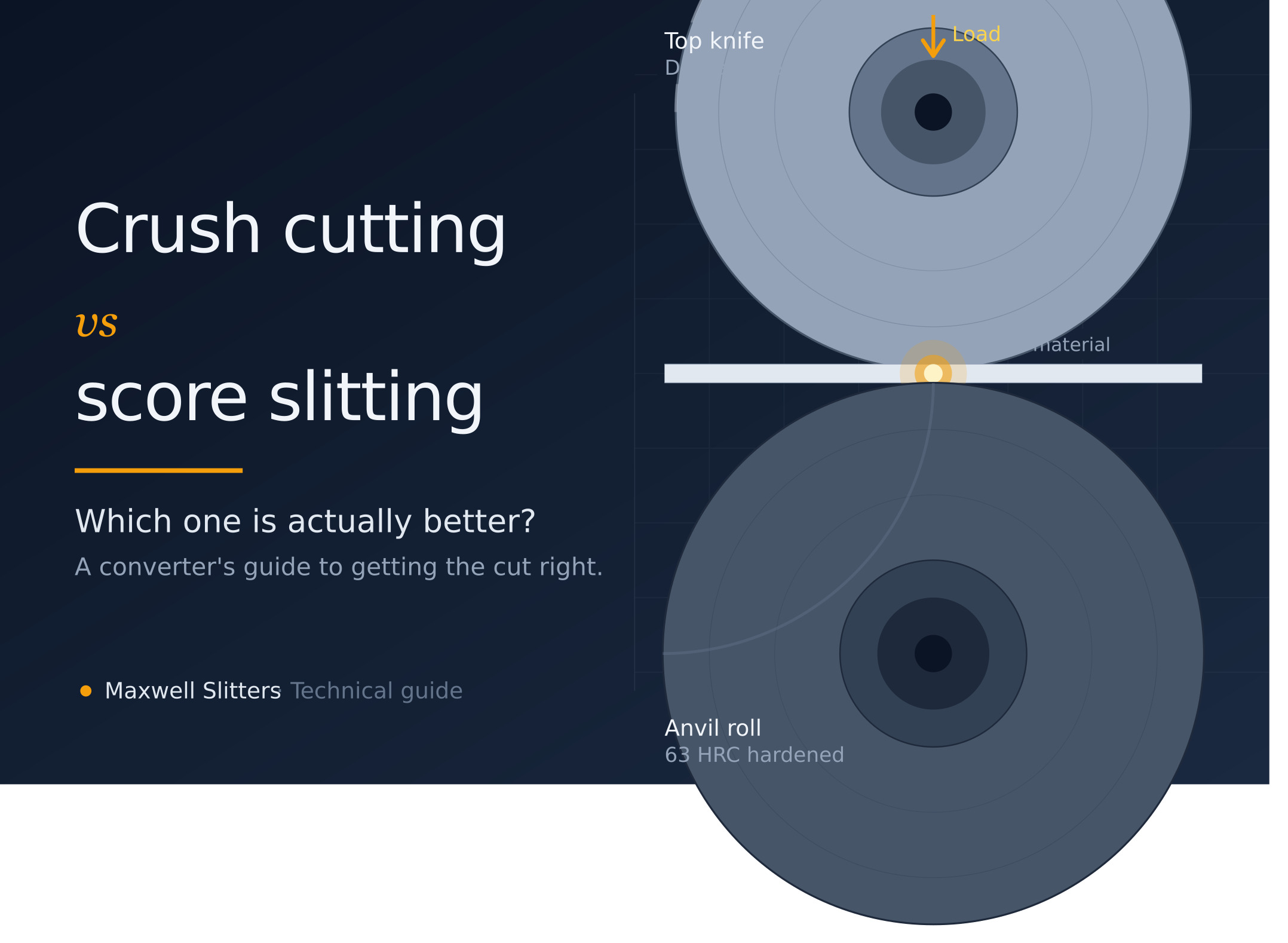
Yes, in most industrial converting contexts, crush cutting and score slitting refer to the same slitting method. Both use a circular knife with a radiused (blunt) edge that is pressed pneumatically against a hardened anvil roll to sever a web of material through compressive force rather than a shearing action. Some OEMs and older industries prefer “score,” others prefer “crush,” and some machines list the tool as a “crush/score knife” to cover both. The vocabulary varies. The cutting principle does not.
Where the terms can diverge is in the depth of penetration: true “scoring” sometimes refers to a partial cut that creates a fold line without severing the web, while “crush cutting” always implies complete separation. That distinction matters on carton and paperboard lines but is rarely relevant on roll-to-roll converting.
What Is Crush Cutting?
Crush cutting is a slitting method where a rotating circular knife with a dulled, radiused cutting edge is loaded pneumatically against a hardened anvil roll. The web material passes through the pinch point between the knife and the anvil, and the compressive force severs the web. Unlike razor or shear slitting, no sharp blade edge slices through the material. The cut happens because the material cannot withstand the concentrated pressure between the knife radius and the anvil surface.
A few things distinguish crush cutting from other methods:
The top knife is not sharp. If the edge were razor sharp, it would chip or deform the moment it contacted the hardened anvil. The edge is deliberately ground to a small radius, typically in the range of 0.10 mm to 0.15 mm (0.004 to 0.006 inch), with bevel angles usually set to 30, 45, or 60 degrees depending on the material. A 45 degree angle with a small radius is the closest thing to a universal starting point.
The anvil roll is harder than the blade. This is the non-negotiable rule of crush cutting. The anvil is typically through-hardened tool steel at 63 to 65 HRC, and it is designed to be reground over its service life. If the blade were harder than the anvil, the anvil would groove and you would be regrinding an expensive roll instead of replacing a consumable knife.
Force is pneumatic. Shop air through a regulator controls the downward load on each knife holder. Too much pressure shortens blade life and can damage the anvil. Too little pressure leaves you with incomplete cuts, skips, or hanging fibers. Most suppliers recommend staying under 6 bar to protect the system.
Crush cutting is the workhorse method for materials where shear slitting struggles: pressure-sensitive adhesives that gum up shear blades, abrasive nonwovens that eat sharp edges, rubbers, foams, laminates, and thick paper grades where edge quality is not the top priority.
What Is Score Slitting?
Score slitting, as the term is used on most slitting lines today, is the same operation as crush cutting. The knife is called a score knife or score blade, the holders are called score cut holders, and the anvil is often called a score anvil or bottom shaft. The word “score” has deeper roots in paper and adhesive tape converting, where engineers described the action as the knife “scoring” the web against a hard surface.
In a narrower sense, “scoring” can also mean creating a partial cut or crease line for a downstream folding operation, as happens on corrugated board and carton lines. This is not the same as slitting, because the material is not fully separated. For the purposes of this article, and for anyone buying circular score knives for a narrow web or metal slitting line, score slitting and crush slitting are functionally identical.
The Key Difference: Vocabulary, Not Mechanics
The honest answer to “crush cutting vs score slitting” comes down to three overlapping variables:
Industry convention. Paper and tape converters historically said “score.” Film and nonwoven converters often say “crush.” Metal slitting engineers tend to stick with “shear” for their primary method and reserve “score” or “crush” for specialty applications. None of these groups is wrong. They are using the vocabulary of their supply chain.
OEM preference. Some knife holder manufacturers brand their product line as score slitters, others as crush cutters, and a few split the line into “score cut” for lighter pressure and “crush cut” for higher pressure applications. When you read your OEM manual, the word choice tells you about the brand, not about a fundamental difference in cutting action.
Cut completeness. The one place where the terms genuinely diverge is depth of cut. A true score, in the paperboard sense, creates a weakening line without severing the web. A crush cut always goes all the way through. If you are buying blades for a converting line that fully separates the web into narrower rolls, you are doing the same thing regardless of which word is printed on your purchase order.
Technical Comparison: Crush Cutting vs Score Slitting at a Glance
| Parameter | Crush Cutting | Score Slitting |
| Cutting Mechanism | Compressive force vs anvil | Compressive force vs anvil |
| Top Knife Edge | Radiused | Radiused |
| Edge Radius | 0.10–0.15 mm | 0.10–0.15 mm |
| Bevel Angles | 30°, 45°, 60° | 30°, 45°, 60° |
| Anvil Hardness | 63–65 HRC | 63–65 HRC |
| Knife Materials | D2, M2 HSS, Carbide | D2, M2 HSS, Carbide |
| Holder Load | Pneumatic | Pneumatic |
| Setup Speed | Fast | Fast |
The table looks identical for a reason: they are usually the same process.
Materials That Belong on a Crush or Score Cut Line
Not every substrate is a candidate for this cutting method. Use crush or score cutting when your material has one or more of these properties:
Pressure-sensitive adhesives that would gum up a shear blade pair and cause buildup between cuts. The dry, blunt action of a crush knife leaves a cleaner edge on sticky substrates than you might expect.
Abrasive webs such as sandpaper, coated abrasives, fiberglass composites, and filled nonwovens. These materials chew through shear blade edges quickly, and the thicker, more supported edge of a score knife lasts longer per unit length.
Thick or compressible materials such as foams, rubbers, gaskets, felts, and heavy laminates. The force required to shear these cleanly is often higher than what a standard shear holder can deliver, but a pneumatic crush holder handles them without complaint.
Tissue, wet-laid nonwovens, and some tape liners, where a true razor or shear cut would tear or distort the edge.
Short-run and mixed-material jobs where quick blade changeovers and easy indexed positioning matter more than an optically perfect edge.
Avoid crush or score cutting when you need mirror-clean edges, extremely tight width tolerances on thin films, minimal dust generation, or when your downstream process is sensitive to fiber shedding. Those jobs belong on a shear slitting line.
Blade Geometry: The Detail That Separates Good Cuts from Bad Ones
Here is where the real answer to “which one is better” lives, regardless of what you call the method. The blade profile you choose drives cut quality, blade life, and anvil wear more than anything else on the line.
Radius. A smaller edge radius (around 0.004 inch) gives you a cleaner cut and less dust, but wears out faster. A larger radius (0.008 inch or more) extends blade life but coarsens the edge and widens the cut kerf. Start in the middle and let empirical testing on your actual substrate guide you.
Bevel angle. A 30 degree angle cuts cleaner but the thin profile is fragile under load. A 60 degree angle supports more force and lasts longer but produces a rougher edge. 45 degrees is the default starting point for most general-purpose applications and the angle we recommend to new customers unless they have a specific reason to deviate.
Blade material. D2 tool steel, vacuum hardened and tempered, is the standard for most converting applications because it balances wear resistance with toughness and holds its geometry through long runs. M2 high speed steel offers better hot hardness and is worth considering on high speed lines. Carbide tipped knives are the right choice for abrasive materials where blade life is the primary cost driver. For most tape, film, and nonwoven applications, a properly heat treated D2 knife is the cost-performance sweet spot.
Pressure. Even the perfect blade geometry fails if the loading is wrong. Incomplete cuts almost always trace back to insufficient air pressure or worn holders that are not delivering consistent force. Excessive pressure grooves the anvil, chips the knife tip, and shortens everything on the line. Keep a calibrated regulator on each bank and check the loading on a fresh setup.
Common Problems on Crush and Score Cutting Lines
Fuzzy or compressed edges. Usually caused by a blade radius that is too large for the substrate, or by running the line above the recommended web tension. Drop to a smaller radius or reduce tension.
Dust accumulation. Crush cutting inherently generates more dust than shear slitting. If dust is interfering with rewinding or downstream processing, consider a blade with a smaller radius, add a localized vacuum pickup at the cut point, or accept that your material may actually need shear slitting instead.
Anvil grooving. The classic sign that operators are running too much air pressure, or that a blade has chipped and is concentrating force on a small contact area. Inspect blades regularly, replace chipped knives immediately, and regrind the anvil on a scheduled cycle rather than waiting for visible damage.
Short blade life. Often the result of an aggressive blade angle on a hard or abrasive substrate. Step up one angle (from 45 to 60 degrees) or consider a carbide tipped option.
Inconsistent cut along the web width. Usually a symptom of uneven loading across the holder bank, a worn anvil with runout, or a bent shaft. A dial indicator run on the anvil will tell you quickly whether the problem is the roll or the holders.
Crush and Score Cutting vs Shear Slitting: When to Switch Methods
If you are weighing crush/score against shear slitting, the decision usually comes down to three factors.
Edge quality is the first. Shear slitting, which uses two overlapping circular blades functioning like scissors, delivers the cleanest edge of any industrial slitting method. If your customer specifies a clean, dust-free edge, or if your downstream process (lamination, printing, coating) is sensitive to edge defects, shear is worth the extra capital and setup time.
Substrate is the second. Tapes, abrasives, rubbers, foams, and laminates run better on crush or score cut lines. Paper, foil, films, and labels where edge quality is critical belong on shear lines.
Setup flexibility is the third. Crush and score cutting wins hands down for fast changeovers and mixed product runs. Shear slitting requires careful top/bottom knife alignment, overlap
adjustment, and cant angle tuning on every setup. If you change widths constantly, score cutting keeps your line moving.
For a fuller breakdown of shear vs crush decisions, see our companion article on shear slitting and bottom knives.
How Maxwell Slitters Approaches Crush and Score Cut Knives
At Maxwell Slitters, we manufacture crush cutter knives, score blades, and COC (crush-on-crush) cutters for converting lines across paper, tape, nonwoven, rubber, film, and metal industries. Our standard program runs vacuum heat treated D2 at 58 to 60 HRC for general converting, M2 HSS for high speed applications, and tungsten carbide tipped blades for abrasive substrates. Edge radius and bevel angle are matched to the customer’s substrate and line speed rather than sold as a generic part number, because we have learned over decades of supplying slitting lines that the difference between a 90 day blade and a 9 day blade is almost always geometry matched to the job, not the steel grade on the spec sheet.
If you are evaluating a new setup, changing substrates, or troubleshooting blade life on an existing line, you can see our full range of crush cutter knives, score blades, and COC cutters here: https://www.maxwellslitters.com/crush-cutter-knives-score-blades-coc-cutters/
The Bottom Line
If someone asks you “crush cutting or score slitting, which one is better?”, the most honest and useful answer is that you are asking about the same method under two different names. Focus the real decision on the variables that actually change your cut quality and blade economics: substrate match, blade radius, bevel angle, steel grade, pneumatic loading, and anvil condition.
Get those right, and your line will run cleanly whether your paperwork calls the tool a crush knife, a score blade, or a COC cutter. Get them wrong, and no amount of terminology fluency will save you from short blade life and edge quality complaints.
If you want a second opinion on your current setup or help specifying blades for a new substrate, reach out to our technical team. We have been building slitting knives since 1976 and would rather help you pick the right blade once than sell you the wrong one three times.
Frequently Asked Questions
In almost every industrial converting context, yes. Both terms describe a circular knife with a radiused edge pressed pneumatically against a hardened anvil roll to sever a web through compressive force. The vocabulary varies by industry (paper and tape converters often say “score,” film and nonwoven converters often say “crush”), but the cutting mechanism is identical. The one exception is carton and paperboard lines where “scoring” can mean a partial cut for folding, which is a different operation from slitting.
Neither is better than the other because they are the same method. The real question is whether crush/score cutting is the right method for your substrate, or whether you should be on a shear slitting line instead. Choose crush/score for tapes, adhesives, foams, rubbers, abrasives, nonwovens, and thick laminates. Choose shear for paper, foil, film, and labels where edge quality is critical.
The default starting point is a 45 degree bevel with a 0.10 to 0.15 mm edge radius. Use a smaller angle (30 degrees) for cleaner edges on thinner materials, and a larger angle (60degrees) for longer blade life on thick or abrasive substrates. Always test on your actual material rather than relying on a generic recommendation.
Vacuum heat treated D2 tool steel is the standard for most converting applications. M2 HSS works well for high speed lines. Carbide tipped blades are the correct choice for abrasive materials such as sandpaper, fiberglass, or filled nonwovens where blade life drives the total cost of ownership.
Because the cutting action is compressive rather than a clean shear, the edge of the slit is deformed slightly and fibers or particles can release as the web separates. This is inherent to the method. If your downstream process cannot tolerate dust, either add local extraction at the cut point or switch to shear slitting.
Yes, but the edge radius and bevel angle have to be restored to the original specification. Hand resharpening rarely hits the tolerances required for consistent cutting. Most serious converters send crush knives back to the manufacturer or a specialist regrinder who can hold the geometry.
It varies by material and holder design, but staying below 6 bar is a safe general limit. Excessive pressure shortens blade and anvil life and can cause premature bearing failure in the knife holder. Start low, work up to the pressure that gives you a consistent cut, and stop there.