
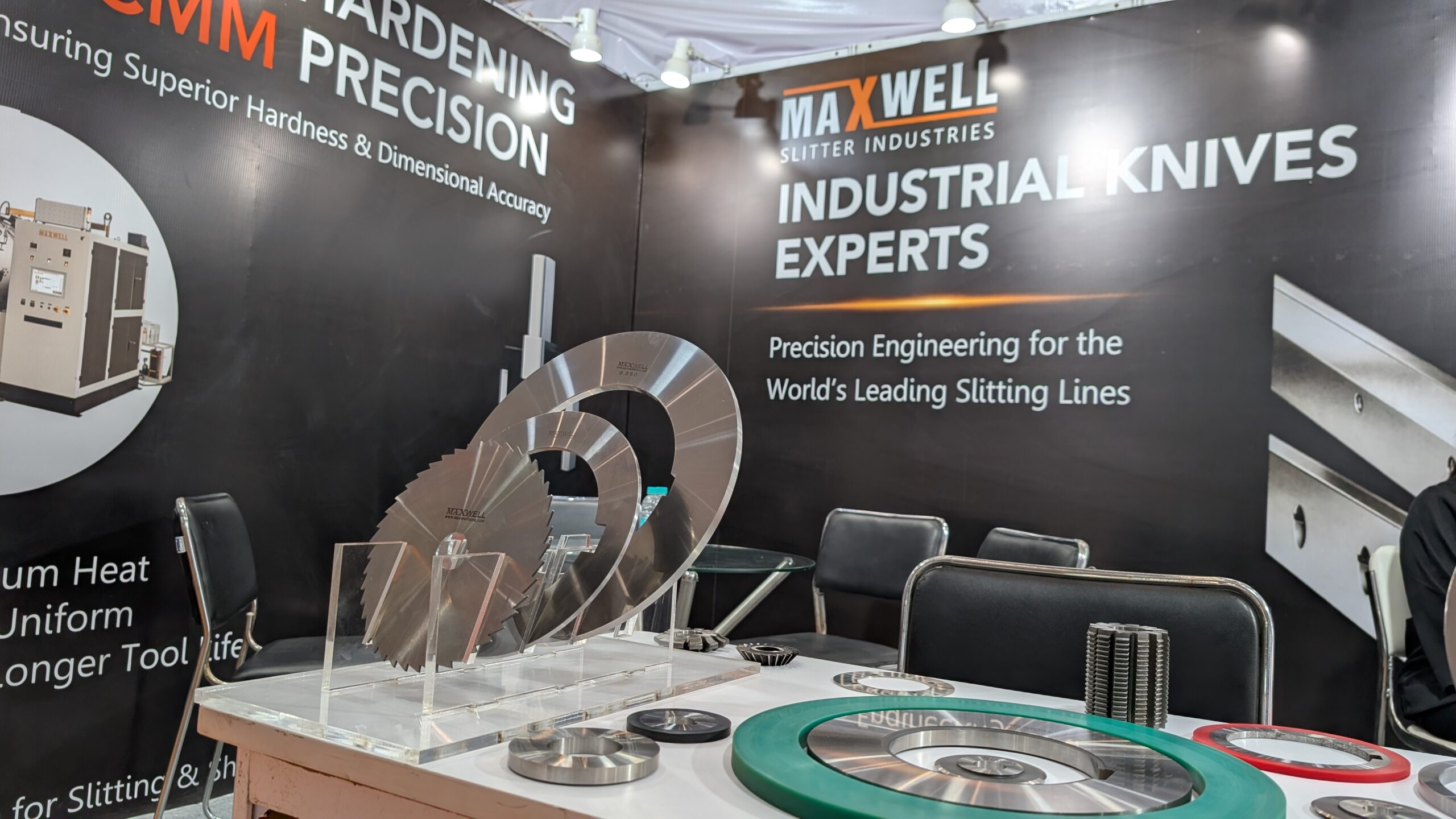
When manufacturers understand blade types, materials, coatings, and applications, they can significantly improve production efficiency and reduce downtime. This guide explains circular slitter blades in detail, including their working mechanism, types, material selection, coatings, and industrial applications, helping you choose the right solution for your specific needs.
About Circular Slitting Knives
Circular slitter blades are round cutting tools designed for continuous slitting operations. These blades cut wide material rolls into narrower strips with high precision and repeatability. They are commonly used in metal processing lines, packaging conversion machines, and film slitting equipment.
Key elements that define circular slitter blades include:
- Round cutting tools
- Continuous slitting process
- Rotating shaft mounting
- High-precision performance
- Consistent strip output
Circular slitter blades are also known as slitting knives. Whatever the name applied, their goal remains the same: to provide clean, consistent cutting across a wide range of materials. These blades are typically paired with components such as Rotary Slitter Blades, Crush Cutter Knives, and Rubber Bonded Spacers to create a complete slitting system for precise material separation.
Working Mechanism of Circular Slitting
Circular slitter blades operate through synchronized rotation with the moving material. The blade rotates at set speeds that match the material feed speed, producing smooth and continuous cuts. This synchronization is critical for minimizing material stress and achieving consistent slit quality.
How the system works:
- Continuous material feed
- Controlled cutting speed
- Smooth cutting movement
- Minimal material stress
- Consistent slit quality
Depending on your setup, you may use shear slitting or score cutting methods.
Shear slitting uses two blades that meet like scissors to create a precise cut. This method is ideal for metals and laminated materials where clean edges are required.
Score slitting uses a single blade pressing against an anvil or hardened surface. This method is suitable for softer materials such as paper, films, and nonwovens.
Both methods often integrate Rotary Slitter Blades and Crush Cutter Knives to achieve optimal performance based on the application.
Types of Circular Slitter Blades
Understanding blade types is essential for selecting the correct cutting solution. Different blade designs are optimized for specific materials and cutting requirements.
1. Shear Slitting Blades
Shear slitting blades are used when the highest precision is required. These blades work in pairs and produce scissor-like cuts. They are commonly used in metal processing, aluminum foil conversion, and laminated material slitting.
Benefits of shear slitting:
- High precision cutting
- Small edge burr
- Clean cut, polished finish
- Metal processing capabilities
- Durable blade performance
- Accurate material separation
Shear slitting systems typically include Rubber Bonded Spacers to maintain consistent spacing and prevent vibration during operation.
2. Score Slitting Blades
Scoring blades are used for soft materials such as cardboard, paper, and films. They provide efficient cutting and require simpler machine configurations. These blades often work with Crush Cutter Knives, which apply pressure-based cutting.
Advantages include:
- Simple setup
- Cost-effective operation
- Suitable for soft materials
- High production speed
- Reduced maintenance requirements
Score slitting is widely used in the packaging and converting industries.
3. Crush Cutting Blades
Crush cutting blades apply force to compress and cut material against a hardened surface. These blades are effective for foam, textiles, nonwovens, and flexible packaging materials. Crush Cutter Knives are often paired with circular slitter blades for enhanced versatility.
Key benefits:
- Efficient for soft materials
- Low setup complexity
- High-speed operation
- Minimal machine adjustments
- Suitable for bulk cutting
4. Film Slitting Blades
Film slitting blades are designed for delicate materials such as plastic films, foils, and laminates. These blades feature razor-sharp edges that prevent tearing and ensure uniform slit widths.
Applications include:
- Flexible packaging
- Plastic film conversion
- Laminated material processing
- Thin foil cutting
- High-speed film production
5. Rotary Slitter Blades
Rotary slitter blades are widely used in continuous production lines. They rotate along with the material, delivering consistent performance and reduced wear. These blades are commonly used in metal processing and packaging industries.
Advantages:
- Continuous cutting capability
- High production efficiency
- Reduced downtime
- Long blade life
- Accurate slit widths
Materials Used in Slitting Blades
Material selection plays a critical role in blade performance, durability, and cost efficiency. Different materials are chosen based on application requirements, hardness, and wear resistance.
High-Speed Steel (HSS)
High-speed steel is commonly used due to its balance between toughness and cost. It is suitable for general-purpose slitting applications.
Why HSS is popular:
- Balanced material strength
- Cost-effective solution
- Moderate wear resistance
- Reliable cutting performance
- General-purpose use
- Stable operational results
Tool Steels (D2 & H13)
D2 and H13 tool steels offer higher hardness and improved wear resistance. These steels are used in applications that require high load-bearing capacity and extended blade life.
Benefits include:
- Higher wear resistance
- Improved edge retention
- Suitable for metal slitting
- Better durability
- Reduced sharpening frequency
Tungsten Carbide
Tungsten carbide blades provide exceptional hardness and long service life. These blades retain sharpness even in high-speed and high-volume applications.
Advantages:
- Extremely long lifespan
- High wear resistance
- Superior edge retention
- Ideal for abrasive materials
- Consistent performance
Carbide blades are widely used in metal processing and high-speed packaging lines.
Blade Coatings for Enhanced Performance
Blade coatings improve durability, reduce friction, and enhance cutting efficiency. Coatings are especially important in high-speed applications and abrasive material processing.
Titanium Nitride (TiN)
TiN coating increases hardness and reduces friction. It improves blade life and cutting performance.
Benefits:
- Reduced wear
- Lower friction
- Improved heat resistance
- Longer blade life
Titanium Carbonitride (TiCN)
TiCN coatings provide higher hardness and better abrasion resistance. These coatings are suitable for cutting tougher materials.
Advantages:
- Higher hardness than TiN
- Excellent wear resistance
- Improved edge retention
- Suitable for metal slitting
Chromium Nitride (CrN)
CrN coatings reduce material buildup and improve corrosion resistance. They are ideal for humid environments and sticky materials.
Key benefits:
- Anti-adhesion properties
- Corrosion resistance
- Smooth cutting performance
- Reduced material buildup
Diamond-Like Carbon (DLC)
DLC coatings provide ultra-low friction and high wear resistance. These coatings are used for precision applications.
Advantages:
- Very low friction
- Improved surface finish
- Extended blade life
- Ideal for film slitting
Features That Ensure Precision
Several blade design features contribute to cutting accuracy and performance.
Why geometry is a fundamental aspect of the process:
- Optimized edge angles
- Controlled blade profile
- Decreased burr development
- Improved interaction with the material
- Cleaner cut results
- Improved cutting effectiveness
Smooth blade surfaces reduce friction and eliminate material buildup. Proper spacing using Rubber Bonded Spacers ensures consistent alignment and vibration-free cutting.
Applications Across Industries
Circular slitter blades are used across multiple industries where precise material cutting is required.
Metal Processing Industry
Metal processors use circular slitter blades for cutting steel coils, aluminum sheets, and copper strips.
Applications include:
- Steel coil slitting
- Aluminum foil cutting
- Copper strip processing
- Stainless steel slitting
- Precision metal strip production
Packaging Industry
The packaging industry relies heavily on slitting blades for cutting flexible materials.
Common uses:
- Plastic film cutting
- Laminated material processing
- Flexible packaging
- Label stock slitting
- Paperboard cutting
These applications often combine Rotary Slitter Blades with Crush Cutter Knives for improved efficiency.
Film and Plastic Industry
Film converters use slitting blades for high-speed production of plastic films and laminates.
Benefits:
- Exact width control
- Thin material handling
- Smooth edge finish
- Continuous production
- High-speed cutting
Nonwoven and Textile Industry
These industries require precise cutting to maintain material integrity.
Uses include:
- Textile cutting
- Nonwoven fabric processing
- Medical material slitting
- Hygiene product manufacturing
Maintenance and Blade Life Optimization
Proper maintenance helps maximize blade life and maintain cutting quality.
Why sharpening is important:
- Increased cutting efficiency
- Less material waste
- Sharper blade edges
- Consistent cutting quality
- Optimized production output
- Longer blade usability
Correct installation and alignment are equally essential. Even top-quality blades may not perform well when incorrectly installed. Using Rubber Bonded Spacers ensures consistent positioning and reduces vibration.
Choosing the Right Circular Slitter Blade
You must thoroughly assess your specific requirements before selecting a blade. The material you will be cutting is the primary factor. Different materials require different hardness levels, coatings, and geometries.
Selection factors include:
- Material type and considerations
- Hardness level
- Edge geometry selection
- Cutting condition study
- Performance expectation setting
- Application-specific selection
Combining Rotary Slitter Blades, Crush Cutter Knives, and Rubber Bonded Spacers ensures a complete slitting solution for optimal performance.
Explore Reliable Slitting Solutions
You can improve cutting precision and productivity by choosing the right supplier. High-quality slitting knives and film slitting blades are engineered for industrial performance. Reliable manufacturers provide custom blade solutions tailored to specific applications.
Why quality suppliers matter:
- Precision engineering standards
- Custom blade solutions
- Industry-specific expertise
- Consistent product performance
- Trusted manufacturing support
Conclusion
Circular slitter blades play an essential role in any cutting process. Understanding blade types, materials, coatings, and applications helps manufacturers make informed decisions. This knowledge improves productivity, reduces downtime, and ensures consistent product quality.
By selecting the right slitting blades and supporting components like Rotary Slitter Blades, Crush Cutter Knives, and Rubber Bonded Spacers, manufacturers can maintain consistent performance while reducing operating costs. Investing in the right cutting equipment ensures long-term reliability and efficient production.
Frequently Asked Questions
Circular slitter blades serve to cut large sheets of material into smaller strips.
- High degree of precision
- Used for packaging industries
- Metal processing and film production
The ideal material depends on your needs. Common choices include:
- High-speed steel
- Carbide
- Tool steels
Blade life can be extended by:
- Maintaining proper alignment
- Regular sharpening
- Using quality materials
- Proper coating selection
Blades for slitting films are typically utilized in manufacturing facilities for:
- Laminates
- Plastic film
- Flexible packaging materials
- High-speed conversion lines